


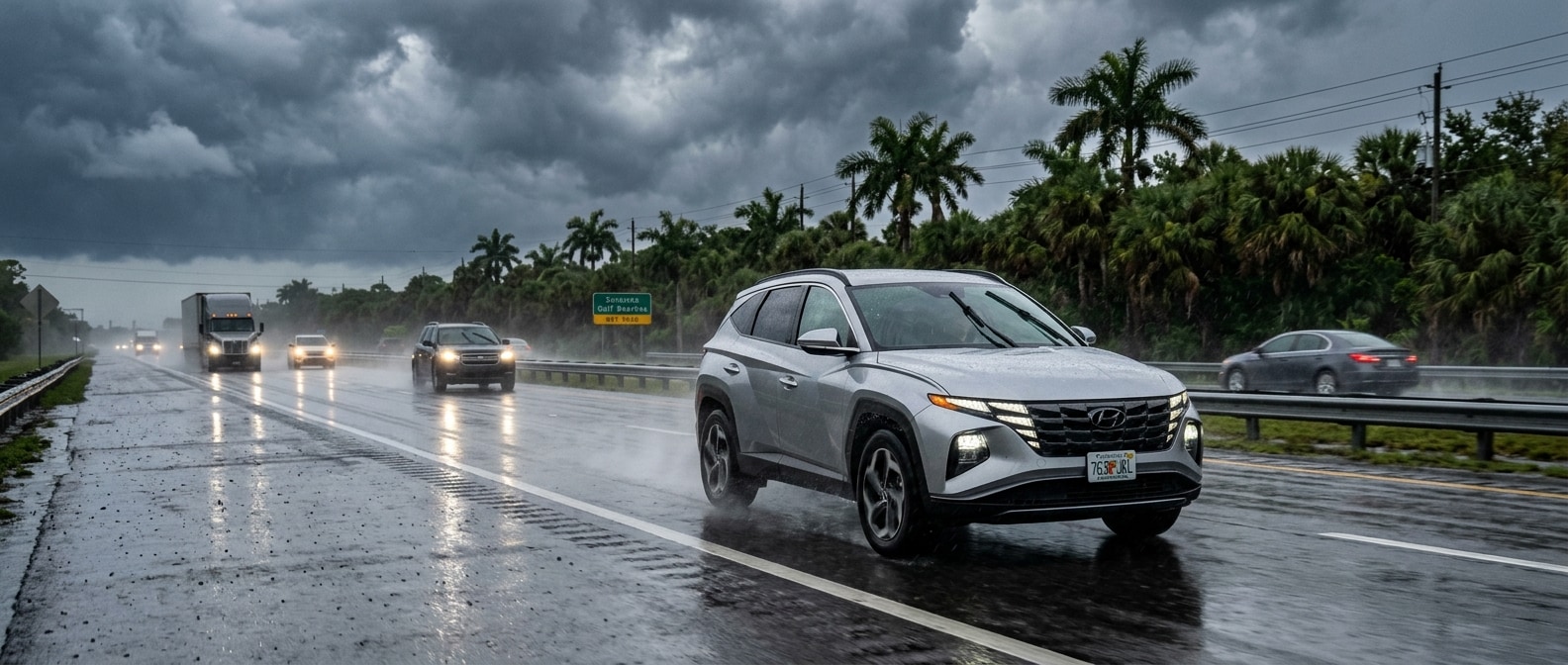
August in Panama City is not a soft drizzle kind of month. August is the wettest month of the year, averaging 8.3 inches of precipitation across roughly 19 rainy days, and a large share of that falls in sudden, heavy afternoon bursts that can turn US-98 into a river in a matter of minutes. If you've ever watched brake lights disappear into a wall of spray near the Hathaway Bridge, you already know the stakes.
The 2026 Hyundai Tucson earned IIHS's highest honor and NHTSA's top rating in 2026. Credentialing like that matters, but what matters more when you're on a soaked Tuesday commute is knowing exactly which systems activate, which ones work best when the sensors can actually see clearly, and why knowing that difference makes you a sharper driver in Gulf Coast conditions.
Per IIHS's March 2026 evaluation, the 2026 Hyundai Tucson earned the TOP SAFETY PICK+ designation, IIHS's highest current award, alongside a 5-star overall safety rating from NHTSA.
What Do the Specs Actually Mean for a Wet-Road Driver?
For a wet-road driver, the specs mean the safety architecture is already built in, because the 2026 Tucson ships with Hyundai SmartSense as standard across every trim, so nothing below is a line item you bargain for, though the wet-weather payoff really depends on which systems stay active once the sensors can't see.
SmartSense isn't marketing filler here. Standard across the lineup means the safety architecture below is already yours. No package to negotiate.
| SmartSense Feature | How It Works on Wet Roads | When It's Most Effective |
|---|---|---|
| Forward Collision-Avoidance Assist | Radar + camera monitors the path ahead; initiates emergency braking if a collision risk is detected | Fastest in moderate rain; sensor performance can reduce in heavy spray |
| Lane Keeping Assist + Lane Following Assist | Camera detects painted lane markers; applies gentle steering correction if the car drifts without signaling | Works well when lane lines are visible; may reduce if markings are obscured by standing water |
| Blind-Spot Collision-Avoidance Assist | Monitors adjacent lanes via radar; applies corrective braking to the opposite front wheel if you steer toward an occupied lane | Radar-based, so generally more resilient in rain than camera-only systems |
| Vehicle Stability Management | Adjusts braking and engine power if the system senses a slide beginning in a corner | Always active; independent of visibility |
| Anti-lock Braking System | Pulses the brakes up to 15 times per second to maintain steering control during hard stops | Always active; works whether sensors see clearly or not |
| Smart Cruise Control with Stop-and-Go | Maintains a pre-set following distance; can bring the Tucson to a full stop in heavy traffic | Best in moderate rain; gap management adds a buffer before you need to brake hard |
| Safe Exit Assist | Holds rear doors closed if approaching traffic is detected via radar when parked | Especially useful in roadside stops during reduced-visibility storms |
| Driver Attention Warning | Monitors steering patterns; alerts you if fatigue or distraction is detected | Relevant when a long rain delay or stop-and-go traffic adds cognitive load |
Being straight about it, the always-active systems (ABS, ESC/Vehicle Stability Management) are your rain-day foundation. The camera-dependent systems add a meaningful layer in moderate rain, though they can lose some effectiveness in extreme downpours. No camera brand escapes that. Every camera needs a clear line of sight. That's just physics.
The Features That Work Hardest for You on US-98
The features that work hardest on US-98 are the ones that stay useful when visibility drops, and the road itself explains why, because eastbound US-98 at Billings Ave has closed due to flooding in previous storm events, so a system that only works in clear weather won't help you there.
The stretch through Panama City shifts quickly from beach-town stop-and-go near Thomas Drive intersections to higher-speed arterial running, and wet pavement amplifies every situation where you're behind a driver who brakes unexpectedly.
Forward Collision-Avoidance Assist is the feature we see doing the most work in those scenarios. It monitors traffic ahead using both a front-facing camera and radar, then provides an audible and visual alert if a collision risk is detected. If you don't react fast enough, the system can initiate emergency braking on its own. For context, human reaction time in normal stop-and-go runs around a second and a half. On a wet road where stopping distances increase by 30-40 percent compared to dry pavement, that head start is material.
The Tucson Hybrid adds another dimension here. Its regenerative braking delivers smooth, progressive deceleration at low speeds, so there's less abrupt weight transfer on slick pavement when you're decelerating through a puddle-heavy intersection.
Blind-Spot Collision-Avoidance Assist is particularly relevant on US-98's multi-lane segments. It uses radar (not just a camera), so it holds up better in spray. When you activate your turn signal and another vehicle sits in your blind zone, the mirror icon flashes and an audible alert fires. The intervention is subtle. If you steer toward that lane anyway, the system applies light braking on the opposite front wheel to guide the Tucson back. It's not grabbing the wheel, but it corrects the line before a sideswipe can develop.
Rain-readiness note: SmartSense features work as a system, not in isolation. Keeping your windshield clean and your front bumper free of grime is a practical step that'll extend sensor effectiveness in heavy rain. A buildup of road film on the camera or radar housing can temporarily reduce system response, and the Tucson will alert you when a sensor is obstructed.
Pros and Cons of the 2026 Tucson for Panama City Rain Driving
| Pros | Cons |
|---|---|
| SmartSense is standard across all trims, no safety features gated behind expensive packages | Camera-based Lane Keeping Assist can see reduced performance in heavy downpour or standing water over lane markings |
| Radar-based Blind-Spot system is more resilient in spray than camera-only designs | FWD models rely on Electronic Stability Control for wet-road traction; HTRAC AWD is available but not standard on base trim |
| ABS and Vehicle Stability Management are always active, regardless of sensor visibility | Sensor housings require clean maintenance to sustain full function in persistent rain |
| Safe Exit Assist protects passengers getting out roadside during reduced-visibility conditions | Smart Cruise Control works best in moderate, not extreme, rain intensity |
| IIHS TOP SAFETY PICK+ and NHTSA 5-star overall rating for 2026 | Visibility improvements (LED headlights, rain-sensing wipers) vary by trim level |
Who the 2026 Tucson Fits in the Bay County Market
The Hyundai Santa Fe is the right call if you're regularly carrying a third-row's worth of passengers or need maximum cargo space for longer hauls, while the Kona is the smarter choice if tight parking or city-scale maneuvering is your daily reality, and the Tucson sits firmly between them. For most Panama City commuters and military families managing daily driving between base and home, that middle position is exactly right.
One genuine tradeoff is worth naming. If you drive extended stretches of US-98 in heavy rain frequently, you'd benefit from the HTRAC AWD system, which is available on the Tucson but not standard on the SE. It distributes torque proactively to reduce wheel slip on wet pavement before slip can start. For drivers whose routes stay mostly on paved, maintained roads through Panama City proper, the FWD Tucson with SmartSense is more than sufficient. If you're also running east toward Apalachicola or north through lower-trafficked Panhandle roads in storm season, the AWD configuration is a conversation worth having with our team.
Panama City receives nearly 60 inches of rain per year, with June through September bringing frequent showers and thunderstorms. You're buying a car for that climate. The 2026 Tucson, particularly with its standard SmartSense suite and an optional HTRAC AWD configuration, is built to match it honestly.
Frequently Asked Questions
Does the 2026 Hyundai Tucson's Forward Collision-Avoidance Assist still work in a heavy rainstorm?
Forward Collision-Avoidance Assist uses both a front-facing radar and a camera. The radar component maintains function in heavier rain better than camera-only systems do. In extreme downpours or when road spray directly obscures the lens, the camera's effectiveness can drop temporarily. In practice, the system provides meaningful protection across a wide range of Gulf Coast weather, though it's designed to support the driver, not replace driver judgment. Keeping your windshield clean and your front bumper free of road grime helps sustain full function.
Does the 2026 Tucson have all-wheel drive for wet Florida roads?
The 2026 Tucson is available with HTRAC all-wheel drive on select trims above the base SE. HTRAC proactively distributes torque between front and rear axles to reduce wheel slip before traction is lost, which is particularly useful on wet pavement. The base SE trim comes with front-wheel drive paired with Electronic Stability Control and Vehicle Stability Management, always-active systems that respond when slip is detected. If your routes regularly include higher-speed wet-road driving or areas prone to standing water, the available AWD configuration is worth discussing, and we're glad to walk you through it with our team at Bay Hyundai.
Categories:
Social


