


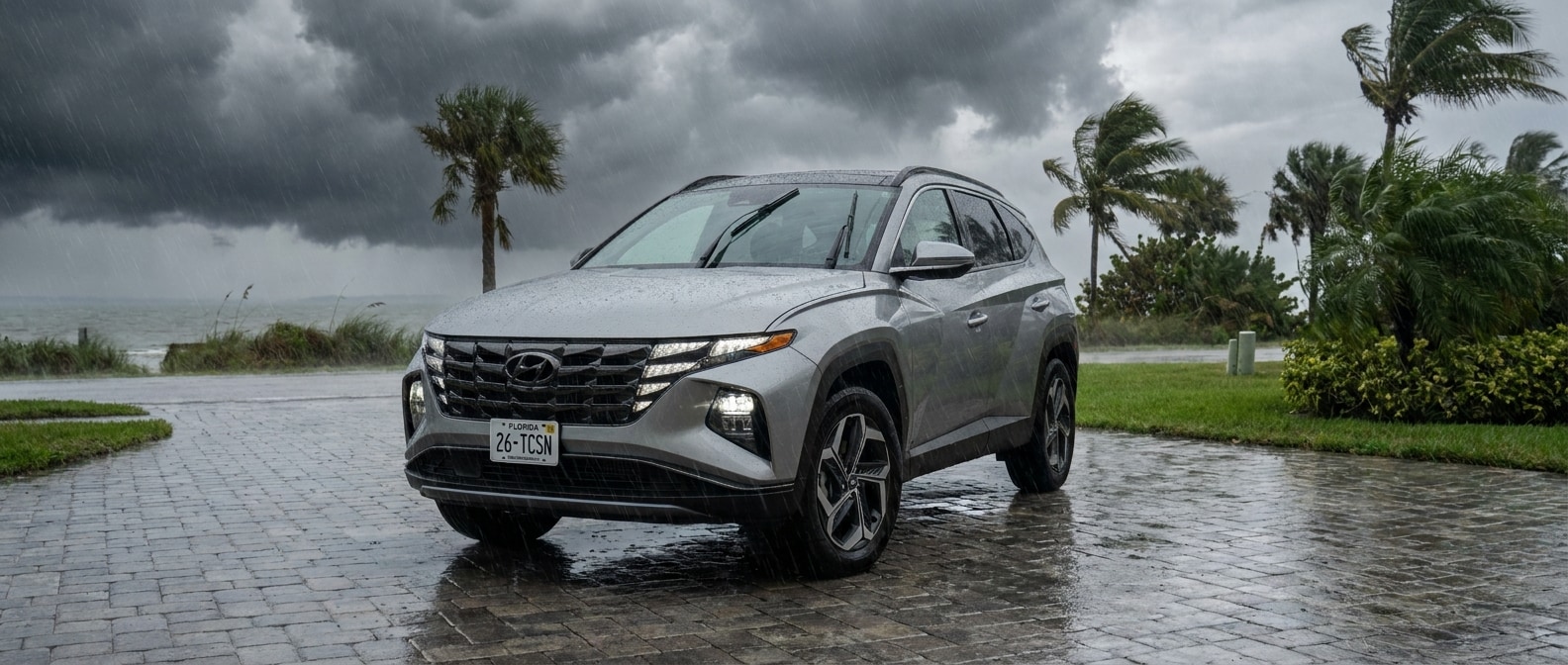
August in Panama City means a warm Gulf, thick air, and afternoons that can flip into a sideways-rain situation with almost no warning. We're right in the middle of the Atlantic hurricane season, which runs June through November, and the storms we see here don't hand you much prep time. So we put this guide together from the service side, covering the three components that actually fail when the weather turns, the specs worth looking for, and the straight tradeoff on each one.
The short version runs like this. Tires come down to tread depth more than brand name. Wipers come down to the rubber compound more than the price tag. And the battery truth in Florida runs opposite to what you'd expect.
The short version
- Tires for storm season: you need at least 4/32" of tread depth for wet roads; at the legal Florida minimum of 2/32", NHTSA data shows your tire has almost no water-dispersing ability left.
- Wipers for Gulf Coast rain: beam-style silicone blades outperform traditional ones in sustained Florida downpours; replace every 6-12 months because humidity degrades the rubber even when you're not using them.
- Battery in the Gulf Coast heat: Florida heat limits most batteries to roughly 2.5-3 years (compared to 4-6 years up north); prioritize Reserve Capacity over Cold Cranking Amps for our climate.
- Timing: if your battery is past the 3-year mark heading into storm season, replace it now, not after it leaves you stranded on US-231.
Book a pre-storm service check at Bay Hyundai
What Actually Matters When Choosing Storm-Season Equipment?
Three things drive every decision here, and none of them is the badge on the box. It comes down to how much water Panama City roads carry in a storm event, how long your current parts have baked in Gulf Coast humidity and heat, and what spec threshold separates functional from dangerous. Brand loyalty is easy to fixate on. Those three get skipped.
| Component | What Matters Most | Key Spec/Threshold | Real Tradeoff |
|---|---|---|---|
| Tires | Tread depth for water evacuation | Replace at 4/32" for wet roads (2/32" is legal floor only) | Higher tread = better wet stopping; worn tires can't be fixed by spending more |
| Wiper blades | Rubber compound and blade type | Beam/silicone lasts longer in heat and humidity | Beam blades cost more upfront; they pay back in Gulf Coast conditions |
| 12V battery | Reserve Capacity (RC), not Cold Cranking Amps (CCA) | RC tells you how long the battery sustains load if the alternator strains | Heat kills batteries here; a 3-year-old Florida battery is already aging out |
The table sums up the conversation. Everything below unpacks the "why" behind each row of it.
Tires: The 4/32" Line That Changes Everything
Tread depth is the tire spec that decides your storm-season safety, and it matters far more than the brand stamped on the sidewall. NHTSA data shows that hydroplaning risk climbs sharply below 4/32" of tread depth, and at the legal minimum of 2/32", a tire has virtually no water-dispersing capacity left. Panama City receives nearly 60 inches of rain per year, with June through September carrying the heaviest volume. When a squall drops an inch of rain in 20 minutes on US-98, tread depth is the one thing standing between your Hyundai and a hydroplane.
AAA testing at 60 mph found that tires worn to 4/32" of tread required up to 87 additional feet to stop on a wet road compared to new tires. That's roughly the length of three car lengths of extra slide when you need to stop hardest.
The tradeoff here is worth stating plainly. You don't need premium tires to be safe in the rain. AAA testing confirmed that tread depth had a much larger influence on wet stopping performance than tire cost. A worn expensive tire performs worse than a fresh budget tire. The fix has nothing to do with brand loyalty, so check your tread depth before storm season settles in.
How to check without a gauge: press a quarter into the tread groove with Washington's head pointing down. If you can see the top of his head, you're at roughly 4/32". If you see the top of Lincoln's head on a penny, you're at 2/32" and your tires need to go now.
See which Tucson trims come with all-season tires standard
Drivers with the Palisade and larger SUVs should also check that their spare is inflated and has usable tread. An emergency evacuation on US-231 with a flat is not where you want to discover the spare is sitting at 15 PSI.
A note from our team: When we inspect tires before storm season, the rear axle tends to wear faster than the front on front-wheel-drive Hyundai models because drivers feel the front tires wearing (vibration, steering pull) while the rears go quiet. Rotate at the OEM-recommended interval, and check all four corners when you gauge tread depth, not just the front two.
Wipers: Gulf Coast Rain Is a Different Animal
Standard traditional-frame wipers handle a brief shower just fine, and they fall apart in a sustained Gulf Coast storm. When rain comes hard and sideways, the frame on a traditional blade catches wind, lifts off the glass, and leaves those chattering streaks right in your sightline. Beam-style blades (also called bracketless or flat blades) stay pressed against the curved windshield under high-speed airflow because there's no frame to catch the wind.
The other Gulf Coast issue is one you can't see coming. UV and humidity degrade wiper rubber even when the blades are parked. Most OEM guidance recommends replacing blades every 6-12 months. In Panama City, if your wipers have made it through a full summer without replacement, they've been baking in direct sun since May. The rubber is probably cracking at the edge you can't easily see. Let one streak across the glass mid-storm and you'll know it right away, and wish you'd swapped them earlier.
Signs it's time now, not "soon":
- Visible streaking or skipping across the glass at medium speed
- Chattering sound at high speed (the blade isn't making consistent contact)
- Squealing on a wet but lightly-rained-on surface
- Rubber that looks shiny or cracked near the blade edge
Size matters too. Driver's side and passenger's side blades are almost always different lengths on Hyundai models. A 2026 Hyundai Palisade, for example, uses a 26-inch driver's blade and a 20-inch passenger blade. Beam blades cost more upfront, and there's no way around that. Put the wrong size on and you get incomplete sweep coverage, which defeats the purpose. Check your owner's manual or bring the vehicle to us and we'll match the spec to your VIN.
Schedule a Storm-Ready Service Inspection
Match the Gear to How You Actually Drive in Bay County
Batteries are where storm-season prep gets counterintuitive, and the Gulf Coast climate is the reason. Cold weather gets blamed for dead batteries, but down here the heat is the culprit that does the quiet damage, shortening service life long before winter ever shows up. That surprises drivers who moved down from cooler states.
AAA has documented that heat does more damage to battery life than cold does. Florida heat shortens most battery lifespans to roughly 2.5-3 years, compared to 4-6 years in cooler northern climates. The reason is chemistry. Every 15-degree increase above 77 degrees Fahrenheit speeds up the internal chemical reactions that wear down the battery's lead plates and evaporate the electrolyte fluid. Panama City in July has under-hood temperatures that regularly exceed 200 degrees Fahrenheit.
Which spec should you actually ask about? For our climate, Reserve Capacity (RC) matters more than Cold Cranking Amps (CCA). CCA measures how well a battery starts an engine in freezing weather, and we don't have freezing weather. RC measures how long a battery can sustain your vehicle's electrical load if the alternator is under stress or failing. During a storm, with AC running hard, wipers going, headlights on, phone charging, and safety systems active, your battery and alternator are working together at maximum load. That's when RC decides whether you make it home or pull over on Beck Avenue.
What to do right now if your battery is 2.5 years or older:
- Have it load-tested, not just voltage-checked. A battery can read 12.6 volts at rest and still fail under load.
- Look for white or blue corrosion buildup at the terminals. Gulf Coast salty, humid air speeds up terminal corrosion faster than inland climates.
- Note any slow or labored cranking when starting, especially after the car has been sitting in direct sun.
- Garage parking adds meaningful time to battery life by keeping under-hood temps lower.
We'll be straight about the tradeoff. AGM (Absorbed Glass Mat) batteries cost more than standard flooded lead-acid batteries. They resist heat-related evaporation better and handle deep discharge better. For a Gulf Coast driver who parks outside year-round and runs the AC constantly from April through October, the AGM's longer service life in our climate tends to make it the better choice. A fresh standard battery is still better than a 4-year-old AGM. Age wins over technology here.
Frequently Asked Questions
How often should I replace my wiper blades if I drive in Panama City?
Every 6 to 12 months is the standard recommendation, and in Gulf Coast conditions we lean toward the shorter end of that window. Intense UV exposure from May through September degrades wiper rubber even when the blades aren't being used, so a set installed before last storm season has likely hardened and cracked enough to streak when you need it most. If your wipers smear or chatter during the first hard rain of a storm, that's the answer: they needed replacing before the storm, not after.
Is the tire penny test good enough, or do I need an actual gauge?
The penny test tells you whether you're at the legal minimum (about 2/32" of tread depth), and if Lincoln's head is visible, your tires are overdue for replacement regardless of what else is going on. But for Gulf Coast storm season, 2/32" isn't the standard to aim for. The practical safety threshold for wet-road driving is 4/32", and the quarter test gets you there: press a quarter into the tread with Washington's head down. If you can see the top of his head, you're near 4/32" and should start shopping for tires before the next named storm. An inexpensive tread depth gauge costs a few dollars at any auto parts store and takes the guesswork out. ---
Categories:
Social


