


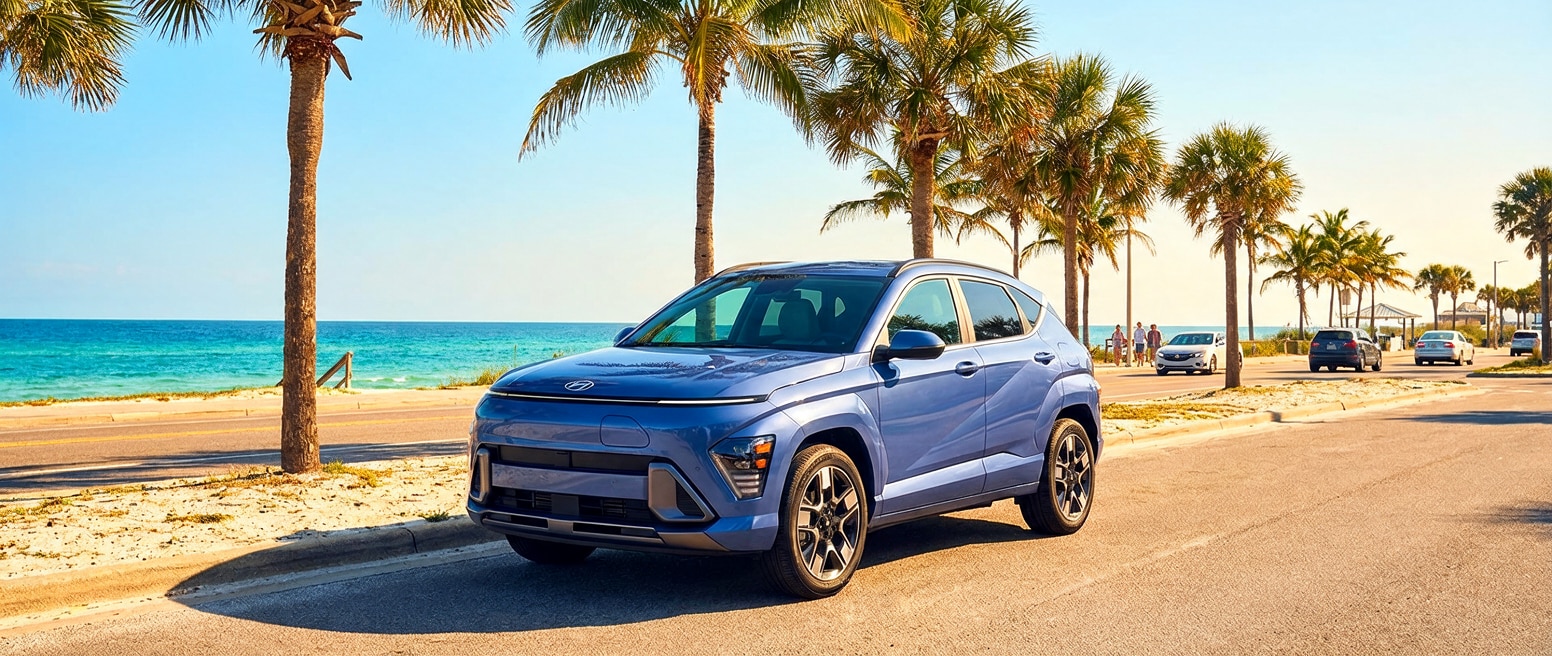
If you're considering a 2025 Kona Electric for daily life in Panama City, we'll give you the short version first. The range covers almost everything you'll do between Callaway and downtown, with room to spare. What actually takes planning isn't the miles. It's the charging setup at home.
The 2025 Kona Electric comes in SE and SEL/Limited/N Line trims, with two battery options. The EPA rates the SE at 200 miles of range and the SEL and Limited at 261 miles, each on a full charge. Living well in 32404 and 32405 doesn't demand anywhere near that top number. A typical daily round-trip across the metro sits comfortably below 50 miles. So the ceiling isn't the problem. How you replenish overnight, the floor, is what deserves a real plan.
How Far Will the Kona Electric Really Go Here?
In everyday Panhandle driving you can count on the EPA-rated 261 miles on the SEL and Limited and 200 miles on the SE as a fair reference point, though neither figure is a guarantee, since heat, speed, and A/C use all pull the real number down a little. Hot weather does affect range. Running the A/C hard in August will trim a few percent off those numbers. What it won't do is gut them. Florida heat is far gentler on EV range than subfreezing winters up north, and that ranks as one of the genuine environmental advantages of living in the Panhandle with this car.
Below, the Kona Electric's range maps against a few real local trips.
| Route or stop | Estimated round trip | Range remaining (SEL, 261 mi) | Range remaining (SE, 200 mi) |
|---|---|---|---|
| 32404 to downtown Panama City | ~12 miles | ~249 miles | ~188 miles |
| Callaway to Pier Park, PCB | ~28 miles | ~233 miles | ~172 miles |
| Panama City to Destin | ~90 miles | ~171 miles | ~110 miles |
| Panama City to Pensacola | ~200 miles | ~61 miles buffer | Charge stop needed |
| Panama City to Tallahassee | ~200 miles | ~61 miles buffer | Charge stop needed |
EPA range figures from Hyundai USA for the 2025 Kona Electric. Actual mileage varies by speed, A/C use, and driving style.
Around town, the picture is reassuring. Longer hauls to Pensacola or Tallahassee are doable in the SEL, though you'll want to plan a charge stop rather than count on arriving with reserves to spare. In the SE, those trips get less comfortable without a mid-route stop. For the Destin run, both trims handle it without drama.
If you regularly make the Tallahassee or Pensacola run and want more breathing room, the IONIQ 6 is worth comparing (it offers longer EPA-rated range and significantly faster DC charging). None of that knocks the Kona Electric, it just names a real decision point that depends on your driving radius.
Where Do You Charge in 32404 and 32405?
Public charging in Panama City is real but still thin, so you'll find working stations across 32404 and 32405 without much trouble, yet you shouldn't build your daily driving around them the way you might in a bigger metro, and that gap between existing and dense is the thing to keep in mind here. Context like this matters for planning.
In 32405, a ChargePoint DC fast charger sits at the Bill Byrd Kia location on East 15th Street, and the Hilton Garden Inn on US-231 has Level 2 chargers available. Over in 32404, the Candlewood Suites near North Tyndall Parkway runs a Tesla Destination charger that non-Tesla vehicles can use. The Kona Electric's native CCS port lets it use DC fast chargers directly. Hyundai also offers a NACS adapter that unlocks access to Tesla Superchargers, which meaningfully widens your options in the region.
Check our current Kona Electric inventory to see which trims are available now (the 2025 model year is what you'll find, as Hyundai skipped the 2026 model year and plans to return in 2027).
The Kona Electric can DC fast charge from 10 to 80 percent in approximately 43 minutes at up to a 100 kW station. For an errand run or a lunch stop on a longer drive, that pace works fine. It won't match the IONIQ 5 or IONIQ 6, which is a fair tradeoff to name. If you charge at home most days, that 43-minute window really only matters on a longer trip, not day to day.
A note from our team: The way we see it, a Kona Electric owner with a 240V outlet at home (in a garage or via an outdoor outlet) almost never needs a public fast charger for local driving. You leave full every morning. The public network around Panama City keeps improving, but for now it works best as a backup for longer trips, not a primary plan for daily charging.
See Current Kona Electric Offers
For a Gulf Coast commuter charging overnight at home on Level 2, the 2025 Kona Electric's 200- or 261-mile EPA-rated range comfortably covers a week of typical Panama City daily driving on a single overnight charge.
Building Your Charging Plan
Your charging plan really comes down to how far you drive on a normal day, since the 2025 Kona Electric ships with a Level 1 cable good for roughly 3 to 5 miles of range per hour from a standard 120V outlet, enough for a light-commute household but far too slow for anyone covering real distance. If your daily driving is under 30 miles, that setup can work long term. It's slow, and you'd need to leave the car plugged in for several hours each day, but it's not nothing. For someone who commutes 15 miles and parks at home all evening, Level 1 covers the miles just fine.
For long-term ownership, a Level 2 setup (240V) is the one that makes daily life easy. The Kona's 10.8 kW onboard charger handles it well. On a properly sized 240V circuit, the SE battery replenishes from near-empty in about six hours. The long-range 64.8 kWh pack (SEL, N Line, Limited) takes a bit over seven hours from near-empty to full. Plug in with 40 to 60 percent left and a full overnight window brings you back to 100 percent without rushing.
Below is a practical charging summary for Panama City ownership.
| Charging method | Power level | Est. time to 80% (SE, 200 mi) | Est. time to 80% (SEL, 261 mi) | Notes |
|---|---|---|---|---|
| Level 1 (120V outlet) | ~1.4 kW | 20+ hours | 30+ hours | Overnight top-ups only; works for low-mileage days |
| Level 2 home (240V, 40A) | Up to 10.8 kW | ~4 hours | ~5.5 hours | Recommended for most owners |
| DC fast charge (public, 100 kW) | Up to 100 kW | ~43 minutes (10-80%) | ~43 minutes (10-80%) | At local ChargePoint or NACS-compatible stations |
Charging time estimates based on Hyundai's published specs for the 2025 Kona Electric.
One more feature earns a mention here, the Vehicle-to-Load (V2L) system. The Kona Electric can power devices through its front charging port using an available V2L adapter. For a Gulf Coast household that weathers the occasional storm, a car that can run a fan, a lamp, or small appliances off its battery pack is a practical benefit that goes beyond the commute.
Frequently Asked Questions
Is 200 miles of EPA range enough for daily driving in Panama City, FL?
For nearly all daily driving in 32404 and 32405, yes. A typical round-trip across the Panama City metro (including runs to Panama City Beach, Callaway, or across town) lands well under 50 miles. The 2025 Kona Electric SE's 200-mile EPA-estimated range covers several days of that driving on a single full charge. If you commute much longer distances, or you run to Pensacola or Tallahassee often without a charge stop, the SEL's 261-mile EPA-estimated range or a different Hyundai EV may fit you better.
Can the 2025 Kona Electric use Tesla Superchargers in Panama City?
Yes, with an adapter. The 2025 Kona Electric has a native CCS charging port, and Hyundai offers a NACS adapter that allows access to Tesla Superchargers that support CCS compatibility. The adapter widens public fast-charging options around Panama City, where Supercharger locations sit within a short drive. Confirm adapter availability and compatibility details with our team.
Does Florida heat reduce the Kona Electric's range?
It does, though less than cold weather hits most EVs. Running the A/C in August trims your real-world range modestly against the EPA estimate, usually a few percent in normal driving rather than a dramatic drop. Florida's climate is actually one of the more EV-friendly environments in the country for range consistency, since the battery doesn't burn energy fighting deep cold. Hyundai includes a pre-conditioning system on the Kona Electric to help manage battery temperature during charging. ---
Categories:
Social


