

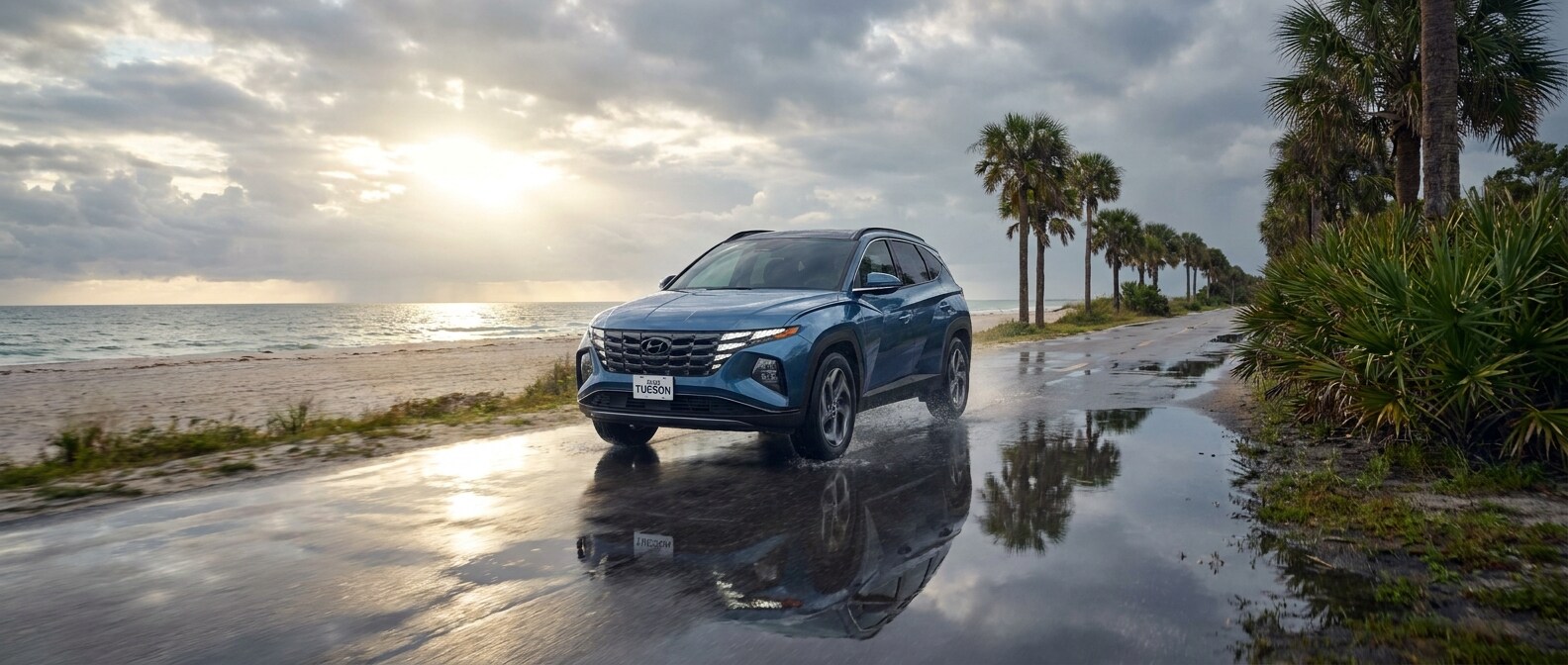
If you just drove through standing water on Thomas Drive or anywhere else in Bay County and your Hyundai made it home, do one thing before you make plans for tomorrow. Don't assume it's fine yet.
The Tucson, the Santa Fe, and every other Hyundai in our lineup run air intakes that sit relatively low in the engine bay. None of that is a design flaw. You just can't ignore it when Thomas Drive turns into a drainage channel on a Gulf Coast summer afternoon and a 15-minute storm drops four-plus inches of rain before the sky even turns dark.
Most post-rain situations are entirely manageable. A quick visual inspection and a call to our service team tell you far more than you'd learn by driving it again and finding out the hard way.
If you're currently shopping, explore other models in our lineup. If you already own a Hyundai and you just came through standing water, read this first.
What to Do and What to Skip Right Now
Work through the table below in order, because the sequence matters more than any single step, and the right first move depends entirely on whether your engine stalled, kept running, or took on water inside the cabin. Follow it top to bottom, and you'll skip the guesswork.
| Situation | Do This | Skip This |
|---|---|---|
| Engine running fine after the drive | Check oil dipstick for milky color or frothy texture | Ignore it and drive on without looking |
| Engine stalled in standing water | Call for a tow immediately | Try to restart the engine |
| Water visible inside the cabin (footwells) | Open doors and windows; do not run the blower on recirculate | Wait and see if it dries on its own |
| Check engine light appeared after rain | Get it scanned; do not clear the code yourself first | Assume it will reset and go away |
| Vehicle ran through visible spray at road speed | Inspect the air filter box for moisture | Ignore it if the car feels normal |
| Sunroof drains are clogged (musty smell follows rain) | Bring it in to have the drain tubes cleared | Keep running the A/C hoping the smell disappears |
The table covers most of what we see at the service bay after a Bay County storm. The biggest mistake sits at the top of the "Skip This" column. Restarting an engine that stalled in water risks hydrostatic lock, or hydrolock, a condition where water trapped in a combustion cylinder stops the piston from completing its stroke. Water doesn't compress. The piston doesn't care. You get a bent connecting rod or a cracked block, and that's not a repair.
The One Thing That Changes Everything
Stopping the engine before you try to move it is the single decision that separates a cheap afternoon from a ruined one, and it's the rule we'd give any Hyundai owner who just came off a flooded stretch of Thomas Drive. Kill it and leave it. Then call us.
If your Hyundai stalled in standing water on Thomas Drive and you haven't restarted it, you may have dodged the expensive outcome entirely. Our service team can pull the spark plugs, check for water in the cylinders, and run a compression test before anything turns over. Plan on about an hour for that inspection. The alternative, cranking a hydrolocked engine, takes minutes and can cost you the engine itself.
Schedule that inspection with our service team before you decide anything, and don't move the car until we've looked.
For drivers whose Hyundai ran through spray or a deep-looking puddle without stalling, the checks are less dramatic, but they're still worth doing. Milky or frothy engine oil on the dipstick is the clearest sign that water reached the crankcase. A wet or visibly saturated air filter means the intake pulled in moisture. You're a step toward the scenario above even if the engine kept running. Moisture at the mass airflow sensor can produce a rough idle or a check engine light for days after the event (sometimes weeks).
Palisade owners and anyone in a larger SUV get some help from ride height, but it doesn't make them immune. Thomas Drive flooded to knee depth in documented Bay County storm events, so even a taller SUV was wading through the water, not clearing it.
A One-Sentence Safety Recap
If your Hyundai stalled in water on Thomas Drive, call us before you restart it and let us take the first look, since a stopped engine can usually be saved but a cranked, hydrolocked one often can't recover, and that single choice is the entire recap. Our service team is ready to take a look, and we'll get you back on the road the right way.
Bay County's summer storms move fast, and they don't wait for you. A little caution after the rain moves even faster.
By the Bay Hyundai Team | August 2026


