

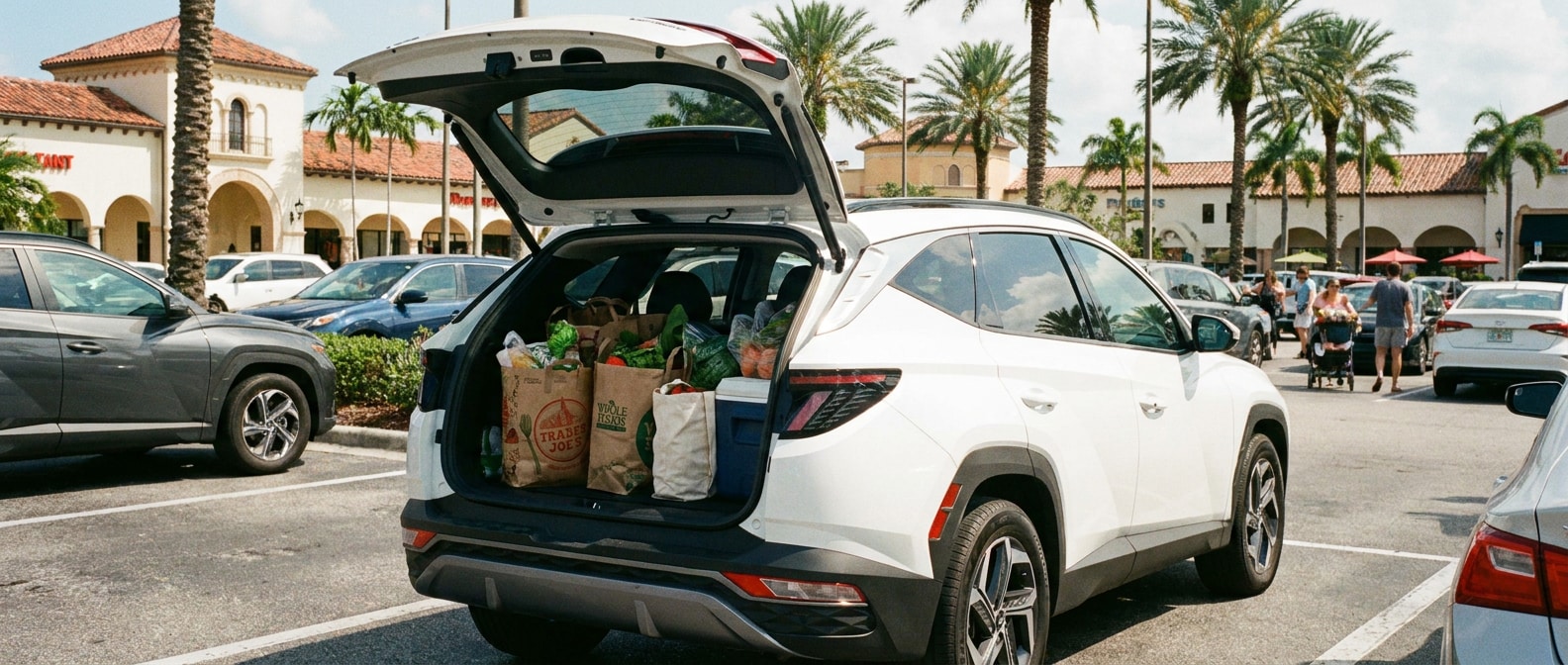
A Saturday errand run in Bay County is never just one stop. You hit Pier Park, loop through The Fresh Market at Pier Park North for the good produce, maybe swing by the Walmart Supercenter on Panama City Beach Pkwy for the bulk items, and suddenly you're staring at a packed cargo area and three kids who still need their soccer gear for Sunday. That's a real load management problem, and the right Hyundai SUV solves it differently depending on your family's specific version of chaos.
The short version is simple. Match your model's cargo number to your typical haul, configure the rear seats before you leave the driveway, and you won't have to play cargo Tetris in the parking lot.
We'd start most Bay County families running weekly errands with the Tucson Hybrid, though it isn't right for everyone. Read the steps first. See where your real load lands.
What Do You Need Before You Start?
Before you load the first bag, get a clear count of what you're hauling, because a solo shopper grabbing a week of groceries lives in a very different vehicle than a family of five restocking the pantry after a beach weekend. Get the number right and the rest of the day gets easier.
The table below shows how the 2026 Hyundai lineup stacks up on the numbers you'll care about on an errand run.
| SUV | Cargo (Seats Up) | Cargo (Seats Folded) | EPA Combined MPG | Best Fit |
|---|---|---|---|---|
| Venue | 18.7 cu ft | 31.9 cu ft | 31 mpg | Solo or couple, short runs |
| Kona | 25.5 cu ft | 63.7 cu ft | 31 mpg (SE FWD) | Small family, one-store trips |
| Tucson (gas) | 41.2 cu ft | 80.3 cu ft | 28 mpg (FWD) | Family, flexible budget |
| Tucson Hybrid | 38.7 cu ft | 74.5 cu ft | 36 mpg combined | Family, fuel-conscious |
| Santa Fe Hybrid | 40.5 cu ft (3rd row folded) | 79.6 cu ft | 37 city / 36 hwy (FWD, EPA est.) | Bigger family, 3-row option |
| Palisade Hybrid | 46.3 cu ft (3rd row folded) | 86.7 cu ft | 33 city / 35 hwy (FWD, EPA est.) | Large family, max cargo |
All EPA figures are estimates for comparison purposes only; actual mileage varies with load, driving habits, and conditions.
You'll want a few answers first.
- How many passengers are riding on errand day (determines how many rows you actually need)?
- Do you use reusable bags or a box-and-bag mix (affects how floor space loads)?
- Are you stopping at Pier Park North's Fresh Market or doing a full Walmart run (Fresh Market = smaller, precision loads; Walmart = volume)?
- Is August heat making you run the AC through multiple parking-lot transitions? (This is where hybrid regenerative braking earns its keep in stop-and-go parking.)
Setting Up Your Hyundai for a Bay County Errand Day (Step by Step)
The setup runs the same whether you're in a Venue or a Palisade Hybrid, and the one thing that shifts from model to model is which single step ends up mattering most for how you load. Figure out that step and the rest falls into place.
Step 1: Decide how many rows you need for the trip. If it's just you and a passenger, every rear row is cargo space. Do this at home. Folding the Santa Fe's third-row seats takes about ten seconds with the power-fold button in the cargo area. But if you're picking up a friend on the way home from Pier Park, leave that row up and adjust your load plan accordingly.
Step 2: Configure the rear seats before you leave the driveway. Don't do this in the Pier Park parking lot in August heat. The Palisade Hybrid and Santa Fe Hybrid both have power-fold rear seats you can trigger from the cargo area. The Tucson Hybrid runs a manual fold instead, which is quick but means clearing anything already stored behind the seats. If your household regularly hauls both passengers and big cargo on the same trip, the Santa Fe's 40.5 cubic feet behind the third row (third row folded, second row up) gives you genuine two-row hauling without giving up the third row for the whole trip.
Step 3: Use the flat load floor, not the seat backs. Every 2026 Hyundai SUV folds to a reasonably flat floor, though "reasonably" covers a range. Tucson's fold comes out flatter than you'd expect from a compact SUV, which makes it practical for box-shaped grocery hauls. The Palisade Hybrid gives you real volume at 86.7 cubic feet, but it's a longer vehicle, so you'll feel its 39.2-foot turning circle in the Pier Park surface lot. One more to flag is the Kona, whose 63.7 cubic feet (seats folded) is a useful number for a vehicle that parks easily in tighter beach-area lots.
Step 4: Activate the Hands-Free Smart Liftgate if your trim has it. Available on select Tucson Hybrid trims, this is the August errand hero. Stand behind the vehicle with the key fob in your pocket for three seconds and the liftgate opens on its own. When you're carrying two tote bags and a flat of water bottles from the Pier Park Walmart run, not having to set anything down matters. Check your specific trim spec sheet, because it's an available feature and not universal across the lineup.
Step 5: Load heavy items flat on the floor, not stacked on folded seats. A full week's grocery run from The Fresh Market can easily run 80-100 pounds of total load. Stacking heavy cases on top of folded seat backs shifts weight upward, and they can slide when you're braking. Load the heaviest items (water cases, bulk canned goods) flat on the floor at the front of the cargo area, closest to the rear seats. This matters most in the Venue and Kona, where the cargo floor is smaller and the weight balance shows up more. Lighter bags and bread go on top.
Step 6: For hybrid models, let the stop-and-go work for you. For hybrid models, the stop-and-go works in your favor. The Tucson Hybrid's EPA-estimated 36 mpg combined and the Santa Fe Hybrid's EPA-estimated 37 city mpg (FWD, EPA estimate) aren't just highway numbers. The hybrid system recovers energy during the repeated braking cycles of a parking-lot-heavy errand run. An August Saturday at Pier Park involves a lot of low-speed maneuvering and short stop-start segments, which is exactly when a hybrid powertrain earns back fuel versus a straight gas engine. The Venue and Kona run gas-only, so their 31 mpg combined is real efficiency through a different mechanism.
Step 7: Reset your cargo area before the next stop. At multi-stop Pier Park runs, the trouble is letting bags pile up randomly after the first store. Move earlier bags to one side, consolidate them, and leave a clear zone for the next load. It takes 90 seconds. Skip it and you'll get a jumbled cargo area by the third stop, with produce crushed under bulk items from the final Walmart sweep.
Your Errand-Day Checklist
Print this or save it to your phone before a big Bay County shopping run, and you'll have it when it counts.
- [ ] Count passengers for the day (are all rows needed, or is cargo the priority?)
- [ ] Fold unused rear rows at home before you leave
- [ ] Confirm liftgate access (Hands-Free Smart Liftgate: key fob in pocket, stand behind the vehicle 3 seconds)
- [ ] Pack a flat of reusable bags or a folding cargo bin to keep items upright
- [ ] Load heaviest items (water, canned goods) flat on the cargo floor first
- [ ] Leave one clear zone for the next store's bags when doing a multi-stop run
- [ ] Lighter and crushable items (bread, eggs, produce) go in last, on top
- [ ] On the way home: move perishables to the front floor or a cooler bag (Bay County August ambient temps climb fast in a parked vehicle)
Quick Recap: Which Hyundai for Which Errand Load
Which Hyundai fits your errand load comes down to how many rows you actually use and how heavy the typical haul runs, so the short version sorts by household size rather than asking you to memorize every cargo figure in the lineup. You don't need it all memorized.
Solo or couple, mostly one-stop trips: The Kona's 25.5 cubic feet with seats up handles a full weekly shop without drama, and you'll park it with the confidence of a smaller footprint. The Venue handles lighter, more frequent runs.
Family of four, mixed passenger and cargo days: The Tucson Hybrid is our honest recommendation. It's roomy for a compact SUV at 38.7 cubic feet of cargo space (seats up), the EPA-estimated 36 mpg combined softens the Bay County stop-and-go, and the available Hands-Free Smart Liftgate earns its keep on a loaded errand run.
Larger families or households that regularly max out cargo: The Santa Fe Hybrid hands you three-row flexibility (40.5 cubic feet with the third row folded) plus EPA-estimated 37 city mpg, and you're not moving up to full-size SUV dimensions to get it. The Palisade Hybrid is the answer when you truly need 86.7 cubic feet and tow capacity alongside the family.
The honest trade-off is straightforward. Tucson Hybrid's cargo with seats up (38.7 cubic feet) comes in slightly under the gas Tucson (41.2 cubic feet), because the hybrid battery takes a small bite out of the underfloor storage. For most families, the fuel economy difference more than makes up for it. But if you're regularly hauling large, flat items and fuel economy is secondary, the gas Tucson or Santa Fe gives you the full uncompromised floor.
See Current Hyundai SUV Offers
Bay Hyundai is at 641 W 15th St in Panama City. Come by and we'll walk you through the exact cargo configuration on any model you're considering. It takes five minutes in the lot and answers questions a spec sheet never quite covers.
Frequently Asked Questions
How much cargo space does the 2026 Hyundai Tucson Hybrid have?
The 2026 Tucson Hybrid offers approximately 38.7 cubic feet of cargo space behind the rear seats and up to 74.5 cubic feet when those seats are folded flat. That makes it a strong choice for family grocery runs and multi-stop errand days in Bay County.
Is the 2026 Hyundai Santa Fe or Palisade better for big grocery hauls?
It depends on how many rows you use. The 2026 Santa Fe gives you 40.5 cubic feet behind the third row (third row folded) and up to 79.6 cubic feet total. The 2026 Palisade Hybrid tops out at 86.7 cubic feet with all rows folded, and 46.3 cubic feet with just the third row down. If you need cargo and three rows of real passenger space regularly, the Palisade Hybrid is the stronger choice.


