


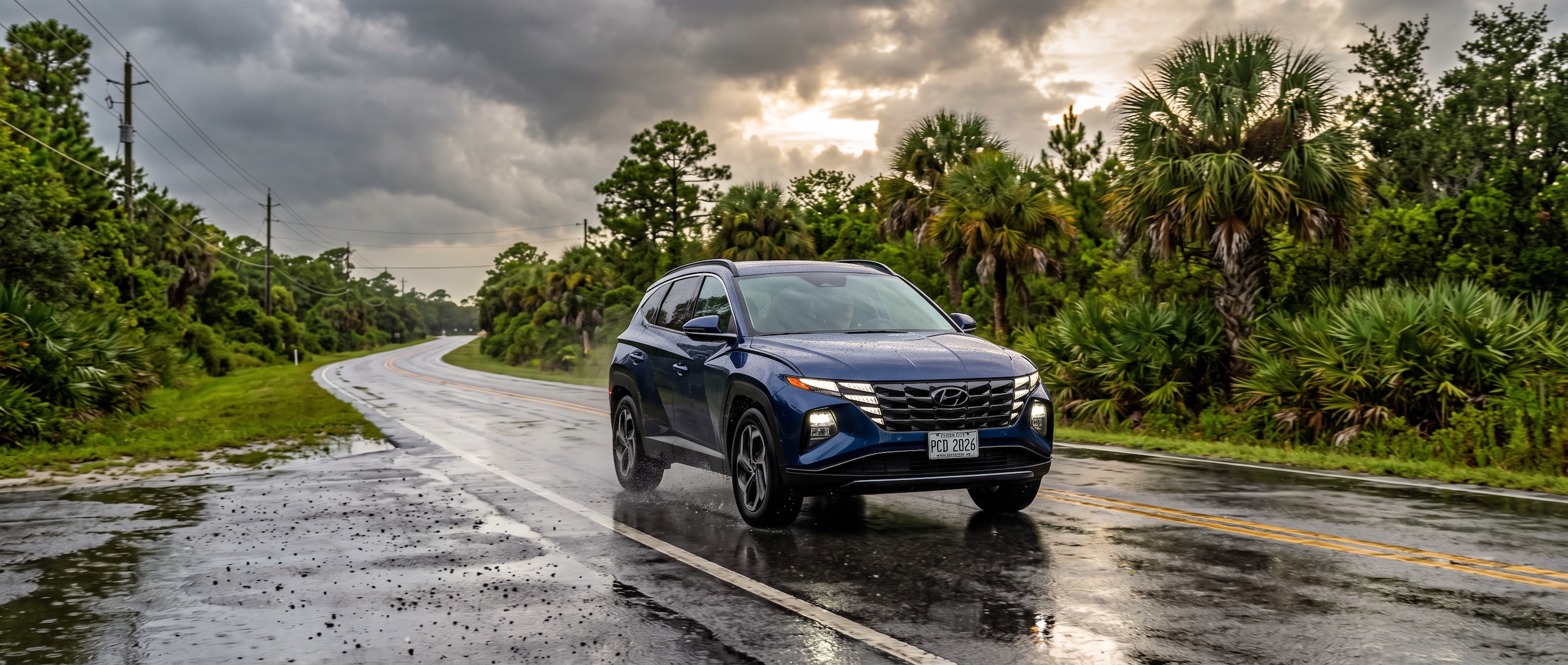
August in Panama City comes down to one thing above everything else. It rains hard, it rains fast, and the street out front of our dealership turns into something you don't want to underestimate from behind the wheel of a low-slung sedan with worn tires and no AWD.
August is Panama City's wettest month, with rain falling on roughly 23 or 24 days and accumulating over five inches of precipitation. Eastbound lanes on 15th Street between Harrison Avenue and Luverne Avenue have been closed due to flooding in past rain events, and that pattern recurs. So when customers ask us which Hyundai handles Bay County's late-summer rain best, we don't just answer with "get the AWD." We answer with ground clearance first, drivetrain second, and visibility features third. Those are the three variables that actually matter here.
The short version
- Deepest puddles and pop-up flash floods: 2026 Tucson AWD or Tucson Hybrid AWD (8.3 inches ground clearance, AWD standard on all Hybrid trims)
- Daily commuter in moderate rain with best fuel efficiency: 2026 Elantra Hybrid (EPA-estimated 54 MPG combined in Blue trim, standard rain-safety tech)
- Compact SUV balance of clearance and value: 2026 Kona with optional HTRAC AWD (higher ride than the Elantra sedan, EPA-estimated 31 MPG combined FWD)
- Families managing multiple rain-day errands: 2026 Santa Fe or Palisade (more interior room, available AWD, taller body)
- One honest boundary: Higher ground clearance does NOT mean you should drive through standing water. No vehicle here is rated for flood crossings. Ground clearance helps you clear submerged road debris and stay above shallow pooling. That is its job.
See the 2026 Tucson on our lot
What Actually Matters When Choosing a Hyundai for Rain?
Ground clearance, drivetrain, and standard safety tech are the three spec categories that separate a rainy commute from a miserable one in Bay County. Below is the decision table across the lineup we actually carry.
| Model | Ground Clearance | Drivetrain | EPA Combined (est.) | Best Rain Use Case | Honest Tradeoff |
|---|---|---|---|---|---|
| Tucson AWD (gas) | 8.3 in | Optional AWD (standard on XRT and up) | 27 MPG | Deep puddles, debris clearance | Costs more than FWD trims |
| Tucson Hybrid AWD | 8.3 in | AWD standard on all trims | 38 MPG | Rain plus fuel savings | Lower tow rating vs gas |
| Kona AWD (turbo) | ~6.3 in | Optional HTRAC AWD | 28 MPG (AWD) | Daily urban rain, tight parking | Less clearance than Tucson |
| Elantra Hybrid | ~5.5 in | FWD only | 54 MPG (Blue) | Efficient stop-and-go rain driving | No AWD option |
| Santa Fe AWD | ~8.0 in | AWD available | ~26 MPG | Family errands in heavy downpours | Larger footprint |
| Palisade AWD | ~8.0 in | AWD available | ~22 MPG | Max passenger count plus rain days | Least efficient option |
Ground clearance is your first filter. The difference between 5.5 inches and 8.3 inches sounds abstract until you're rolling through a submerged intersection wondering whether the floor drain is deeper than your air intake. On flat coastal terrain that doesn't shed water quickly, that gap is real and it matters for your undercarriage.
AWD is your second filter. Rear-wheel slip on a soaked 15th Street, especially when you accelerate out of a light, is where AWD earns its keep. It doesn't help you stop faster. Your brakes and your tires handle that.
Standard safety tech is your third filter. Rain-sensing wipers (available on higher Tucson and Santa Fe trims), Lane Keeping Assist, and Forward Collision-Avoidance Assist matter when an afternoon squall drops visibility to a quarter mile in about thirty seconds flat.
Ground Clearance Is the Number Bay County Buyers Should Look Up First
For most Panama City customers thinking seriously about late-summer driving, the 2026 Tucson is where we'd steer you, mostly because its 8.3-inch clearance figure holds up under real scrutiny, though that number only applies to certain configurations you'll want to confirm before you buy.
See the 2026 Tucson Hybrid AWD
The 2026 Tucson's ground clearance on the FWD gas configuration is 7.1 inches, while the AWD gas version and all Hybrid and PHEV trims measure 8.3 inches. That 1.2-inch jump on the AWD and Hybrid versions isn't marketing rounding. On a street that flash-floods, that extra clearance is the difference between your undercarriage taking a hit from submerged debris and clearing it cleanly.
Every trim in the Tucson Hybrid lineup pairs that same 8.3-inch clearance with AWD, no upsell required. The EPA estimates the 2026 Tucson Hybrid Blue at 38 MPG in every metric, whether city, highway, or combined. In August, when you're sitting through a slow crawl because 15th Street became a parking lot mid-storm, that fuel efficiency compounds over a very long month of daily driving.
Here's the tradeoff, stated plainly. The Tucson Hybrid gives up towing capacity compared to the gas version, and it isn't priced like an entry-level vehicle. If you're primarily in town and the occasional highway stretch covers your range, that's a non-issue. If you haul a boat to the bay regularly, check the tow spec before you decide.
From our service team's perspective: Vehicles that repeatedly navigate shallow flooding with low FWD clearance tend to show up with undercarriage wear and debris lodged in the wheel wells. The geometry is simple. Higher clearance keeps the vehicle's critical components farther from whatever the street is hiding under three inches of water.
Schedule Service at Bay Hyundai
Pros and Cons of Prioritizing Ground Clearance Over AWD
Sometimes the smarter move is deciding which spec to optimize for first rather than which model to buy, and the answer really does depend on where and how you drive through Bay County's wet season. Below is the unvarnished version.
| Pros | Cons |
|---|---|
| Clears submerged debris and uneven flooded pavement | Does NOT allow you to drive through standing water safely |
| Keeps the air intake higher and away from deep puddle spray | Taller vehicles can feel less planted in the crosswinds that come with Gulf squalls |
| Reduces undercarriage damage risk on flash-flooded streets | Higher-clearance trims typically cost more than base FWD versions |
| Pairs with AWD for the most capable wet-road setup overall | Ground clearance alone does not improve braking distance on wet pavement |
| Genuine peace of mind during August pop-up storms | Larger footprint can feel less agile in congested post-storm traffic |
The Kona is worth naming here because it sits in an interesting middle position. Its options list includes HTRAC AWD and a turbocharged engine. The EPA estimates the 2026 Kona at up to 29 MPG city and 34 MPG highway. Its ride height isn't the Tucson's 8.3 inches, but it clears the Elantra sedan comfortably, and the optional AWD turbo variant has real grip on a wet merge onto US-98.
Match the Hyundai to How You Actually Drive in August
Matching the Hyundai to your actual routine matters more than buying the most capable rain vehicle on the lot, because the most capable choice is only the right call when your route genuinely demands it, and plenty of Bay County commutes simply don't. Plenty of buyers assume the biggest rig is always the answer. It isn't.
For 15th Street's August conditions, any Hyundai with more than 7 inches of ground clearance and standard Hyundai SmartSense safety tech covers the real risk factors for Bay County pop-up storms.
The 2026 Elantra Hybrid earns an EPA-estimated 54 MPG combined in its Blue trim. A genuinely useful number for a daily commuter. Its limitation in rain is FWD only and a lower sedan ride height that puts you closer to whatever pooled water is sitting on the road. For a driver whose commute runs on streets that drain within a couple of hours, the Elantra Hybrid makes complete sense. For someone whose route takes them through lower-lying areas near the waterfront or through intersections with a documented history of flooding, the Tucson is the more appropriate choice. Two different real situations, two different right answers.
Check the forecast all you want; Bay County storms don't politely announce themselves, and sunny at noon can become knee-deep water by mid-afternoon, driven by sea-breeze collisions that build into fast-moving thunderstorms. That pattern is exactly why matching vehicle spec to driving habit matters more than just buying the highest-clearance model you can afford.
The Palisade and Santa Fe are worth a mention for families who need interior room. Both offer available AWD, taller ride heights, and Hyundai SmartSense across the lineup. The efficiency tradeoff is real. But if you've got three kids and a summer schedule that refuses to cooperate with the weather, the space math still works out in your favor.
Frequently Asked Questions
Does AWD help you stop faster on a wet road?
No. AWD distributes power to all four wheels to help you accelerate and hold traction, but it doesn't shorten your stopping distance on wet pavement. That responsibility belongs to your brakes and your tires. A well-maintained FWD vehicle with quality all-season tires may stop shorter in the rain than an AWD vehicle on worn rubber. If you're preparing for Panama City's August downpours, checking your tire tread is the first practical step, not upgrading to AWD.
Is the Tucson Hybrid AWD on every trim, or do I have to pay for it?
All 2026 Tucson Hybrid trims come standard with AWD. There's no FWD option in the Hybrid lineup, so you don't have to choose a higher trim to get all-wheel drive. The gas Tucson is where the choice comes in. Lower trims default to FWD, and the 8.3-inch ground clearance paired with AWD comes on the configured AWD variants. If you want both the clearance and the drivetrain on the gas model, confirm the trim's configuration before making your decision.
Categories:
Social


