


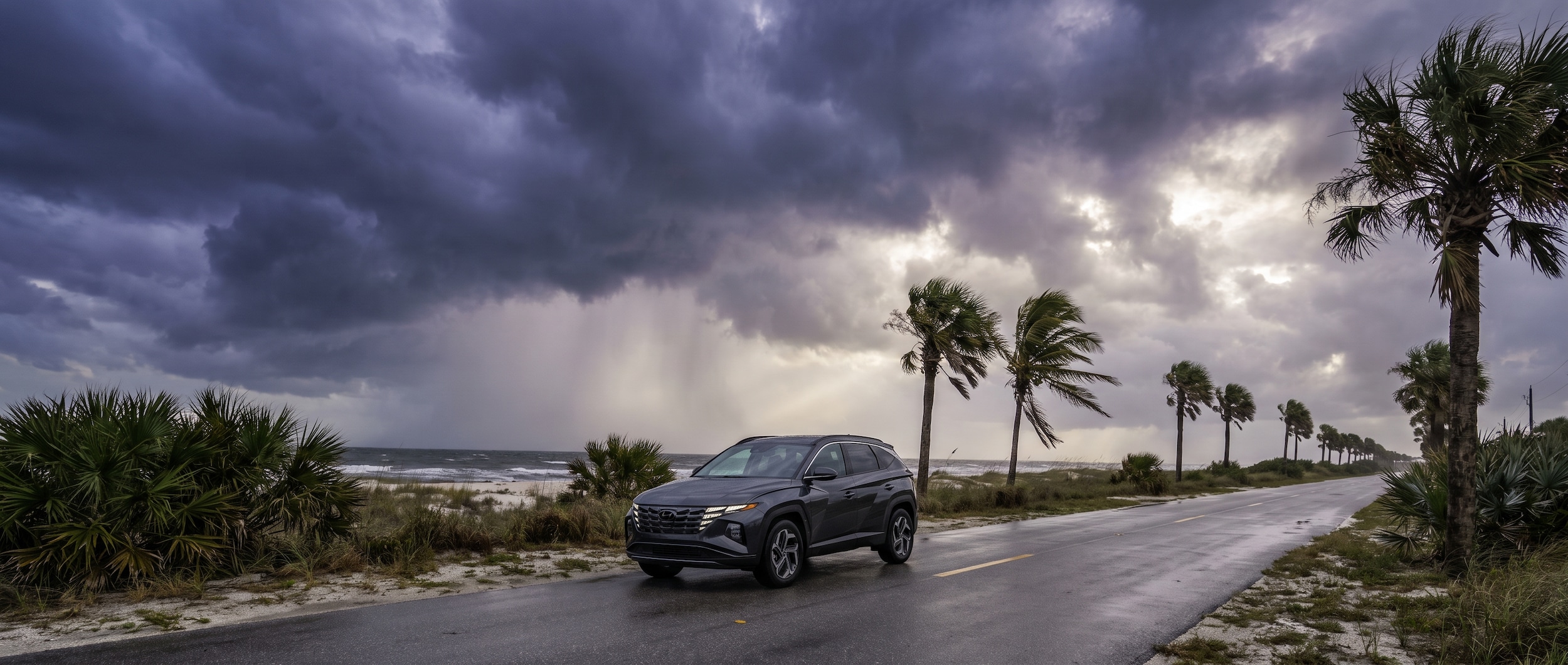
August is peak season around here. We don't mean beach season, though it's certainly that too. We mean the stretch Bay County drivers know carries real stakes, since the Atlantic's most active two-month window runs from now through early October, and this coast has the scar tissue to prove it. Hurricane Michael made landfall near Mexico Beach in October 2018 as a Category 5 storm, and portions of US-98 washed out. Evacuation zones A, B, and C in Bay County filled overnight. What separates a smooth evacuation from a breakdown in stalled traffic on US-231 north is a vehicle that was actually ready before the cone appeared.
This checklist is what our service team at Bay Hyundai walks through before every pre-storm appointment. Work through it now, because August is exactly the right time.
What Goes on the Checklist?
The checklist runs eleven items, and while most take only a minute to confirm, a couple can turn up work that needs a bay, which is exactly why we'd rather you run it now than during storm week. Print it, screenshot it, or bring it in on your phone. We unpack the ones that matter most in the next section.
Bay Hyundai Hurricane-Ready Service Checklist
- [ ] Battery load test (have it load-tested, not just voltage-checked; a weak battery passes a voltage check and fails you in traffic)
- [ ] Tire pressure + tread depth (check pressure against your door-jamb placard, not the sidewall number, and measure tread; include the spare)
- [ ] Wiper blades (replace if they chatter, streak, or skip on a light sprinkle; Gulf Coast UV and salt air degrade rubber faster than the calendar suggests)
- [ ] Brake fluid condition (have the moisture content tested; Bay County's coastal humidity accelerates moisture absorption into the fluid)
- [ ] Brake pads and rotors (any squeal, soft pedal, or vibration on braking means a look now, not during storm week when appointments are gone)
- [ ] Cooling system (coolant level, condition, and hose integrity; idling in evacuation traffic in August heat is the hardest test your cooling system faces all year)
- [ ] Engine oil (if you're within a month or so of your next change, do it early; a storm can delay service access for days or weeks)
- [ ] Air filter (cabin) (replace if overdue; post-storm air quality in Bay County can be rough, and a clogged cabin filter makes it worse inside the car)
- [ ] Lights (all exterior lights functional, including brake lights; debris and post-storm darkness increase the need)
- [ ] Emergency in-car kit (portable charger, flashlight, basic first aid kit, paper copy of insurance and registration, water, and sturdy shoes)
- [ ] Fuel level habit (keep the tank at or above the halfway mark from now through late October; gas stations run dry when a watch is posted)
Bay County's evacuation zones A, B, and C cover coastal and low-lying areas; local officials activated mandatory evacuation for those zones ahead of Hurricane Michael in 2018, and having your vehicle genuinely ready is what keeps that order from becoming a crisis.
Why the Key Items Hit Differently on the Gulf Coast
Four of those items deserve more than a checkbox, because on this coast the battery, the brake fluid, the wipers, and the tires can fail in ways a dry-climate list won't flag, and knowing why changes how you prioritize them. Below is what our service team sees on each one, and why they matter in this specific market.
Batteries wear down quietly all summer in Florida's sustained heat. By August, a battery that started the season at borderline capacity can fail a load test it would've passed in April. That matters because evacuation traffic means extended idling, AC running hard, a phone charging off the USB port, and no highway driving to recharge. A marginal battery won't survive that sequence. Have us load-test your Tucson, or whatever you drive, before a watch is posted, because service slots fill the moment the National Hurricane Center issues one.
Brake fluid is the item that catches drivers off guard. In Bay County's Gulf Coast humidity, brake fluid absorbs moisture faster than it does in a dry climate, because the fluid is hygroscopic (it's engineered to pull in moisture). Hyundai recommends inspecting brake fluid condition roughly every two years, and the practical consequence of moisture-laden fluid is a lower boiling point. Sit in stop-and-go evacuation traffic for two hours in August heat and you're generating real brake heat. Moisture-saturated fluid can develop vapor lock under those conditions, producing a spongy pedal when you need the brakes most. A technician can test the moisture content in minutes, and it's cheap insurance before a long drive north.
Wipers seem like an obvious one until you see how fast Gulf Coast UV and salt air eat through the rubber. Blades that looked fine in June can chatter and streak by August. A tropical squall can dump two to four inches an hour. Chattering wipers on a dark, rain-soaked US-231 at night aren't a minor inconvenience. Replace them if there's any doubt at all.
Schedule a Pre-Storm Service Appointment
Tires should always be set from the door-jamb placard on your specific Hyundai rather than the number molded into the sidewall, which is a maximum instead of a target. Florida's August heat makes tire pressure climb through the day, but underinflated tires stay the bigger risk in standing water and during hard cornering on a wet evacuation route. Check pressure cold, in the morning, against the placard. And check the spare while you're at it. A storm is a bad time to find out the spare is flat.
Gulf Coast reality check: Emergency management in Bay County advises residents to keep gas tanks full and know their evacuation zone. Your car can't help you execute that plan if a weak battery or bald spare tire sidelines it at the worst possible moment.
The Item-by-Item Logic: Why It Matters
| Checklist Item | Why It Matters in Bay County |
|---|---|
| Battery load test | Gulf heat shortens battery life; evacuation idling drains a marginal battery fast |
| Tire pressure + tread | Wet roads and standing water demand real tread; check pressure from the door placard |
| Wiper blades | UV and salt air degrade rubber quickly here; tropical rain rates exceed worn-blade capacity |
| Brake fluid moisture test | High coastal humidity accelerates moisture absorption, lowering the fluid's boiling point |
| Brake pads and rotors | Loaded vehicle plus wet roads plus heat finds tired brakes first |
| Cooling system | Extended idling in 95-degree heat is the hardest stress a cooling system faces all year |
| Engine oil | Storm disruptions can delay service access for days; don't be overdue going into it |
| Cabin air filter | Post-storm Bay County air quality; a clogged filter means that debris circulates inside the cabin |
| All exterior lights | Post-storm darkness and debris; brake lights are life-safety, not optional |
| Emergency kit | Bay County Emergency Management recommends 72 hours of self-sufficiency after a storm |
| Fuel above half | Gas sells out countywide when a watch is issued; don't be caught below a quarter tank |
The Palisade handles a fully loaded family evacuation better than almost anything in the lineup, but only if the tires are properly inflated and the cooling system has been checked. Size alone doesn't prepare a vehicle. The checklist does.
Your Print-and-Go Recap Before the Season Peaks
You don't need to wait for a watch to be posted, and running this in August means you can book on your own timeline instead of scrambling once a storm has a name. Book a service appointment now, bring this list, and give our team about an hour. We'll hit the battery, tires, wipers, brake fluid, coolant, oil, filters, and lights in one visit.
Here's a tradeoff worth naming. This checklist takes time, and on some vehicles a few items will need attention. That's actually the argument for doing it now rather than in September. Pre-season, our service bays have availability and parts are on normal supply schedules. The week a storm is named, brake pads and wiper blades sell out at every auto-parts store in the county, and service appointments are gone. Getting ahead of it by a few weeks is the smart strategy.
Book your pre-hurricane service visit online and you can choose a time that works around your schedule. Show up with the checklist, and we'll go through it with you.
Frequently Asked Questions
When is the best time to do a hurricane prep service in Bay County?
The most practical window is July through early August, before hurricane season peaks, which historically runs late August through October. By that point, service bays in Bay County fill quickly once a watch or warning is issued, and common parts like wiper blades and batteries can get hard to find locally. Booking in early August, right where you are now, is genuinely the right call. Our service team can inspect your Hyundai before conditions turn urgent.
Does the humid Gulf Coast air actually affect my brakes?
It does, and the mechanism is specific. Brake fluid is hygroscopic, meaning it's designed to absorb moisture from its environment. In a high-humidity coastal climate like Bay County's, that absorption happens faster than in drier parts of the country. As moisture content rises, the fluid's boiling point drops. During extended stop-and-go evacuation driving in summer heat, brake systems generate significant heat, and fluid with elevated moisture content can develop vapor, a condition called vapor lock, which produces a spongy or reduced pedal feel. Hyundai's general guidance is to have brake fluid condition inspected approximately every two years, and in Gulf Coast conditions, erring on the earlier end of that interval makes sense. A technician can test moisture content in the fluid in a few minutes.
Categories:
Social


