

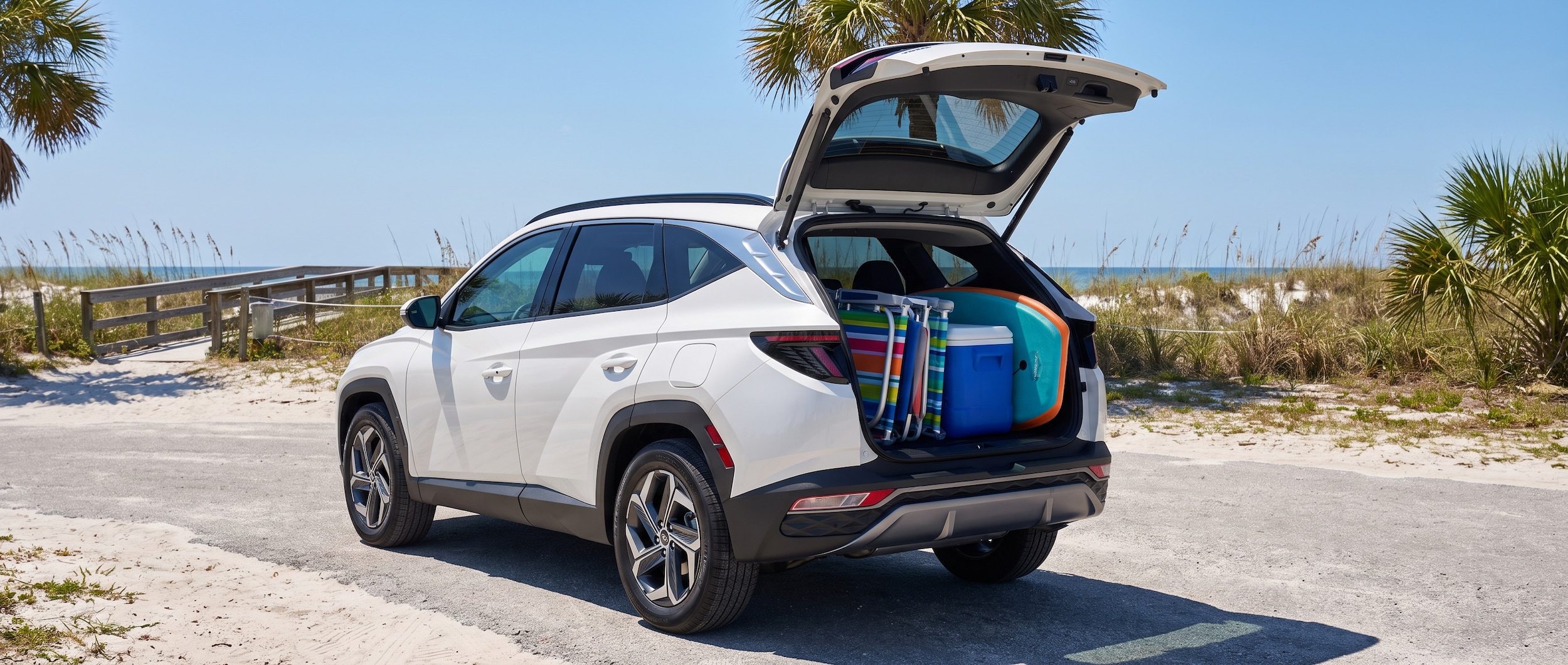
The 2026 Hyundai Tucson Hybrid makes a compelling case the moment you look at it on paper. But the specs land differently when you map them to a real commute -- say, the 16-mile stretch of US-98 from Callaway through Panama City to Panama City Beach on a July afternoon, windows up against the heat, three kids in the back, beach chairs and a cooler in the cargo bay, and a long stoplight at every major intersection along the way. That context is where this SUV genuinely earns its place in a Gulf Coast family's driveway.
What Do the Specs Actually Mean for This Drive?
The 2026 Tucson Hybrid pairs a turbocharged 1.6-liter four-cylinder engine with an integrated electric motor for a combined system output of 231 horsepower and 271 lb-ft of torque -- and every single hybrid trim comes standard with HTRAC all-wheel drive and a 6-speed automatic transmission. There is no FWD-only option to accidentally choose. The EPA rates the Blue SE trim at 38 mpg combined and the SEL, SEL Convenience, and Limited trims at approximately 36 mpg combined. The Tucson Hybrid runs a 13.7-gallon fuel tank, giving most trims an EPA-estimated range of around 493 miles per full tank.
Here is the part that matters for a stop-and-go Gulf Coast commute: hybrid powertrains recover energy through regenerative braking -- the same physics that make city driving more efficient than highway driving for this type of system. The US-98 corridor between Callaway and PCB is exactly the kind of mixed urban-coastal driving where the electric motor carries more of the load. You will likely see real-world numbers that track closely with the EPA city estimate, not below it.
| Spec | 2026 Tucson Hybrid (Blue SE) | 2026 Tucson Hybrid (SEL / SEL Conv. / Limited) |
|---|---|---|
| Combined System Output | 231 hp / 271 lb-ft torque | 231 hp / 271 lb-ft torque |
| EPA City MPG | 38 mpg | 37 mpg |
| EPA Highway MPG | 38 mpg | 36 mpg |
| EPA Combined MPG | 38 mpg | ~36 mpg |
| Drivetrain | HTRAC AWD (standard) | HTRAC AWD (standard) |
| Fuel Tank | 13.7 gallons | 13.7 gallons |
| Est. Range per Tank | ~521 miles | ~493 miles |
| Towing Capacity | 2,000 lbs (w/ trailer brakes) | 2,000 lbs (w/ trailer brakes) |
| Cargo (seats up) | 38.7 cu ft | 38.7 cu ft |
| Cargo (seats folded) | 74.5 cu ft | 74.5 cu ft |
| Rear Legroom | 41.3 inches | 41.3 inches |
Sources: EPA fuel economy estimates from hyundaiusa.com and fueleconomy.gov; cargo and legroom figures from Hyundai USA and US News & World Report.
The Cargo and Cabin Story Nobody Tells You
One of the most common questions families ask about any hybrid SUV is whether the battery eats into trunk space. For the Tucson Hybrid, the answer is no -- Hyundai packaged the battery underneath the cabin, leaving cargo volume identical to the standard gas Tucson. You get 38.7 cubic feet of space behind the rear seats and 74.5 cubic feet with both halves of the 60/40 split-folding rear bench folded flat. That is a meaningful number for a compact SUV, and it comes standard with a dual-level cargo floor that lets you hide valuables or drop the floor slightly to accommodate taller items like folded beach chairs.
The rear seat legroom figure -- 41.3 inches, near the top of the compact SUV segment per US News & World Report -- translates directly to whether your kids stop complaining on the way to Pier Park. The rear seats also recline, a feature you will notice on a longer trip once the novelty of the beach wears off at mile two of the return drive.
If your family regularly carries more than five people or needs a third row, the Santa Fe Hybrid is worth considering before you commit. But for a family of four or five making the Callaway-to-PCB run, the Tucson Hybrid is sized right: compact enough to park without stress, roomy enough to carry everyone and their gear without playing Tetris.
See Current Tucson Hybrid Offers
Safety That Shows Up in Every Category
The IIHS awarded the 2026 Tucson Hybrid the Top Safety Pick+ designation -- the highest recognition the Insurance Institute for Highway Safety issues. NHTSA gave the 2026 Tucson an overall five-star safety rating, with five stars in both the frontal and side crash tests. For a family vehicle covering US-98 summer traffic, those ratings carry real weight.
Hyundai's SmartSense suite comes standard across all Tucson Hybrid trims and includes Forward Collision-Avoidance Assist with pedestrian and cyclist detection, Lane Keeping Assist, and Blind-Spot Collision Warning. Higher trims add a Blind-Spot View Monitor that feeds a live camera image directly into the digital instrument cluster when you activate a turn signal -- a genuinely useful feature for lane changes in heavy PCB tourist traffic.
The Tucson also comes with two full sets of LATCH connectors for the rear outboard seats and a tether anchor for the center position, which matters if you are installing car seats. NHTSA notes the lower anchors are set somewhat deep in the seat fabric, so confirm your seat installation before the first drive.
| Feature | Standard on All Hybrid Trims | Higher Trims |
|---|---|---|
| Forward Collision-Avoidance (w/ pedestrian detection) | Yes | Yes |
| Lane Keeping Assist | Yes | Yes |
| Blind-Spot Collision Warning | Yes | Yes |
| 12.3-inch Touchscreen / Wireless CarPlay | Yes | Yes |
| Blind-Spot View Monitor (live camera) | No | SEL Conv. / Limited |
| Heated Front Seats | SEL and above | Yes |
| Dual 12.3-inch Digital Display | No | SEL Conv. / Limited |
| Hands-Free Smart Liftgate | No | Available on higher trims |
Sources: IIHS ratings at iihs.org; NHTSA safety data at nhtsa.gov; feature information from hyundaiusa.com.
Pros / Cons Table
| Pros | Cons |
|---|---|
| IIHS Top Safety Pick+ and NHTSA 5-star overall | Hybrid towing rated at 2,000 lbs (vs. 2,750 lbs for the gas Tucson) |
| 231 hp combined with AWD standard on every trim | Real-world highway MPG can dip below EPA estimate at sustained high speeds |
| 38.7 cu ft of cargo -- battery adds zero penalty | Regenerative braking setting resets every time you restart the vehicle |
| 41.3 inches of rear legroom (near segment-leading) | No third-row option -- max five seats |
| 12.3-inch wireless CarPlay touchscreen standard | Hands-free liftgate requires a trim upgrade |
| IIHS-rated Top Safety Pick+ with standard SmartSense | LATCH anchors rated Acceptable (not Good) by IIHS for car seat ease |
Browse the standard Tucson lineup if you prefer the higher 2,750-lb tow rating and a lower entry point; the hybrid adds AWD standard and the efficiency advantage on a daily Callaway-to-PCB-style commute.
Who the 2026 Tucson Hybrid Actually Fits
The Tucson Hybrid makes the most practical sense for families who run the US-98 corridor regularly -- school drop-offs, Saturday morning Pier Park runs, midweek errands between Callaway and the beach -- where the stop-and-go character works in the hybrid system's favor. You will see strong efficiency on those mixed daily trips, and the standard AWD and IIHS Top Safety Pick+ mean you are not trading capability or safety to get it.
If you regularly pull a jet ski or a small fishing boat, the 2,000-lb tow rating handles a light single-axle trailer fine, but you will want to verify your trailer weight before assuming it qualifies. For anything heavier, the gas Tucson or the Hyundai Santa Fe is the more capable choice.
For military families stationed at nearby installations who need a reliable, easy-to-own vehicle that handles both daily base commuting and weekend Gulf Coast driving, the Tucson Hybrid checks the practical boxes without asking for a compromise: modern tech, standard AWD, and efficiency that pays off on repeated short trips.
Frequently Asked Questions
Is the 2026 Hyundai Tucson Hybrid's AWD system standard or an upgrade?
HTRAC all-wheel drive is standard on every trim in the 2026 Tucson Hybrid lineup -- Blue SE, SEL, SEL Convenience, and Limited. There is no front-wheel-drive option for the hybrid version. This is a meaningful distinction from many competitors, where AWD costs extra, and it is relevant for Gulf Coast families who want confident traction in sudden summer downpours without paying an upcharge.
Does the hybrid battery reduce cargo space in the 2026 Tucson Hybrid?
No. Hyundai packaged the battery underneath the cabin floor, so the 2026 Tucson Hybrid offers the same cargo volume as the non-hybrid gas model: 38.7 cubic feet behind the rear seats and 74.5 cubic feet with the rear bench folded. The dual-level cargo floor is also standard across the hybrid lineup, so you can adjust the floor height to fit taller items or keep smaller items out of sight. Explore financing options at Bay Hyundai to build a complete picture of what ownership looks like before you visit.


