

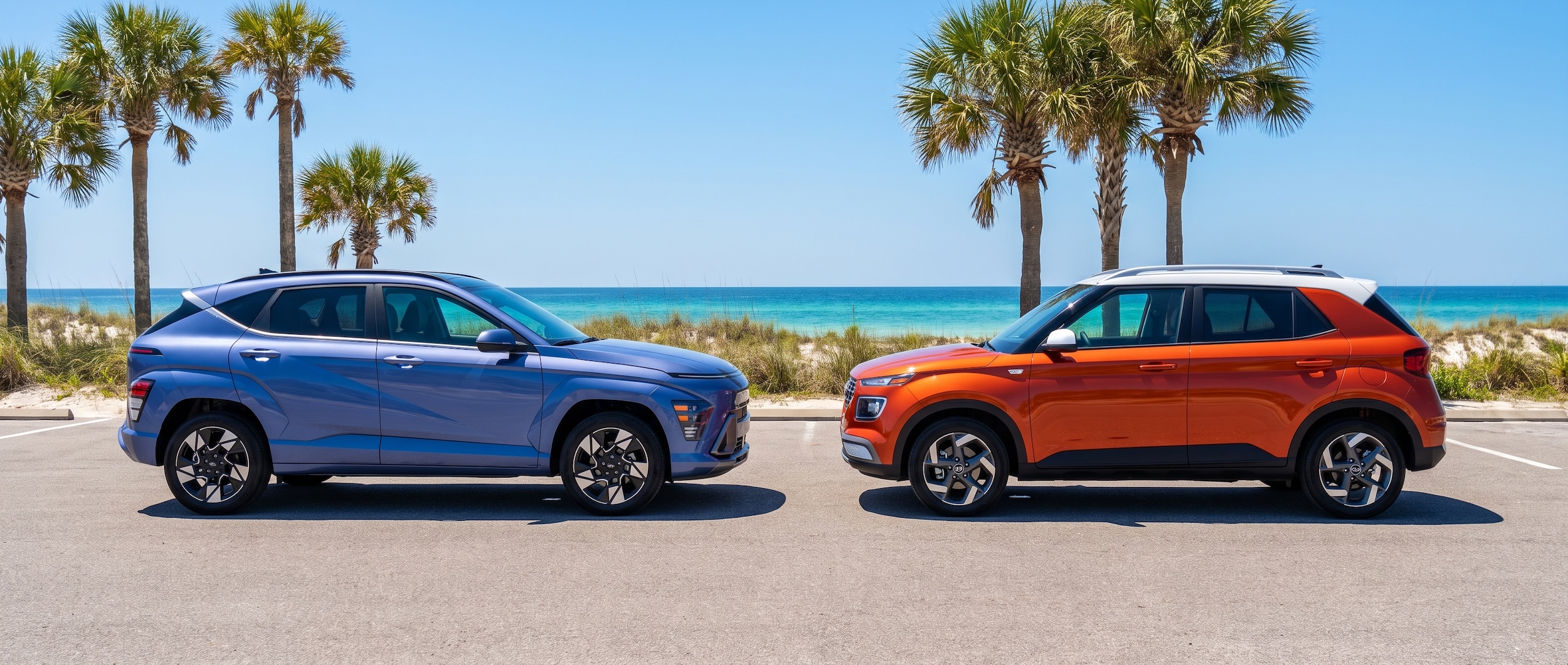
Cross-shopping these two, you're probably wondering whether the Venue is "enough" or the Kona is "worth it." For solo commuters and tight-parking situations, the Venue earns its keep. Add regular passengers, a bike, a dog crate, or an occasional wet-road concern? The Kona pulls away fast.
The 2026 Hyundai Kona sits a step above the Venue in every measurable dimension, but the Venue fights back with a smaller footprint and an identical 31 mpg combined EPA estimate. Knowing which matters more to your day-to-day is what settles it.
- Both models return an EPA-estimated 31 mpg combined, so fuel cost is a wash at that base level.
- The Kona carries nearly double the maximum cargo (63.7 vs. 31.9 cubic feet with rear seats folded), a gap that shows up fast on grocery runs or beach gear days.
- The Venue is FWD only, always. The Kona can add Hyundai's HTRAC AWD on any trim.
- The Kona offers an optional 1.6-liter turbo producing 190 horsepower; the Venue has one engine, one output (121 hp), and no performance upgrade path.
- For a solo commuter parking in tight spots around town, the Venue's shorter 159-inch footprint is a genuine edge. For anyone hauling people or stuff regularly, the Kona is the answer.
What's the Real Difference Between These Two?
On paper these two look almost identical, and at the base level the fuel numbers really are a tie, but in practice the Kona is a clearly larger vehicle that shares a nameplate tier with the Venue and not much beyond that.
| Spec | 2026 Hyundai Venue | 2026 Hyundai Kona |
|---|---|---|
| EPA Combined MPG | 31 mpg (FWD) | 31 mpg (base FWD) |
| Engine | 1.6L NA, 121 hp | 2.0L, 147 hp (base); 1.6T, 190 hp (upper trims) |
| Drivetrain options | FWD only | FWD or HTRAC AWD |
| Cargo (seats up) | 18.7 cu ft | 25.5 cu ft |
| Cargo (seats folded) | 31.9 cu ft | 63.7 cu ft |
| Rear legroom | 34.3 in | 38.2 in |
| Vehicle length | 159.1 in | ~164 in |
| Standard infotainment | 8-in touchscreen | 12.3-in touchscreen |
| NHTSA overall safety | 4-star | 4-star |
The MPG tie at the base level is real and confirmed by the EPA. Everything else skews Kona.
Does the Venue Have Enough Power for Highway 98 and the Hathaway Bridge?
For everyday town driving the Venue has plenty of pep, but load it with passengers and luggage for a highway climb and the answer changes, so how much power you need really comes down to how you fill it on a given day. Unloaded, the Venue's 121-horsepower 1.6-liter paired with a CVT handles Panama City's stop-and-go just fine. It's composed at town speeds, light on the wheel, and easy to park anywhere. Front Beach Road in July is bumper-to-bumper tourist traffic, and the Venue's compact 159-inch length makes lane changes and lot entries noticeably less stressful than a larger crossover.
The Hathaway Bridge is where the Venue shows its limits. Loaded with two or three adults plus luggage, the merge-and-climb at bridge speed takes real patience. It's not unsafe, just unhurried. The Kona's base 147-horsepower 2.0L handles that same situation with more in reserve, and upper trims can add a turbocharged 1.6L producing 190 horsepower and 195 lb-ft of torque for drivers who want something livelier on the run down US-98.
The 2026 Hyundai Venue and the full Bay Hyundai new inventory are both worth checking if you're still narrowing down which direction fits your load.
Practicality on Gulf Coast Schedules
Cargo is where this comparison stops being close, and the Venue's 18.7 cubic feet behind the rear seats covers the basics but tells you the truth the first time you try to load a weekend's worth of gear. It handles a grocery run for one. It handles a gym bag. A folding kayak cart, a stroller, or a mid-sized dog kennel is a stretch. The Kona's 25.5 cubic feet (seats up) and 63.7 cubic feet (seats folded) sits in a different conversation entirely.
Rear legroom follows suit. The Kona gives 38.2 inches back there; the Venue gives 34.3 inches. For a solo driver commuting from Lynn Haven to downtown, that gap is invisible. Put a couple of adults back there on a trip to Destin and it matters.
The safety package is comparable at entry level. Both carry forward collision warning with pedestrian detection, lane-keep assist, driver attention monitoring, and a rearview camera as standard. The Kona adds stop-and-go adaptive cruise control as standard on the 2026 model, which is a real quality-of-life feature on congested summer stretches of the Emerald Coast Parkway.
One trade the Venue clearly wins is parking. Its shorter body slips into spots the Kona has to work at, and around the beach district lots in midsummer, the difference is easy to feel. That edge shows up every single day.
So Which One Should You Pick?
Sorting these two comes down to how you actually use the vehicle, and from what we see driving around this market the split is fairly clean. Solo commuters lean Venue, while anyone hauling people or gear regularly lands on the Kona, no surprise there.
Pick the Venue if:
- You drive solo or with one other person most days and rarely haul cargo beyond groceries or a bag.
- Tight parking around Panama City Beach is a regular part of your routine.
- You want the lowest entry point into a new Hyundai crossover with meaningful standard tech and a 31 mpg EPA estimate.
- You don't need AWD and don't plan on upgrading beyond the SE or SEL trim.
Pick the Kona if:
- You regularly carry more than one or two passengers, especially adults in the back seat.
- You need practical cargo room, not just "it technically fits."
- You want AWD availability. No hurricane season is identical, and wet road crossings feel different when traction is distributed. The Venue simply doesn't offer that option.
- You want the turbo upgrade path. The 190-horsepower 1.6T on upper Kona trims is a real engine, not a spec footnote.
- You want a 12.3-inch touchscreen on every single trim level, not just upper ones.
For the right buyer the Venue isn't a compromise at all. It's a sharp, efficient, easy-to-own crossover for someone who doesn't need the extra volume. The honest downside is a low ceiling, meaning no AWD, one engine, modest cargo, and a tight rear seat. If you know those limits fit your life, it's a strong choice. If you're already picturing the moments it falls short, the Kona answers those before you ask.
Explore financing options at Bay Hyundai to get a sense of what your next step looks like.
Frequently Asked Questions
Is the Hyundai Venue available with all-wheel drive?
No. The 2026 Hyundai Venue is front-wheel drive only across all trims. There is no AWD option. If all-wheel drive matters to you, the 2026 Hyundai Kona offers Hyundai's HTRAC AWD system on every trim level for drivers who want that added traction on wet roads.
Do the Kona and Venue get the same fuel economy?
At the base engine and FWD level, yes. The EPA rates both the 2026 Venue and the base 2026 Kona at 31 mpg combined. However, the Kona's available 1.6-liter turbocharged engine drops to 28 mpg combined in FWD configuration and 26 mpg combined with AWD, so trim level matters when you're comparing efficiency across the Kona lineup.


