

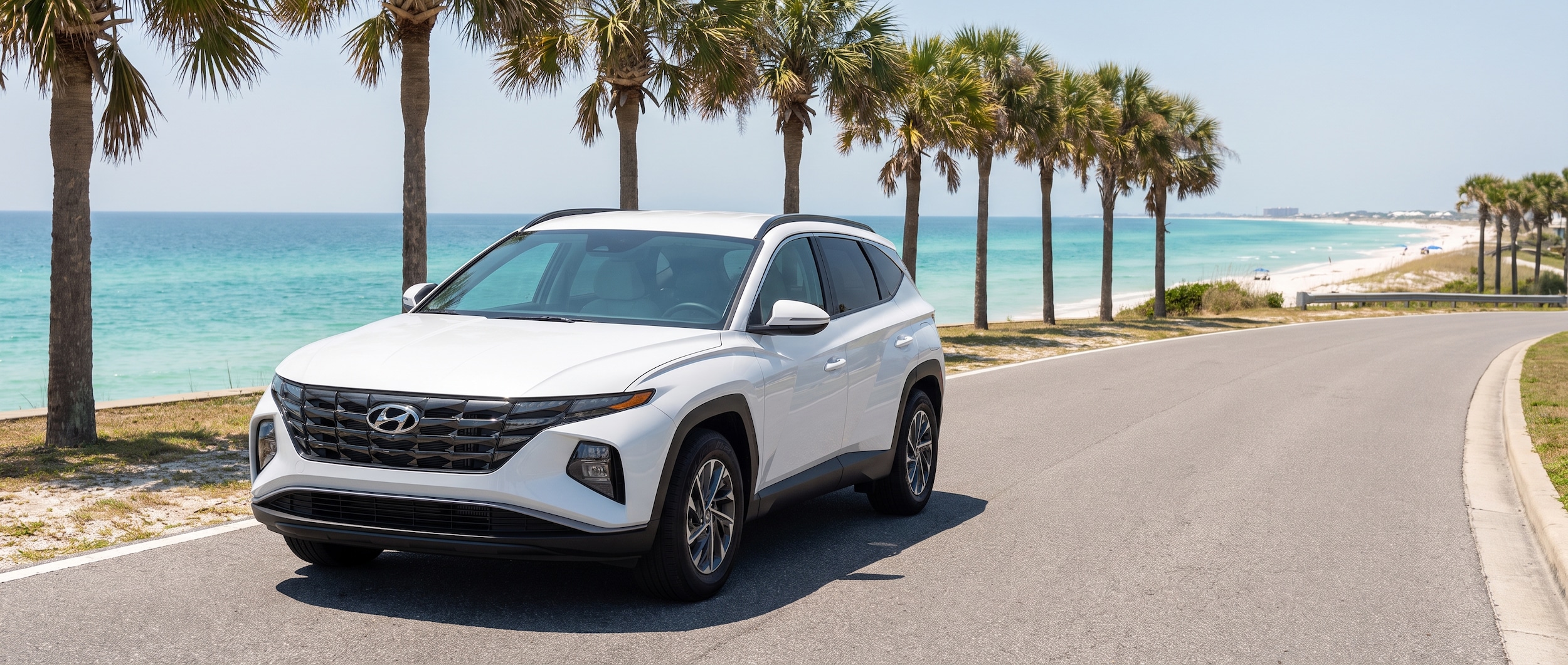
If you're driving Thomas Drive this summer, your Hyundai is already working harder than a typical commute. The stop-and-go traffic stacking up toward St. Andrews State Park, afternoon heat climbing past 90 degrees Fahrenheit, and the salt air that hangs over Bay County year-round all land on Hyundai's official list of Severe driving conditions. That matters because Hyundai publishes two maintenance schedules, and around here the tighter one is what most summer driving actually calls for.
Getting service isn't just about hitting a mileage number. On the Gulf Coast, it's about making sure your fluids haven't quietly degraded before you sit in traffic on a July Saturday with the A/C maxed out. The 2026 Tucson is a common face in our service bays ahead of beach-season trips, and the same logic covers every Hyundai we sell.
What Do You Actually Get From Each Tier of Service?
Each service tier does a different job, and knowing which one closes which gap is what turns a pre-trip visit into time well spent rather than a box you tick without thinking, so you'll want to read the table below against where your own Hyundai actually stands. Hyundai structures maintenance into tiers that build on each other, and each closes a different vulnerability. Here's what each tier does for a Bay County driver, and who genuinely needs it before a weekend run.
| Service Tier | What You Actually Get | Who Needs It Before the Weekend |
|---|---|---|
| Oil and Filter Change | Fresh full-synthetic oil that resists thermal breakdown; Hyundai recommends every 7,500 miles under Normal conditions, 5,000 miles under Severe | Anyone within 1,000 miles of either interval, given sustained 90-degree heat and stop-and-go traffic |
| Tire Rotation | Equalized tread wear across all four positions; Hyundai schedules this at the same cadence as oil changes | Any driver who skipped the last one; front tires take a disproportionate beating in low-speed maneuvering |
| Brake Fluid Check | Verification that moisture contamination hasn't lowered the fluid's boiling point; replacement interval is every 30,000 miles or two years | Critical in coastal Bay County: Gulf salt air and ambient humidity from St. Andrews Bay accelerate moisture absorption faster than in dry inland climates |
| Cabin Air Filter Replacement | Clean filtration for the HVAC system; a clogged filter strains A/C output | High priority in summer: pollen and salt particulate load this filter faster on the Gulf Coast than a generic schedule assumes |
| Coolant Inspection | Concentration check and corrosion inhibitor verification; Florida's sustained heat depletes inhibitors faster than inland schedules anticipate | Anyone past 24 months from the last coolant service, especially before high-temp weekend driving |
| Multi-Point Inspection | Brake pad depth, tire pressure, fluid levels, belts, lights | A 20-minute check that catches anything developing before it becomes a roadside problem |
Can you get away with just an oil change if that's all you can fit in before the weekend? Yes, that's still the right call. A service visit does eat part of your day, and there's no dodging that. Treat this table as a decision tool for prioritizing, so you can spend the time you've got where it counts.
Coastal Conditions Are Severe by Hyundai's Own Definition
The Santa Fe, the Tucson, and every Hyundai SUV we carry ship with a maintenance manual that separates Normal driving from Severe driving, and coastal Bay County lands squarely in Severe, though Severe here doesn't ever mean a tow truck and a dirt road. Hyundai's published criteria include sustained high temperatures, frequent stop-and-go operation, and high-humidity environments. Thomas Drive in July checks all three at once, and that carries real consequences for how fast certain fluids degrade.
The oil interval is the most visible difference. Under the Severe schedule, Hyundai calls for an oil and filter change every 5,000 miles or six months instead of the 7,500-mile Normal interval. High heat accelerates oil oxidation. Degraded oil loses the viscosity that keeps metal off metal inside the engine, and the damage runs cumulative and invisible until it isn't.
Our service team sees the same pattern all summer. A Hyundai that's run mostly in coastal stop-and-go and then serviced at the full Normal interval shows oil condition closer to a much higher mileage in a cooler, drier climate, which is why the Severe schedule exists.
Brake fluid is the piece that's easy to overlook entirely. Brake fluid is hygroscopic, which means it pulls moisture out of the surrounding air over time. The mix of Gulf salt air and humidity off St. Andrews Bay means Bay County vehicles take on moisture in their brake fluid faster than a dry-market schedule assumes. Moisture lowers the fluid's boiling point. Long stretches of stop-and-go in 90-degree heat pour sustained heat into the braking system, and fluid with a compromised boiling point can experience vapor lock under exactly those conditions. You get reduced stopping power right when you need it most.
Book a service appointment before the weekend, while you've still got time.
Schedule Your Pre-Trip Service
The Call That Protects What You Already Own
A pre-trip service visit is worth doing before a Thomas Drive weekend, with the fair limit that you should still prioritize by where your Hyundai actually stands, because the whole point is protecting the investment you've already parked in your driveway from a Bay County summer that runs hot and salty for months on end. You're not throwing money at a beach weekend for its own sake. The heat does the aging whether you book the visit or not.
The Tucson Hybrid brings a consideration that purely gas-powered vehicles don't share. Hyundai's hybrid platform runs a separate inverter coolant circuit for the high-voltage power electronics, kept apart from the engine cooling system. That circuit carries its own service interval, and sustained thermal stress (which is exactly what a Bay County summer delivers from late May through September) leans on it hard. Catching a depleted inverter coolant level before a long, hot, slow day on Thomas Drive protects the most expensive component in the vehicle. None of that is alarmist. Call it the math.
The value calculus here isn't complicated. A brake pad caught at 20% wear and replaced during a routine visit costs a fraction of what a pad worn to the backing plate costs in rotor damage. A coolant system handled before the inhibitors are spent won't turn into a towing call and a possible engine repair on US-98 in 95-degree heat. The maintenance visit is boring. The breakdown isn't.
We're at 641 W 15th St in Panama City, FL. Our service team knows this climate because they drive in it every day.
Frequently Asked Questions
Does stop-and-go traffic on Thomas Drive count as Severe driving for my Hyundai?
Yes. Hyundai's own maintenance schedule defines Severe driving conditions to include frequent stop-and-go traffic, sustained high temperatures, and high-humidity environments. Thomas Drive in a Bay County July satisfies all three criteria simultaneously. Under the Severe schedule, Hyundai shortens the recommended oil-change interval from 7,500 miles to 5,000 miles (or six months, whichever comes first), and tire rotations follow the same cadence. If you're driving primarily in Panama City Beach during summer, the Severe schedule is the appropriate baseline. Check your owner's manual for the full criteria, or ask our service team to walk through it with you.
How often should brake fluid be replaced on a Hyundai driven in Panama City Beach's coastal climate?
Hyundai's general guideline is brake fluid replacement every 30,000 miles or two years, whichever comes first. In Bay County's Gulf Coast environment, the two-year mark is the practical ceiling rather than a distant milestone. Brake fluid is hygroscopic: it absorbs moisture from the surrounding air, and the Gulf salt air combined with ambient humidity near St. Andrews Bay means moisture accumulates faster here than in dry inland markets. Moisture lowers the fluid's boiling point, which can reduce braking effectiveness during sustained stop-and-go driving under high heat. If you're approaching two years or heading into a summer of heavy Thomas Drive traffic, a fluid check is a quick and worthwhile step before you go.


