


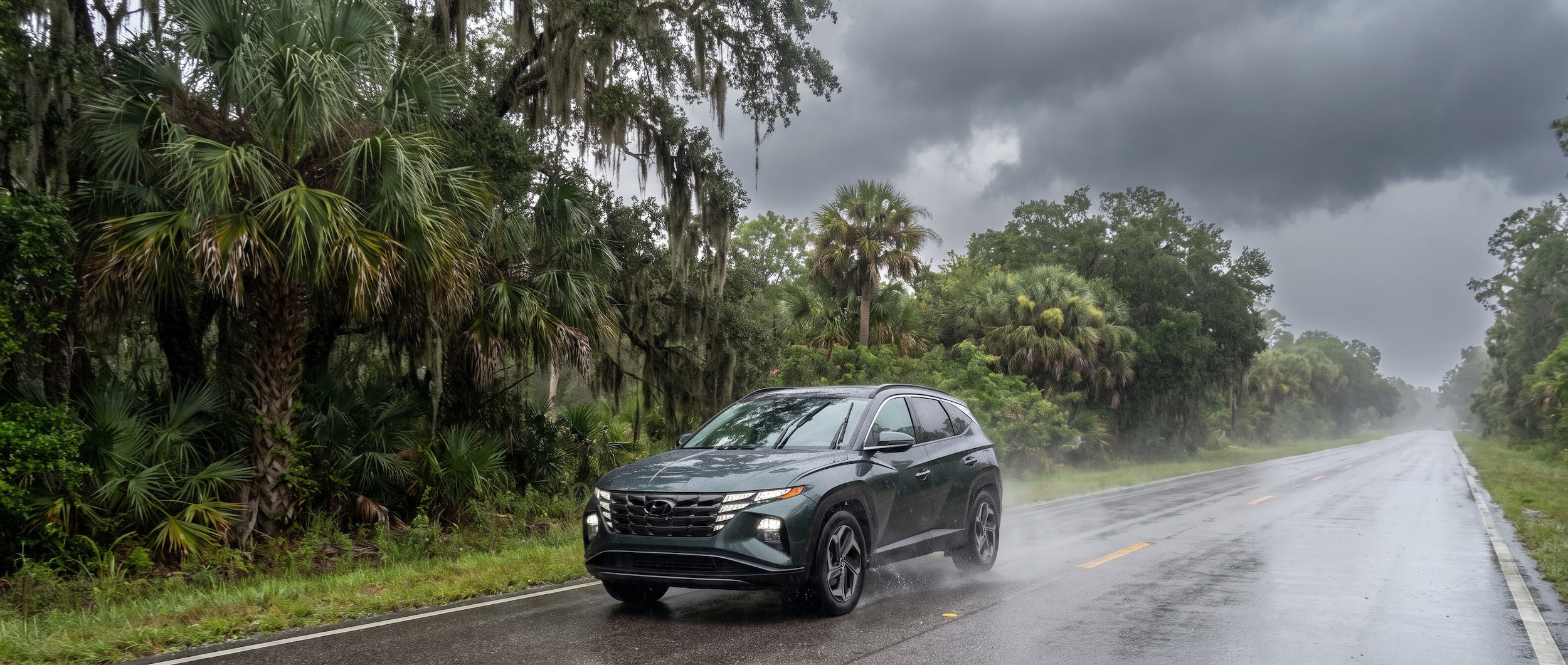
Bay County's summer roads rank among the wettest in Florida. We'll keep this simple. Check your tread depth against the 4/32-inch wet-road threshold (a step above the legal 2/32-inch minimum), keep your tires inflated to the placard spec before rain hits, and rotate on Hyundai's 6,000-to-8,000-mile schedule. Your TPMS light is only a backstop.
See our Hyundai Tucson inventory
What Does "Safe Tread Depth" Actually Mean on Wet Bay County Roads?
Safe tread depth on wet roads means roughly 4/32 inch, which sits well above Florida's legal 2/32-inch minimum, so a tire can pass the law and still leave you at genuine hydroplaning risk in a July thunderstorm on US-98. The legal number and the safe number diverge, and that gap is where you're most exposed.
| Tread Depth | What It Means for Wet Roads | Bay County Reality |
|---|---|---|
| 10/32"-11/32" | New tire, full wet-weather performance | Where you want to start |
| 6/32" | Strong wet-road grip, full hydroplaning resistance | Recommended comfort zone |
| 4/32" | Minimum for genuinely safe wet-road driving | Replace planning should start here |
| 2/32" | Legal minimum in Florida (most U.S. states) | Dangerous in rain before this point |
| Below 2/32" | Illegal, severe hydroplaning risk | Replace immediately |
The danger is physical and it shows up early. Tires turn genuinely dangerous on wet roads well before they hit the legal 2/32-inch floor. At roughly 3 millimeters of remaining tread (around 4/32"), hydroplaning risk climbs much faster as speed increases, because water forms a wedge ahead of the tire instead of channeling through the grooves. Bay County pulls in an average of 61 inches of rain per year, with July and August consistently ranking as the wettest months. We aren't talking about drizzle. On these roads, partial hydroplaning can begin at speeds as low as 20 mph under certain conditions.
For a quick test, slip a quarter into a tread groove with Washington's head pointing toward the tire. If you can see the top of his head, you're at or below 4/32", so treat that as your replace-soon signal. The penny test (Lincoln's head) only flags the moment you've crossed the legal line. By then, that margin is gone.
What Are the Other Tire Checks That Actually Protect You in Florida Summer Rain?
Beyond tread, two checks do most of the protecting in a Florida downpour, and they matter nearly as much as the tread itself. Inflation pressure and rotation timing shape how your Hyundai handles when a thunderstorm floods a crowded beach-town road, and getting either wrong undoes good tread. Tread grabs the headline. These two decide the outcome.
Tire Pressure and the TPMS Misunderstanding
Your Hyundai's Tire Pressure Monitoring System is federally required on all 2008-and-newer passenger vehicles, and it's a genuine safety feature. The limit worth knowing is its trigger point, because the TPMS warning light doesn't illuminate until at least one tire is 25 percent or more below the manufacturer's recommended cold inflation pressure. A 25 percent gap is a lot of missing air. Driving 5 or 8 PSI low (which happens gradually over weeks without tripping the light) still degrades wet-road grip and enlarges the contact patch in ways that work against you in standing water.
Check the pressure sticker on your driver's door jamb rather than the tire sidewall. The sidewall number is the tire's maximum, which runs higher than your car's recommendation. Do this check in the morning before you've driven, because tire pressure rises as rubber heats up, and Florida summer heat throws off ambient-temperature readings later in the day. Elantra owners and compact-model drivers, take note. Smaller tires run at higher pressures, so a few PSI off matters more proportionally.
Rotation Interval
Hyundai recommends rotating tires every 6,000 to 8,000 miles for most models (Elantra, Sonata, Tucson, Santa Fe, Palisade, Kona, Venue). On front-wheel-drive models the front tires do the braking work, so they're the ones wearing faster. Uneven wear is the enemy of wet-road traction. A front tire worn to 4/32" while your rears still sit at 7/32" leaves your steering and braking geometry uneven right when you need it most.
The simplest habit is rotating at every other oil change. Bundle it with each oil change if you're driving a hybrid that goes longer between services.
The 4/32-inch tread threshold, correct inflation from the door-jamb sticker, and rotating every 6,000 to 8,000 miles are the three specific numbers that keep a Hyundai safe on Bay County's wet summer roads.
- Check tread depth with a quarter (Washington's head = 4/32" warning zone)
- Use the door-jamb pressure sticker, not the tire sidewall, for your target PSI
- Check pressure in the morning before driving, especially in summer
- Rotate every 6,000 to 8,000 miles or at every other oil change
- Inspect sidewalls for bulges, cuts, or cracking at each rotation
What Should You Actually Do If Your Hyundai Starts to Hydroplane?
If your Hyundai starts to hydroplane, ease off the accelerator and hold the wheel steady toward where you want to go, and don't grab the brake, because braking or jerking the wheel only deepens the slide. Lift off smoothly, let the tires slow and find the surface again, then ease back to a controlled speed.
Santa Fe and larger SUV drivers, this one is for you specifically. Heavier vehicles resist hydroplaning better because there's more force pressing the tires against the road, but that advantage disappears the moment tires are worn or underinflated.
When you feel the steering go light and the car begin to float, the urge to stamp the brake is the wrong instinct. Lift off the accelerator smoothly and hold the steering wheel steady in the direction you want to go. No hard braking, no jerking the wheel. Let the tires slow down and find the road surface, and you'll feel grip return, then ease back to a controlled speed. NHTSA data covering 2019-2023 shows that over 77 percent of all weather-related crashes happen during rain or mist conditions (not ice, not snow). Bay County's summer storms are the scenario that statistic describes.
Cruise control is the other system to switch off in rain. It's built to hold speed and will try to do exactly that on a wet surface, which works against everything you need. Switch it off the moment rain starts.
A few habits hold up when a Bay County thunderstorm hits fast:
- Drop speed before you enter standing water, not while you're in it
- Increase following distance to at least four seconds (wet roads extend stopping distances dramatically)
- Turn off cruise control the moment rain starts
- Avoid lane changes through visible puddles on US-231 and the beach causeway routes
- If you lose traction, ease off the gas, hold the wheel steady, no hard inputs
Frequently Asked Questions
How often should I have my Hyundai's tires checked during rainy season?
At minimum, do a tread-depth and pressure check at the start of Bay County's rainy season in late spring and again mid-summer. Because July and August are the wettest months, catching a worn tire in June is better than discovering it when August thunderstorms hit daily. Our service team checks tires as part of every multi-point inspection, so any scheduled service visit also gives you a current read on where your tires stand.
My TPMS light came on in the morning but went off after driving. Is that normal?
It can happen. Tire pressure drops in cooler overnight temperatures and rises once the rubber warms up from driving. If the light goes off and stays off, your pressure is probably sitting just at the edge of the warning threshold. Don't ignore it. A few PSI below spec is enough to change how your Hyundai handles on a wet road, so check the pressure manually using the door-jamb sticker as your target and top off if you're low. If the light comes back, get the tires inspected.
Does driving on wet Florida roads wear tires faster than dry conditions?
Not directly from water alone, but the driving behaviors Florida summer roads encourage do contribute. Frequent braking in stop-and-go beach traffic, short trips that don't let tires fully heat and channel water efficiently, and the rapid temperature swings between air-conditioned garages and 90-plus-degree pavement all put more stress on tires than a steady highway commute would. The bigger risk isn't faster wear. It's that worn tires reveal themselves as a problem in wet conditions first, because the margin for grip disappears sooner in rain than on dry pavement.
Categories:
Social


