


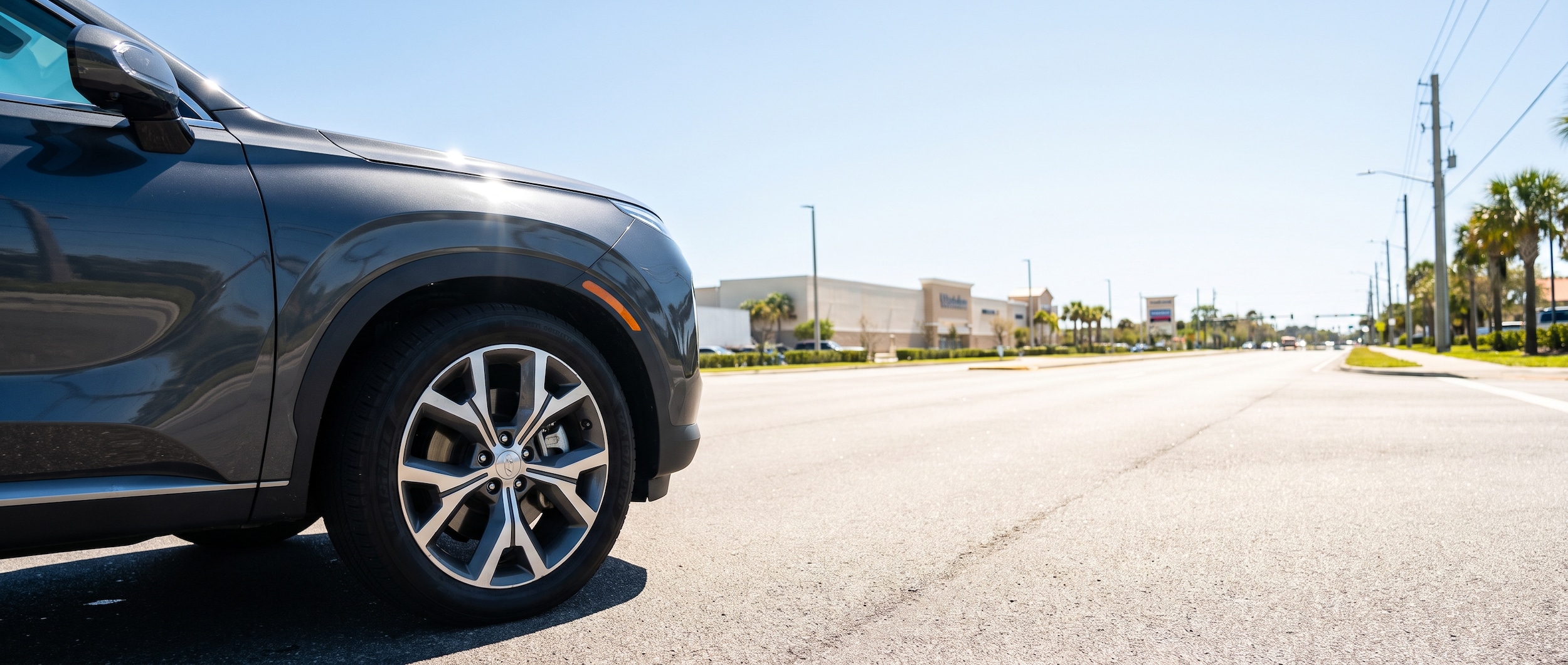
Panama City's heat index hits triple digits by mid-July, and every one of those degrees matters to the two systems that stand between your Hyundai and the car ahead of you. Standard service intervals are written for average conditions -- 23rd Street in July is not average.
Book a summer brake and tire check at Bay Hyundai
The short version
- Brake inspections: Hyundai recommends every 7,500 miles or 6 months -- cut that to every 5,000 miles or after a heavy summer of stop-and-go on commercial corridors like 23rd Street.
- Tire rotation (FWD/RWD): Every 5,000-7,500 miles; for AWD models (Tucson Hybrid, Santa Fe Hybrid), tighten to every 3,000-5,000 miles.
- Tread depth to retire tires: NHTSA sets the legal floor at 2/32 inch; for Panama City's daily summer thunderstorms, replace at 4/32 inch or sooner -- wet stopping distance nearly doubles at the legal minimum.
- Pressure checks: Always cold, always against the door-jamb placard -- not the tire sidewall maximum. Check monthly; Gulf Coast July heat adds 1-2 PSI per 10 degrees of ambient temperature rise.
- Tire age: Replace by 10 years regardless of tread; hot climates accelerate rubber degradation -- some manufacturers recommend 6 years.
What Actually Matters When Choosing a Brake and Tire Service Schedule?
The variables that change your service math in Panama City are not the ones a national maintenance guide talks about. Three factors drive the real numbers here: the heat load on your tires from black asphalt that reaches 130-160 degrees Fahrenheit under direct summer sun, the frequency of full stops on a signalized commercial corridor, and the wet-road traction demand created by afternoon thunderstorm seasons that run June through September.
The table below maps each driving pattern to the service variable it stresses most.
| Your Driving Pattern | What It Stresses | Interval Adjustment | Key Spec to Watch |
|---|---|---|---|
| Daily 23rd St. errands (FWD sedan/SUV) | Brake pads: front wear doubles vs. highway | Inspect pads every 5,000 mi | Pad thickness below 3mm = replace now |
| Beach-corridor stop-and-go (AWD SUV) | All-four-tire uneven wear from AWD torque split | Rotate every 3,000-5,000 mi | Tread variance over 2/32 across axles = rotate today |
| Highway runs to Tallahassee or Pensacola | Heat soak on long sustained stretches | Monthly cold pressure check | TPMS warning = already 25% low -- don't wait for the light |
| Mixed city + occasional towing | Compound pad + tire load stress | Inspect brakes every 5,000 mi; check tire sidewalls for cracking | Sidewall cracks/bulges = replace regardless of tread |
| Sporadic summer use (stored during travel) | Flat-spot risk, rubber degradation without mileage | Inspect before each extended trip | Tire age over 6 years in FL heat = replace even if tread looks fine |
Hyundai officially recommends a brake inspection every time you rotate tires -- roughly every 6 months or 7,500 miles -- but city driving wears pads roughly twice as fast as steady highway driving, which means that 7,500-mile gap can become a 5,000-mile gap for anyone doing daily 23rd Street commutes.
How Gulf Coast Summer Heat Changes Your Brake Timeline
The 23rd Street corridor is genuinely demanding on brake pads -- not because of speed, but because of frequency. The road is a four-lane commercial strip, heavily signalized, and verified by FDOT to carry regular construction-related traffic modifications that pile on additional stops. Each full stop from city speeds converts kinetic energy into heat through your brake pads and rotors. On a 95-degree July afternoon, your rotors are already warm before you hit the first red light heading west.
Per Hyundai's own guidance on owners.hyundaiusa.com, a brake inspection is recommended every 7,500 miles or every six months. That interval is calibrated for average mixed driving. If your Elantra, Tucson, or Palisade spends most of its summer miles on city corridors rather than highway, pads wear at roughly double the highway rate -- a documented pattern because city braking involves more frequent full stops, each of which removes more friction material than a brief highway speed reduction.
The practical brake warning signs to act on before the mileage clock runs out:
- A squealing sound from the wheel area while moving (the built-in wear indicator tab, not the brakes themselves)
- A grinding sound while braking (metal-on-metal contact: rotor damage is already happening)
- A soft or "long" brake pedal that travels further than normal before the car slows
- Shuddering through the pedal or steering wheel during a stop (warped rotors, common after repeated heat-heavy city stops)
- Brake dust noticeably *decreasing* on your wheels -- counterintuitively, this can signal pads are nearly gone
Heat and brakes -- why summer is not like winter: Black asphalt under direct Florida sun reaches surface temperatures of 130-160 degrees Fahrenheit even when the air reads 90 degrees. Per NHTSA, tire-related crashes peak between May and October for exactly this reason -- sustained high temperature accelerates deterioration of both rubber and brake friction material. Tires and brakes interact: a tire that can no longer grip wet pavement adds stopping distance that your brakes alone cannot compensate for.
Rotors follow the same city-accelerated timeline. Most drivers see rotor replacement needed somewhere between 30,000 and 70,000 miles, but the wide range tightens at the lower end for anyone doing heavy stop-and-go miles. Your service technician measures rotor thickness against the manufacturer's minimum spec at each inspection -- that number is model-specific and not something to estimate.
The Tucson's AWD system distributes torque to all four wheels based on road conditions -- which is a genuine capability advantage for wet 23rd Street afternoons -- but it also means all four tires wear at slightly different rates. That is exactly why AWD Hyundai models call for a tighter rotation interval (3,000-5,000 miles) compared to FWD-only models (5,000-7,500 miles).
Schedule a Summer Brake and Tire Inspection
Tire Tread and Pressure: The Gulf Coast-Specific Numbers
One piece of advice you will not find in a generic maintenance article: the legal minimum tread depth and the safe tread depth are two different numbers in Panama City.
NHTSA establishes 2/32 of an inch as the replacement threshold -- this is also Florida law. But tire safety engineers note that wet-pavement stopping distance has already nearly doubled compared to a new tire by the time tread wears to that 2/32-inch floor. Panama City averages over 24 rainy days in July alone, with afternoon convective thunderstorms that leave standing water on 23rd Street and the surrounding corridors. At 2/32, a Tucson doing a hard stop on wet asphalt takes substantially longer to stop than the same vehicle on new tires.
The Gulf Coast tread rule: The practical replacement threshold for a Gulf Coast driver is 4/32 of an inch. Check it in your driveway by inserting a quarter -- not a penny -- into the tread groove. If the top of Washington's head is visible, you are at 4/32 or below and entering the replacement window. The penny test only tells you when you are already at the NHTSA floor -- too late for a rainy-season commute.
Tire pressure adds a second layer. NHTSA reports that only 19% of consumers properly inflate their tires -- and this matters more in summer than any other season. For every 10-degree Fahrenheit rise in ambient temperature, tire pressure increases approximately 1-2 PSI. On a typical Panama City July day, a tire that was correctly inflated in the morning is several PSI higher by afternoon -- and an underinflated tire that started the day already slightly low is now genuinely dangerous.
Two rules that override everything else on pressure:
- Always check cold (at least three hours after driving, or first thing in the morning before driving).
- Use the PSI listed on your door-jamb placard, not the number on the tire sidewall. The sidewall lists the maximum the tire can hold, not what your vehicle is designed for.
Your Hyundai's TPMS light is a backup signal, not a monitoring tool -- by the time it illuminates, your tire is already 25% below the placard pressure and in the damage zone.
The Elantra's standard TPMS system is one of the features that earns its keep in a Florida summer, but it cannot substitute for a monthly cold-pressure check -- especially heading into August and September when heat remains intense and afternoon rain frequency peaks.
- Check tire pressure monthly, always cold, always against the door-jamb spec
- Run the quarter-tread test before any long trip (to Tallahassee, Pensacola, or anywhere with significant highway miles)
- Inspect sidewalls by hand for hairline cracks (called weather checking) -- heat-degraded rubber can feel structurally fine while hiding fatigue
- Check the DOT date code on your sidewalls: the last four digits tell you the manufacturing week and year (e.g., 1824 = 18th week of 2024); tires over 6 years old in Florida heat warrant a professional inspection even if tread looks fine
- Do not bleed air from a hot tire to reach target pressure -- set it cold and trust the number
Match Your Service Timing to How You Actually Drive
The right interval for your Hyundai is not the number on a generic sticker -- it is the number that reflects what 23rd Street July traffic actually does to your specific drivetrain. If your commute runs mostly along signalized commercial corridors with regular full stops, treat 5,000 miles as your brake-inspection interval, not 7,500. If you drive an AWD model -- the Santa Fe Hybrid with HTRAC AWD, for example -- match the tighter 3,000-to-5,000-mile rotation schedule to keep all four tires wearing in sync.
If your tires are approaching six years old and you live where pavement spends three months above 90 degrees, schedule an inspection regardless of remaining tread. None of these adjustments require guesswork. The numbers exist: Hyundai's OEM guidance, NHTSA's safety thresholds, and the physical reality of Gulf Coast summer heat all point to the same conclusion -- the standard calendar works for the average, and Panama City summer is not the average.
You already made a sharp call on reliability when you chose a Hyundai. Keeping up with brakes and tires is how that reliability actually shows up when you need a hard stop in a summer thunderstorm.
By the Bay Hyundai Team | June 2026
Categories:
Social


