

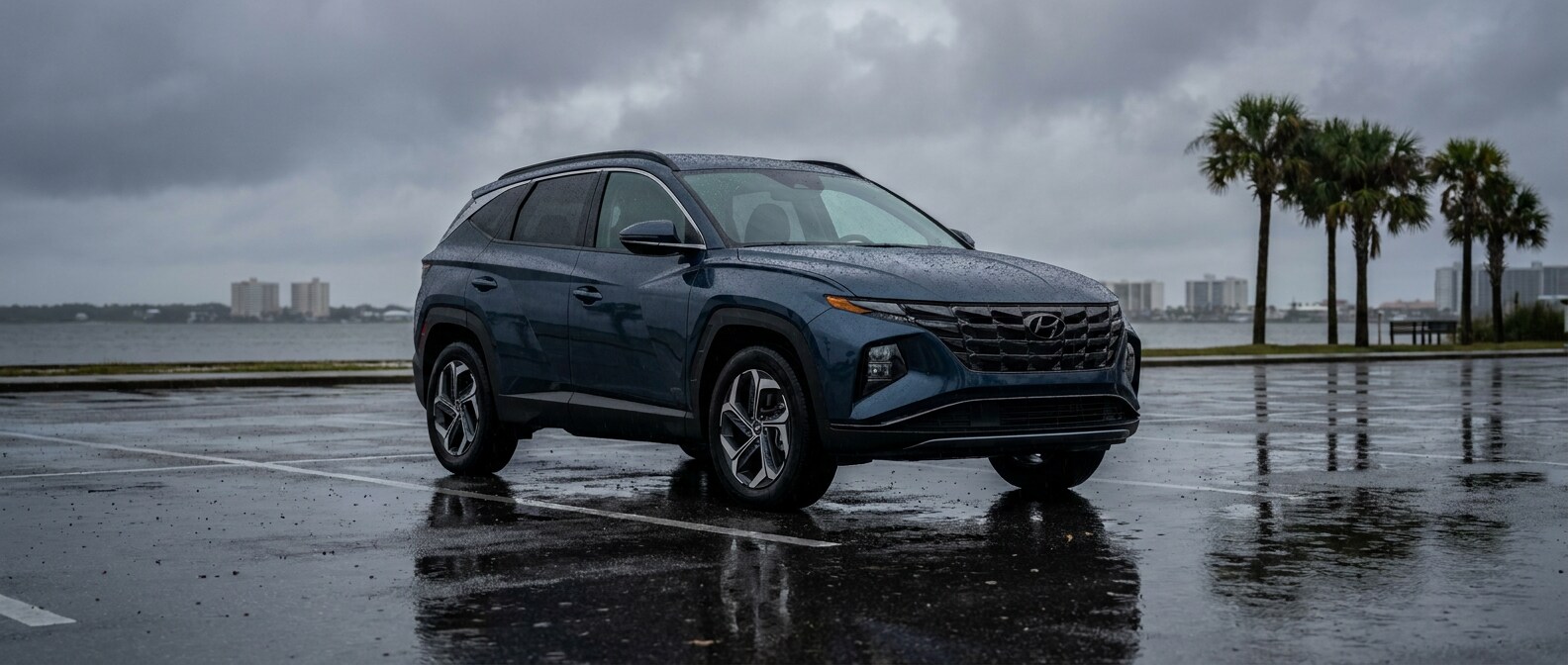
November in Panama City feels mild right up until it doesn't. Overnight lows are already dipping into the mid-to-upper 40s on the cooler end of this month's forecast, and we average roughly 10 rainy days before Thanksgiving. That combination hits the three systems we all put off over summer in a very specific way. A battery that baked in 90-degree heat for five months is now meeting its first real cold-crank mornings, tires that looked fine on dry summer asphalt now have to channel rainwater on US 98 at highway speeds, and brakes that squeaked a little back in August are being asked to perform in wet-on-warm-pavement conditions where stopping distance matters most.
None of this is an emergency. But it's the right month to look.
- Brake pads: Plan replacement when pads reach 3 mm. The legal floor is lower, but wet-road stopping distance expands significantly before you get there.
- Tires: Florida's legal minimum is 2/32" tread. Safety experts recommend replacing at 4/32", the quarter test tells you which side of that line you're on.
- Battery: Hyundai USA recommends checking your battery at least twice a year and replacing it every three years. Gulf Coast heat accelerates wear.
- Hybrids and EVs: They still carry a 12-volt auxiliary battery alongside the high-voltage pack. That 12-volt needs the same attention on the same timeline.
- Our recommendation: A combined brake, tire, and battery inspection in November catches what summer masked and what the coming months will expose.
What Actually Matters When Choosing a Service Interval Here?
Driving by feel works fine right up until wet roads, early darkness, or a cool morning reveal the gap, which is why the three systems we lean on here carry documented thresholds where performance slips before any warning light appears. There's rarely a dashboard light to warn you first.
| System | Service/Replace At | Why That Threshold | Gulf Coast Wrinkle |
|---|---|---|---|
| Brake pads | 3 mm remaining | Below 3 mm, wet-road stopping distance expands; metal-on-metal contact can follow | November rain on warm asphalt is the first real wet-road test after a dry summer |
| Tire tread | 4/32" is the safety target; 2/32" is Florida's legal minimum | Wet traction drops sharply below 4/32"; hydroplaning threshold lowers with wear | 10+ rainy days expected in November; US 98 carries significant traffic at highway speeds |
| 12-volt battery | Test at 3 years; Hyundai USA recommends replacement every 3 years | Heat degrades battery chemistry faster than cold; first cool mornings reveal what summer weakened | Batteries here spend months above 90 degrees before November overnight lows arrive |
| Hybrid/EV 12-volt | Same 3-year interval | The auxiliary 12-volt handles accessories and startup independently of the high-voltage pack | IONIQ 5, IONIQ 6, IONIQ 9, Tucson Hybrid, and Santa Fe Hybrid all carry a separate 12-volt |
We don't run this table to scare anyone. Think of it as the spec-grounded case for why "nothing has failed yet" and "ready for what's coming" sit in two different places.
Brake Pad Thickness: The Threshold That Wet Roads Move
Brakes that felt perfectly adequate on dry Bay County roads all summer are now facing the worst conditions for marginal pad life, since November on the Gulf Coast means rain on warm pavement, and that thin film is exactly when a few lost millimeters turn into measurable stopping distance. You won't feel the loss on a dry afternoon.
Mechanics and safety engineers put the practical replacement threshold at 3 mm, while new pads start at roughly 10-12 mm on the front axle. Per NHTSA, worn brakes reduce stopping power and increase stopping distances. Dig a little deeper and you'll find a worn pad at 2-3 mm displaces less water, takes longer to build friction, and stretches stopping distance further than the dry-condition numbers suggest. And if your tires are also riding the lower end of their tread life? Worn pads and worn tires work as multipliers. Each one alone extends wet stopping distance, and together they can nearly double it.
The squeal you hear is a wear indicator, a small metal tab engineered to scrape the rotor once pad thickness drops to roughly 3 mm. Treat that noise as a spec doing its job, not an annoyance to tune out. Let the pad material wear past the minimum safe limit and you get metal-on-metal contact, which severely damages the brake rotors. Then you're replacing rotors alongside the pads.
Pad wear happens gradually and it's easy to miss. The thickness reading is the number that tells you where you stand.
If your Palisade or any other Hyundai hasn't seen a brake inspection since spring, this is the right month for one. Front pads on a stop-and-go in-town vehicle wear faster than the calendar lets on.
Schedule a Brake and Tire Inspection
Tire Tread Depth: Why the Legal Minimum Isn't the Safety Minimum
Florida law sets the minimum tread depth a tire can have at 2/32 of an inch, the floor below which you can be ticketed and the tire is legally finished, yet safety experts recommend replacing at 4/32" for better wet performance, and that two-step gap isn't trivial. Legal and safe sit a full step apart.
The difference shows up on US 98 in a November rain. Think of tire tread as a drainage system. As depth drops below 4/32", the grooves can't move rainwater fast enough, and the contact patch starts riding on water instead of pavement. We call that hydroplaning, and it sets in below highway speed in standing water.
Grab a quarter for the quick check. Press it into a tread groove, rim-side in. If you can see the top of Washington's head clearly, you're below 4/32", and that's your cue to plan replacement. The 2/32" penny test only tells you you're already at the legal floor. Two tests, two different decisions.
Matching Your Battery Check to How Gulf Coast Driving Actually Ages It
Hyundai USA recommends checking your battery at least twice a year and replacing it every three years, and that interval matters most here because a battery that spent five months in Gulf Coast summer heat meets its first true cold-crank mornings right now, as our overnight lows drop into the 46-55 degrees Fahrenheit range. You'll feel that mismatch the first cold morning out.
Heat weakens a battery's chemistry, and the cold mornings then reveal what summer already did. Battery life varies with driving habits, outside temperatures, how often the vehicle is driven, and the length of your typical trips. Short beach-town hops are especially hard on a battery, since the charging cycle never fully completes on parking-lot runs, the bridge, and quick errands. If your Hyundai mostly runs short hops around town, you'll hit the three-year horizon faster than a highway commuter would.
One meaningful wrinkle shows up if you drive a newer Hyundai with Idle Stop and Go, the automatic engine shutoff feature at stoplights. Per Hyundai service guidance, many models with that system use an AGM battery in place of a standard lead-acid unit, and an AGM typically runs closer to 4 to 7 years because it's built to handle more frequent charge cycles. So the three-year rule plays out differently depending on which battery your model carries. Worth confirming at your next visit.
Hybrid and EV owners, this applies to you too. The IONIQ 5, the Tucson Hybrid, and their siblings all carry a separate 12-volt auxiliary battery alongside the high-voltage drive battery. That 12-volt runs your accessories, the computers that wake the car up, and the systems that allow the vehicle to start the charging process. It wears on the same timeline as any 12-volt, and it'll want the same periodic load test.
A few signs point to testing now rather than waiting. Watch for slow or hesitant startup, dimming headlights, warning lights that appear with no other obvious cause, or a battery that's past three years without a load test.
Match the Service to How You Actually Drive in Panama City
We don't need to run every Hyundai in Bay County through a full workup, and the smarter move is to match the inspection to the wear pattern for how and where you drive, which is what the table below sorts out by driving style.
| Driving Pattern | Brakes | Tires | Battery |
|---|---|---|---|
| Short in-town trips (errands, school runs, local commuting) | Front pads wear faster; check if over 15,000 miles since last inspection | Check tread and age; short trips don't heat tires evenly, which accelerates edge wear | Test if over 2.5 years; short trips prevent full recharges and shorten battery life |
| US 98 highway commuting (Callaway, Parker, Lynn Haven) | More even pad wear; check at the 3 mm threshold | Tread depth is the primary concern at highway speeds in rain | Standard 3-year interval; highway driving is better for charge cycles |
| Towing or hauling (Santa Cruz, Palisade) | Rear pads wear more than typical; both axles need inspection | Load stress increases tread wear rate; check at every oil change | Higher electrical load from towing equipment; test annually if hauling frequently |
| Mostly parked (seasonal residents, infrequent use) | Rotors may show surface rust even with low pad wear | Check sidewall condition and cracking alongside tread depth | Highest risk category; a battery that sits regularly loses charge capacity; test before extended use |
The November window is practical for one more reason. You're past the peak summer heat stress, Thanksgiving travel is coming, and service shops haven't hit the holiday backlog yet. We think it's genuinely the right month to get this done.
Schedule a service inspection with our Bay Hyundai team
Frequently Asked Questions
Does Florida's warm climate mean I can skip the November battery check?
No, and the logic actually runs the opposite way here. Florida's heat is harder on battery chemistry than cold weather is. Five months of ambient temperatures above 85-90 degrees Fahrenheit degrade the electrolyte inside a lead-acid battery more aggressively than a northern winter would. The November overnight lows in Panama City, dropping into the mid-to-upper 40s, represent the first real cold-crank test of what summer already weakened. Hyundai USA recommends battery checks at least twice a year and replacement at the three-year mark. If your battery is approaching that interval and hasn't been load-tested recently, now is the right time, before a cool morning reveals a problem that a service visit could have caught first.
My tires still look fine. Do I really need to check tread depth?
Visual inspection alone misses two things. First, tread depth: a tire can appear to have plenty of rubber without being above the 4/32" threshold where wet-road traction begins to drop. Florida's legal minimum is 2/32", but safety engineers recommend planning replacement at 4/32", especially in a market with regular November rain. The quarter test (rim-side into the groove; if you see the top of Washington's head, you're below 4/32") catches the problem a full step earlier than the penny test, which only confirms you're already at the legal floor. Second, age: Gulf Coast UV and heat degrade rubber compounds even when the surface looks intact. A tire that's four or more years old is worth having a technician check for sidewall condition, regardless of how the tread reads.


