

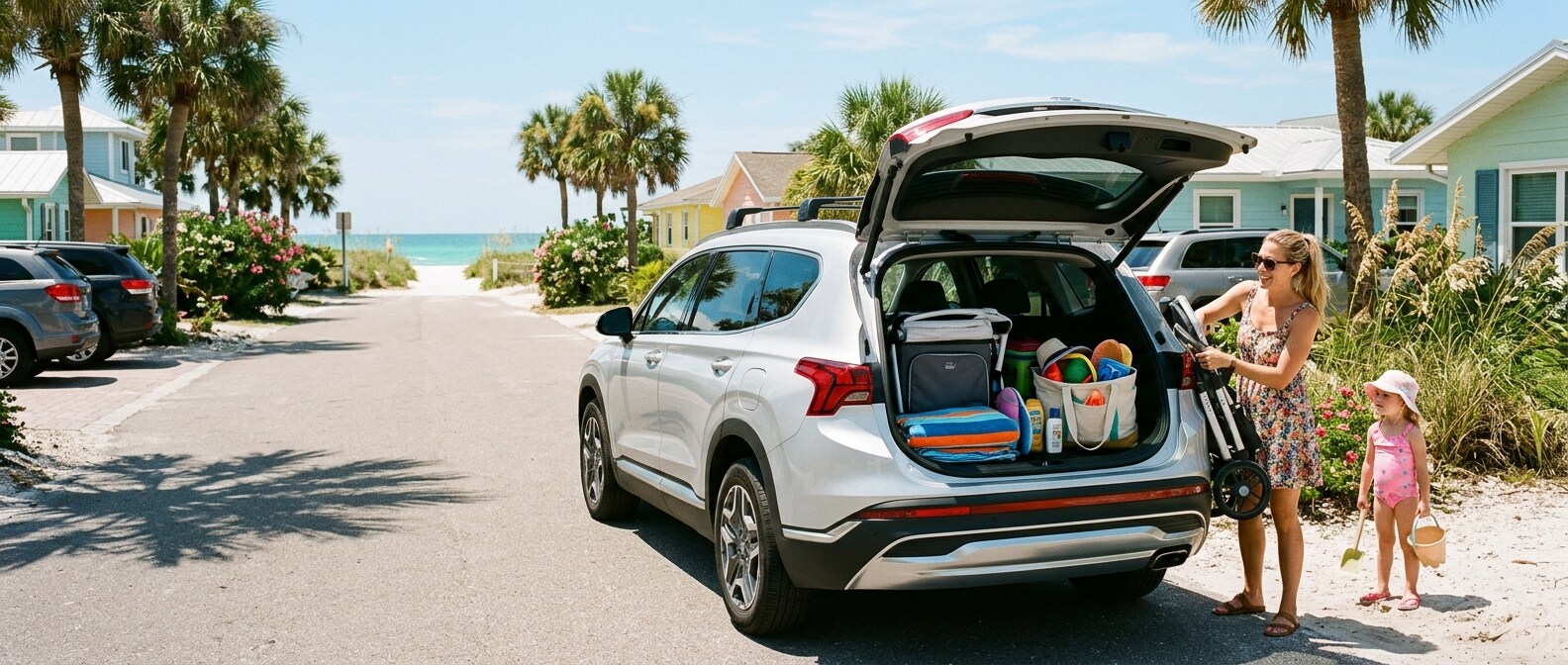
You're shopping used, you've got one or two kids in car seats, and you want to know which Hyundai SUV in which model year is actually worth buying. We're not talking about which one looks good on paper. We mean the real answer, which generation, which years to target, and which ones to approach carefully.
We'll give it to you straight. The right answer comes down to how many people you're moving. We'll keep it that simple.
Browse our current used Hyundai inventory
- Tucson 2020-2021 (third gen): Best compact pick for families of four; buy after the 2019 ABS module recall window, avoid the 2022 first-year fourth-gen roll-out
- Tucson 2023-2026 (fourth gen): Sharply upgraded interior and standard safety suite; the 2023 is the sweet spot for value in the fourth generation
- Santa Fe 2021-2023 (fourth gen, facelifted): The go-to for families of five; Smartstream 2.5L replaces the turbocharged 2.0L, genuine safety tech across all trims
- Santa Fe 2024-2026 (fifth gen): Now a true three-row seven-seater; worth the premium if you need that third row on a budget
- Palisade 2022-2023 (first gen, refreshed): Eight seats, 86.4 cubic feet of cargo, the strongest used buy for families of six or anyone who road-trips regularly
- Years to approach carefully: 2019 Tucson (ABS module recall still worth verifying), 2022 Tucson (first fourth-gen year, minor first-year fit issues), 2020 Santa Fe (turbocharged 2.0L era, pre-facelift)
Which model years are the sweet spot for each model?
The sweet spot cuts across all three models in the same way, so once you know how the generations line up you can shop any of them with confidence, landing on the right year window to get a genuinely capable family SUV instead of inheriting someone else's first-year variance. Get the window right and you won't be guessing.
| Model | Generation | Year Range | Sweet Spot Years | Years to Watch | Why It Matters for Families |
|---|---|---|---|---|---|
| Tucson | Third gen | 2019-2021 | 2020-2021 | 2019 | 2019 sits in the ABS module recall window (20V-543); 2020-2021 are post-corrected production runs with the same reliable 2.0L/2.4L four-cylinder |
| Tucson | Fourth gen | 2022-2026 | 2023-2026 | 2022 | 2022 was the redesign year (2.5L, 8-speed auto, all-new interior); a roof molding recall (23V-038) hit early 2022 builds; 2023 and later run on a settled platform |
| Santa Fe | Fourth gen | 2019-2023 | 2021-2023 | 2019-2020 | 2021 brought the Smartstream 2.5L I4, replacing the turbocharged 2.0L; standard safety suite expanded across all trims from 2021 on |
| Santa Fe | Fifth gen | 2024-2026 | 2024-2026 | . | Full redesign added a standard third row; 277 hp turbo 2.5L; genuinely a different vehicle from the fourth gen |
| Palisade | First gen | 2020-2026 | 2022-2023 | 2020 (minor) | 2022-2023 carry the mid-cycle refresh; 2020 was a solid first year but 2022-2023 show the most rounded used-buy profile; tow hitch harness recall (22V-633) on 2020-2022 covers only vehicles with the accessory harness |
See current Tucson inventory at Bay Hyundai
Which years should you approach carefully, and why?
No Hyundai SUV in this range hides a catastrophic reliability hole, and we mean that as a plain fact rather than a sales line, though a handful of specific years do carry a documented recall or some first-year variance that's worth knowing about before you sign anything. A few just need a closer look.
2019 Tucson (third gen): An ABS module recall (NHTSA 20V-543) covered certain 2019-2021 Tucson vehicles, flagging a potential for the module to cause an electrical issue. The 2019 also sits at the start of the third-gen refresh, which brought in the 2.4L four-cylinder but dropped the turbo. Run the VIN on any 2019 and you'll confirm the recall was completed.
2022 Tucson (first fourth-gen year): The 2022 arrived as a full redesign, with a new 2.5L engine, an 8-speed automatic, and a completely redesigned interior. First redesign years tend to carry early-production variation, and a roof molding recall (NHTSA 23V-038) hit a subset of early 2022 Tucsons from one production batch. If you can find a 2023, it delivers the same platform in a more settled state, and it's worth the small additional step up.
2019-2020 Santa Fe (early fourth gen): These years ran a turbocharged 2.0L four-cylinder (235 hp) that Hyundai swapped for the Smartstream 2.5L naturally aspirated unit starting in 2021. The 2.0T isn't unreliable by any objective measure, but the 2021 engine change lined up with a broader standard safety suite expansion. Buying a fourth-gen Santa Fe, you'll get a cleaner ownership profile from the 2021-2023 range.
Palisade tow hitch harness recall (22V-633): This one trips up buyers who don't read the fine print. The recall covers 2020-2022 Palisades, but only vehicles equipped with the Genuine Hyundai Accessory trailer tow hitch and wire harness. If your used Palisade never had that accessory fitted, it isn't affected. Run the VIN, check for this recall status in particular, and you're clear, that's all it takes. The 3.8-liter V6 itself is an entirely separate architecture from the Theta II engine that caused issues in older Hyundai models. The two aren't related.
A wiper system recall (NHTSA 23V-180) covered certain 2021-2023 Palisade units, and production fixed it by late November 2022, so a 2023 built after that date isn't affected.
See available Santa Fe options at Bay Hyundai Explore Palisade inventory
Pros / Cons of Buying Used Hyundai SUVs (2019-2026 Range)
| Pros | Cons |
|---|---|
| Hyundai SmartSense safety suite standard across most fourth-gen+ trims (lane assist, forward collision warning, blind-spot monitoring) | 2019-2021 Tucsons use an older infotainment generation; Bluetooth connectivity is simpler than the 2022+ redesign |
| Palisade's 3.8L V6 carries no Theta II recall risk | Early 2020-2022 Palisades with the OEM tow hitch accessory harness need VIN verification before purchase |
| 2021+ Santa Fe's Smartstream 2.5L I4 is a newer, more refined engine choice than the 2019-2020 turbocharged 2.0L | The 2022 Tucson first-year redesign brought minor fit-and-finish variance; the 2023 is a cleaner buy at a small premium |
| Fifth-gen Santa Fe (2024-2026) now offers three-row seating at used-vehicle prices on 2024 examples | Fifth-gen Santa Fe is still relatively fresh on the used market; inventory is thinner than the fourth gen |
| All models in this range (2019-2026) qualify for consideration under Hyundai's Certified Pre-Owned program when meeting age and mileage criteria | CPO availability narrows your model year window; not every used example will qualify |
See What Your Current Vehicle Is Worth
Which model year fits which family?
Matching the model year to your family comes down to one number, the count of people you move on a normal day, and the year-by-year breakdown answers it cleanly whether you're a household of four in Springfield or a crew of six running down to the coast from Parker.
A family of four with kids under ten, daily driving as the priority. Which years? Go with the 2020 or 2021 Tucson. It's compact enough to handle school pickup lines and parking garages without stress. The powertrain is proven. The 2.0L or 2.4L four-cylinder pairs with the 6-speed automatic for low-drama daily driving, and if you can stretch to a 2023 or later, the 2.5L and 8-speed deliver noticeably more refinement.
A family of five doing a mix of daily driving and longer Gulf Coast road trips. Here the 2021, 2022, or 2023 Santa Fe is the answer. The 2021 brings the Smartstream 2.5L engine switch, while 2022-2023 adds minor interior upgrades. Five adults fit without crowding the rear seat the way it'd turn ugly after the first hour. If your kids have aged out of car seats, the 2024-2026 fifth-gen Santa Fe is worth a look, since it added a genuine third row the fourth gen never had.
A family of six, or a family of five that travels with grandparents. Don't negotiate on space here. The Palisade is the answer, and a 2022 or 2023 gives you a refreshed interior, 86.4 cubic feet of cargo capacity behind the front seats, and a 3.8-liter V6 producing 291 horsepower. Its third row is sized for adults, not just kids, which matters on a five-hour drive. A 2021 is a solid buy too if the price difference works out in your favor.
A buyer who wants the most technology per dollar from a used Hyundai. Look at the 2023 Tucson or the 2023 Santa Fe. Both ride on platforms that had three full model years to settle out after the redesign, and both carry a richer standard safety and infotainment package than you'll find on the early-build equivalents. Either one is a smart buy.
One thing we tell families shopping Gulf Coast Florida is simple. The humidity and UV load here wear interiors faster than you'd see in drier climates. None of that is a reason to skip a 2019, though it is a reason to inspect the cabin closely on any lower-mileage example and to favor vehicles with documented service history. A well-kept 2020 Tucson in Panama City beats a neglected 2023 anywhere.
Explore financing options for your used Hyundai
Frequently Asked Questions
What's the best used Hyundai SUV for a young family in Springfield or Parker?
It depends on your family size. For a family of four, the 2020-2021 Tucson (third generation) or 2023 Tucson (fourth generation) are the strongest compact picks. For five people, the 2021-2023 Santa Fe (fourth generation, Smartstream engine) hits the right balance of space and running costs. For six or a family that road-trips regularly, the 2022-2023 Palisade is the clear choice, three rows of adult-sized seating and 86.4 cubic feet of maximum cargo capacity.
Are there recalls I need to know about on used Hyundai SUVs from 2019 to 2026?
Yes, and the details matter. An ABS module recall (NHTSA 20V-543) covered certain 2019-2021 Tucson vehicles; run the VIN to confirm it was completed. A roof molding recall (NHTSA 23V-038) affected a subset of early 2022 Tucson builds. A tow hitch harness recall (NHTSA 22V-633) covered 2020-2022 Palisade vehicles, but only those equipped with the Genuine Hyundai Accessory tow hitch harness. Vehicles without that accessory are not affected. A wiper system recall (NHTSA 23V-180) covered 2021-2023 Palisade units built before late November 2022. The Palisade's 3.8-liter V6 has no connection to the older Theta II engine issues. Always verify recall completion on any used vehicle before purchase.
Does Hyundai offer a Certified Pre-Owned program on these SUVs?
Hyundai's Certified Pre-Owned program covers eligible vehicles that meet specific age and mileage criteria. CPO vehicles go through a multi-point inspection process and come with extended coverage beyond the original factory warranty period. Not every used Hyundai will qualify. Eligibility depends on the vehicle's age, mileage, and condition. If a CPO designation matters to your buying decision, ask our team which units on the lot currently qualify; that inventory shifts regularly.


