

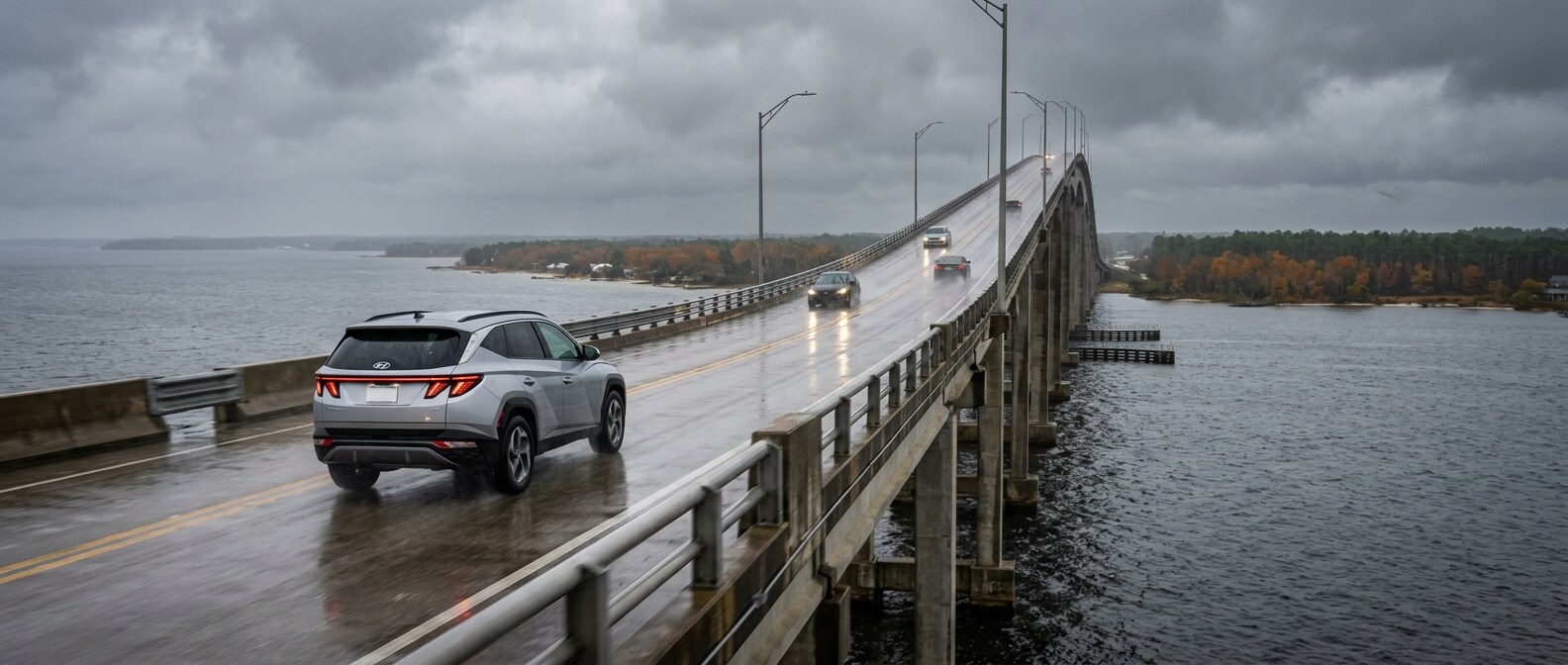
The Hathaway Bridge is 3,812 feet of open-deck, high-rise concrete spanning St. Andrews Bay on US 98. In November, Panama City averages around 3.5 inches of rain across roughly seven to eight wet days. Put those two facts together and you've got a crossing that asks a lot more from your tires than any surface street in town.
We built this plan around four checks. Run them the morning of a rainy-day drive, follow the route south, and you'll roll onto that deck on rubber that's actually gripping the road. We put this sequence together for Tucson Hybrid owners and everyone else in the Bay Hyundai lineup, though every step applies to any Hyundai heading toward US 98.
What's the Route?
The route runs Panama City to Panama City Beach via US 98 over the Hathaway Bridge, and on a dry day it's as plain as any drive in town, but rain changes what happens to your tire contact patch the moment the deck turns wet, a crosswind picks up at 65 feet above St. Andrews Bay, and you carry speed onto the grade. The four stops below address each part of that in order.
| Stop | Location | What to Do | What to Bring |
|---|---|---|---|
| 1 | Home driveway or parking lot | Tread depth + sidewall check | Penny, quarter, or tread gauge |
| 2 | Before you leave | Cold-tire pressure check | Tire gauge (or service station) |
| 3 | Hathaway Bridge approach on US 98 | Adjust speed, lights on, cruise off | Nothing extra |
| 4 | Panama City Beach side | 90-second post-crossing visual | 90 seconds |
The Four Stops in Detail
Stop 1: Tread Depth and Sidewall Check
Florida's legal tread minimum is 2/32 of an inch. Treat that as your legal floor, and understand it sits well below what a wet Hathaway Bridge crossing calls for. At 2/32, your tire's grooves carry almost no water away from the contact patch. You feel that immediately on an open-deck bridge in the rain.
Set your action point at 4/32. Grab a penny and place Lincoln's head pointing down into the deepest groove. If you can see the top of his head, you're at or below 2/32 and that tire needs attention now. For the 4/32 mark, use a quarter. If the top of Washington's head disappears into the groove, you still have usable wet-weather tread. Check all four tires, four spots on each, because tread wears unevenly across the width. On front-wheel-drive Hyundais like the Tucson, Kona, and Elantra, the outside shoulders of the front tires carry extra cornering load and wear faster than the center tread or the rear tires. A single center reading can mislead you.
Sidewalls matter on the Gulf Coast in ways they don't in drier climates. High humidity and persistent warmth accelerate rubber aging year-round. Run a quick visual on each sidewall for cracking, bulging, or anything that looks stressed near the bead or shoulder. If something looks wrong from two feet away, it's wrong. Our service team can confirm whether a sidewall concern is cosmetic or structural in a few minutes.
Stop 2: Cold-Tire Pressure Check
Do this before you drive anywhere. Heat from even a short drive temporarily raises pressure and can mask underinflation. Your Hyundai's door-jamb placard has the number for each axle. Match that number exactly.
Underinflated tires collapse the groove geometry. You lose water-channeling capacity on the bridge deck, and heat builds through the sidewall across the crossing. The Tucson lineup runs 235/65 R17 tires on SE trims, 235/60 R18 on SEL and XRT, and 235/55 R19 on upper trims. Each size has its own placard spec. One thing worth knowing is that Tucson Hybrid trims come with a Tire Mobility Kit in place of a traditional spare. That kit handles a minor puncture at a destination. It won't rescue a tire that fails mid-span. Running this check before you leave is exactly how you avoid finding that out the hard way.
Your Tucson already has TPMS with individual tire indicators in the gauge cluster. That system will alert you to significant underinflation (the amber TPMS light). It won't warn you about tread depth, and it won't flag a tire that's a few PSI below spec, because the sensor threshold sits higher than the pressure gap that changes wet-road behavior. The manual check still matters.
Stop 3: The Hathaway Bridge Approach on US 98
The bridge rises to 65 feet above St. Andrews Bay. That clearance keeps boat traffic moving underneath and puts the full deck in any wind coming off the Gulf or the Bay. On a dry day, nothing. On a wet day with a front moving through, you're crossing an unsheltered surface with no windbreak and no meaningful drainage slope beyond the design crown.
Headlights on before the approach. Turn cruise control off. Your Tucson's Smart Cruise Control is built for steady highway conditions. On a wet bridge with shifting wind, you want your foot on the pedal so you can modulate speed the moment something changes. These precautions come straight from the bridge's physical conditions.
Speed works against traction here in a direct way. The faster you're moving, the more water your grooves need to channel per second, and grooves can only do so much. When the inflow exceeds their capacity, the tire rides on a water wedge and your steering stops connecting to the road. Ease off before you reach the deck.
Schedule a Tire Check at Bay Hyundai
Stop 4: A 90-Second Visual Once You're Over
Pull off on the Panama City Beach side and walk around the vehicle. Check for anything that changed during the crossing. Look for a tire that sits lower than the others, vibration you noticed on the deck, or signs of sidewall contact with debris. Fall rain can move material onto the shoulder that you won't notice at speed. If everything looks right, you're done in 90 seconds. When you do spot something, you've already pulled into a safe spot, so you're not making that call at highway speed.
- [ ] Penny test: check all four tires, four spots each
- [ ] Quarter test for 4/32 confirmation on the front axle
- [ ] Visual sidewall check: cracking, bulging, bead area
- [ ] Cold tire pressure: match the door-jamb placard exactly
- [ ] Confirm Tire Mobility Kit is charged on Tucson Hybrid and upper Tucson trims
- [ ] Headlights on before the US 98 approach
- [ ] Cruise control off for the full bridge span
- [ ] 90-second post-crossing visual on the Panama City Beach side
Tweak It to Your Crew
If you're making this drive with a full load of passengers or gear, every check above still applies, and the stakes on each one simply run higher, because more weight means more load on each contact patch and longer stopping distances on a wet surface. If you're running a Palisade loaded for a weekend, note that the Palisade carries a standard spare rather than a mobility kit, which is one meaningful difference worth knowing before you need it.
For IONIQ 6 drivers making this crossing on a daily commute, regenerative braking changes the feel of a wet descent in ways that take a few crossings to internalize. The regen pedal comes on smooth rather than abrupt, but on a wet grade you want to be deliberate about which drive mode you've selected. Comfort or Eco mode keeps regen gentle and predictable, and that's the right call on the bridge deck in the rain.
If your Hyundai hasn't had a tire rotation in over a year, that's the single maintenance gap that affects every wet-road crossing most directly. Uneven tread depth across the four positions creates handling imbalance that dry pavement hides completely. The fix is a rotation and a fresh inspection. We keep the full Bay Hyundai lineup available for anyone at a point where new tires and an aging vehicle start pointing toward a different conversation.
By the Bay Hyundai Team | November 2026


