

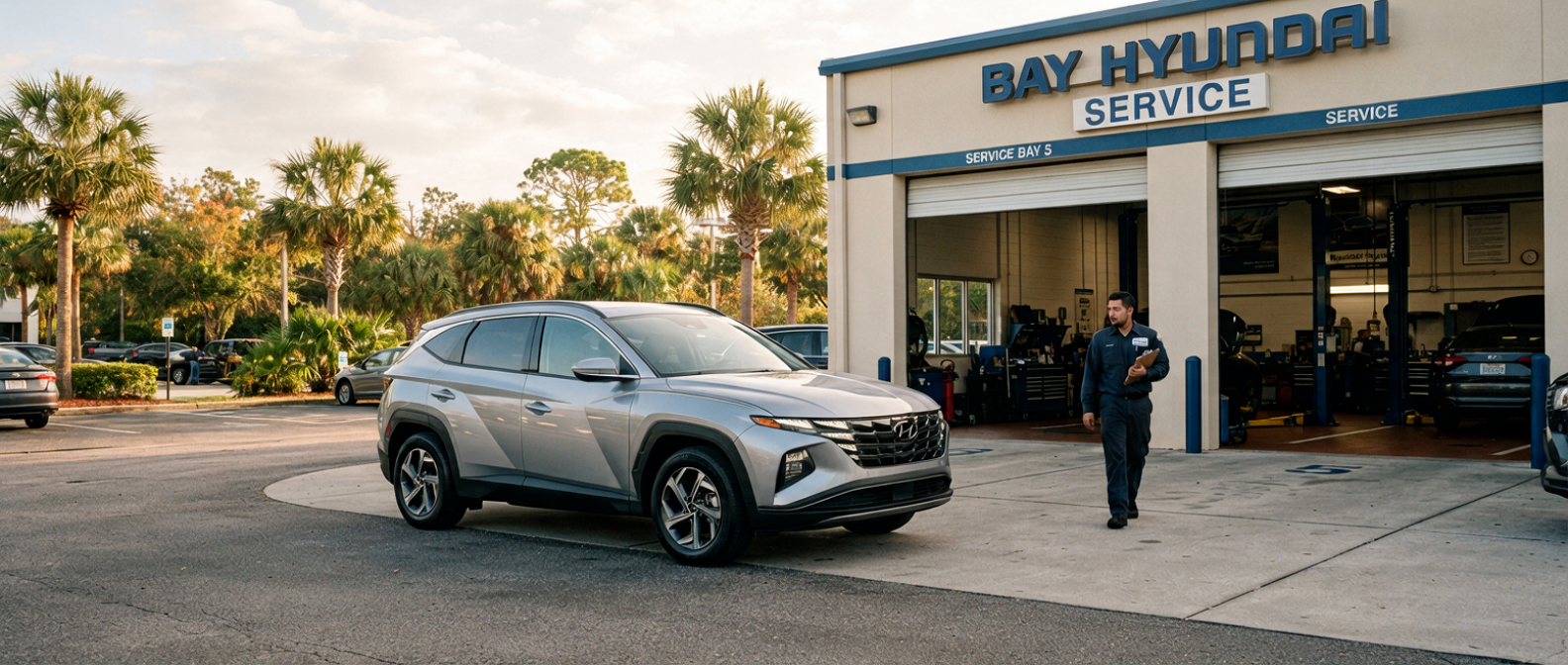
Thanksgiving 2026 falls on November 26, and the busiest driving day of that week is Wednesday, November 25. If you're heading north on US-231 toward I-10, or east on US-98 to see family across the Panhandle, your Hyundai needs to be ready now, before the morning you pack the cooler. A quick service visit this week covers every item below, and skipping even one of them on a Gulf Coast vehicle is a gamble we wouldn't take ourselves.
Schedule your pre-Thanksgiving service at Bay Hyundai
What Goes on the Checklist?
The checklist runs ten items, and they split into two groups that shape how you tackle each one, because some you can self-check in about five minutes in the driveway while the rest need a load tester or a lift that only the service bay has. Work through it in order.
- [ ] Battery load test (priority item, not optional)
- [ ] Tire pressure (cold check against door-jamb spec, not tire sidewall)
- [ ] Tire tread depth (penny test on all four corners)
- [ ] Engine oil level and condition (and confirm which interval applies to your driving)
- [ ] Cabin air filter (easy to overlook, genuinely matters in humid November air)
- [ ] Brake fluid level (a two-minute visual that's easy to skip)
- [ ] Wiper blades (the Panhandle gets surprise showers in November)
- [ ] All exterior lights (headlights, taillights, brake lights, turn signals)
- [ ] Spare tire inflated and jack in vehicle (confirm before you load luggage on top of it)
- [ ] Emergency kit (tire gauge, jumper cables or jump pack, phone charger, flashlight)
Those ten points are the spine of it. The next section explains why each one earns its spot and what, specifically, to look for on a Hyundai in November on the Gulf Coast.
Why These Items Matter for a Gulf Coast November Drive
Battery: the item that earns first place every time
Panama City's humid subtropical climate is hard on 12-volt batteries even in November, when the temperatures turn mild. Summer heat speeds up the evaporation of battery fluid, so a battery that survived the hot months can start showing real resistance once it's asked for longer highway runs in cooler air. Hyundai's maintenance schedule calls for a battery inspection at every service visit, with replacement expected between three and five years of age. A proper load test measures both resting voltage and cold-cranking amps against the battery's rated spec. Ask for the printed load test result, not just a verbal 'it tested fine.' A battery showing 70% or below of its rated cold-cranking amps is worth replacing before a long trip. A battery can pass today and still fail next week. No test removes that risk entirely.
Is the 12-volt battery in a hybrid the same as the high-voltage pack? No. If your Hyundai is a hybrid (Tucson Hybrid, Santa Fe Hybrid, Palisade Hybrid) or an EV (IONIQ 5 or IONIQ 6), that 12-volt auxiliary battery is a separate system that operates independently and needs its own load test. A certified Hyundai tech knows to check it, and that step doesn't always come up during a generic oil-change inspection elsewhere.
See Tucson Hybrid inventory at Bay Hyundai
Tires: pressure first, tread second
Check pressure cold, meaning before you've driven more than a mile that day, and read the number on your door jamb (the sidewall number is a maximum, so treat it as a ceiling). Tire pressure drops roughly one PSI per 10-degree Fahrenheit drop in temperature, and while November in Panama City stays mild, an early morning in Tallahassee or Montgomery after a Thanksgiving visit does not. The federal minimum tread depth for passenger tires is 2/32 of an inch, and at that point the tire has to be replaced. Driving below that threshold is illegal and cuts braking performance hard, especially in the wet.
The penny test is easy. Push a penny into the tread groove with Lincoln's head pointing down. If you can see the top of his head, the tread sits at or below 2/32 of an inch and the tire needs replacing. Do it on all four corners, the rears included, and confirm the spare's inflated and the jack's actually in the vehicle before you stack luggage over the wheel-well access panel. On Gulf Coast vehicles we see a specific wrinkle, uneven wear from under-inflation in humid stop-and-go driving, so the penny might pass on the outer edges and fail in the center groove. Check the middle, too.
Palisade inventory at Bay Hyundai
Engine oil: which interval actually applies to you?
The interval that applies comes down to how you actually drive, and Hyundai splits it two ways. Hyundai requires an oil change every 7,500 miles under normal conditions, but owners driving in severe conditions, such as frequent short trips, stop-and-go traffic, towing, or dusty environments, should use the 5,000-mile interval. Panama City daily driving, with its mix of short beach-town errands, Tourist Season traffic on US-98, and occasional longer Panhandle runs, often qualifies as severe service under Hyundai's own definition. If you're within 1,500 miles of your next interval, change it before you leave. And it's the best time to have our team run the full multi-point inspection while the car's already in the bay.
The cabin air filter pairs naturally with the oil change, and it's one of the two items easiest to overlook before a trip. Coastal humidity means filters collect salt air and mold spores faster here than in drier climates. A clogged cabin filter reduces airflow, makes the HVAC work harder, and fills the car with stale air on a five-hour drive.
| Checklist Item | Why It Matters for a Gulf Coast Drive |
|---|---|
| Battery load test | Heat-stressed batteries from summer can fail on longer November highway runs |
| Tire pressure (cold, door-jamb spec) | Pressure drops with temperature changes on overnight stops away from home |
| Tread depth (penny test, all four corners) | NHTSA's replacement point is 2/32 inch; Panhandle showers make wet traction real |
| Engine oil (confirm normal vs. severe interval) | Gulf Coast stop-and-go often qualifies for the 5,000-mile severe-service schedule |
| Cabin air filter | Coastal humidity loads filters faster; a dirty one makes the HVAC work harder |
| Brake fluid level and moisture | Moisture content rises over 24-30 months; affects pedal feel on downhill grades |
| Wiper blades | November Panhandle showers come fast and without much warning |
| Exterior lights (all) | A burned-out taillight is a citation risk on crowded holiday highways |
| Spare tire and jack | Confirm inflation and access before luggage covers the wheel well |
Book a Pre-Thanksgiving Service Check
Your Print-and-Go Recap Before the Drive
If you want one page stuck to the refrigerator door this week, here it is, a tight version of everything above that you can run through the morning before you pack without digging the owner's manual back out of the glovebox. Run through it before you load up.
- [ ] Battery load test completed (especially if 3+ years old)
- [ ] Tire pressure confirmed cold, all four tires, against door-jamb spec
- [ ] Tread depth: penny test on all four corners (replace if you see Lincoln's head)
- [ ] Oil level confirmed; oil change done if within 1,500 miles of interval
- [ ] Cabin air filter checked
- [ ] Brake fluid level visual check
- [ ] Wiper blades clear and streak-free
- [ ] All exterior lights working (walk around the car with a helper)
- [ ] Spare tire inflated; jack and lug wrench in vehicle
- [ ] Emergency kit in trunk (gauge, jump cables or jump pack, phone charger, flashlight)
US-231 is the main highway joining Panama City with points north and the I-10 corridor in Northwest Florida. It's your on-ramp to Thanksgiving, and it runs two-lane and rural for most of the stretch beyond Youngstown. We point that out for a practical reason. A roadside stop on US-231 at 4 PM on the Wednesday before Thanksgiving is a genuinely long wait, and a one-hour visit here before you leave is a much better trade.
Santa Fe inventory at Bay Hyundai
Frequently Asked Questions
Does my Hyundai really need an oil change before Thanksgiving if the reminder hasn't come on yet?
Not necessarily, though it depends on two things: how close you are to your next interval and whether your driving pattern qualifies as severe. If you're within 1,500 miles of the interval and about to put highway miles on the car, changing it now is the cleaner call. Hyundai's severe-service schedule sets an oil change every 5,000 miles when your daily driving involves frequent short trips or sustained stop-and-go traffic, which describes a lot of Panama City commuting. The in-dash reminder is calibrated to your driving data, and it doesn't always catch the crossover point right before a longer trip. Ask our service team and they'll tell you exactly where you stand.
How do I know if my Hyundai's battery is about to fail?
The honest answer is that a failing battery often gives no obvious warning until the day it doesn't start. The load test earns its keep here because it measures how much of the battery's rated cold-cranking-amp capacity is still there, and it does more than just confirm the car starts today in warm weather. If the battery's three years old or older, or if you've noticed slower cranking on cold mornings, bring it in before the trip. We run the load test at the service lane and hand you the printed result. You leave with an actual number.


