

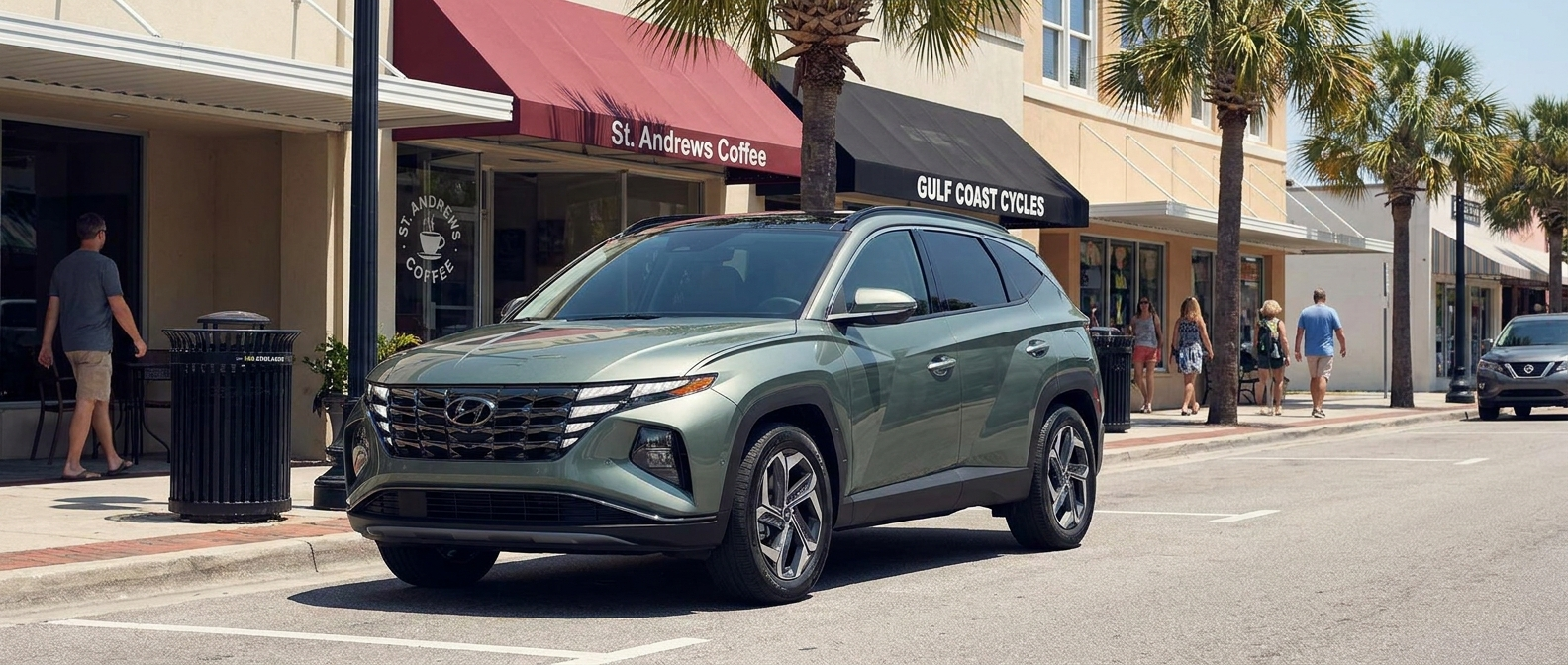
Panama City drivers do a specific kind of commuting, and the 2026 Tucson Hybrid fits it well. Not because of marketing language about "seamless efficiency," but because the stop-and-go rhythm of 23rd Street, the traffic lights at Harrison Avenue, the hospital corridor, and the mid-morning slowdowns near the mall approaches are exactly the pattern where its hybrid system earns back the most fuel. We're not guessing. Regenerative braking just works that way. Every time you lift off the throttle or press the brake pedal, the electric motor reverses direction and converts that kinetic energy into electricity, storing it in the 1.49 kWh lithium-ion battery under the rear seats. On a flat coastal road full of red lights, you do a lot of that.
The tradeoff is real. If your commute is mostly open highway at 70-plus mph, the hybrid advantage narrows. We'll get into that below.
How Far Will the Tucson Hybrid Really Go on a Panama City Commute?
The EPA rates the 2026 Tucson Hybrid Blue SE at 38 mpg combined (38 city, 38 highway), and the rest of the lineup sits just behind, so what you'll see on your route depends on the trim and the road more than anything else. Every other trim (SEL, SEL Convenience, Limited) comes in at 36 to 37 mpg combined with AWD standard across the board.
With a 13.7-gallon tank, the Blue SE's EPA-estimated range works out to around 521 miles per fill-up. Worth knowing, not because you'll drive 500 miles in a week, but because it means fewer stops at the pump each month.
What matters more for a Panama City commuter is where in that range you'll land on your own route. The breakdown looks like this.
| Driving Scenario | EPA/Estimated MPG | Notes |
|---|---|---|
| 23rd Street stop-and-go (city) | 38 mpg (EPA city, Blue SE) | Regen braking works hardest here; flat terrain helps |
| Mixed city/highway (typical commute) | 36-38 mpg | Most Panama City daily drivers will land in this band |
| Sustained highway (70+ mph, longer Gulf runs) | 34-36 mpg | Hybrid advantage narrows at higher steady speeds |
| Full-tank estimated range (Blue SE, 38 mpg) | ~521 miles (EPA-estimated) | 13.7-gal tank; varies by driving mix |
| Full-tank estimated range (SEL/Limited, 36 mpg) | ~493 miles (EPA-estimated) | AWD standard on all hybrid trims |
The warm, flat climate of the Florida Panhandle actually works in your favor here. Cold weather is the enemy of small lithium-ion batteries. It reduces capacity and forces the gas engine to run more often for cabin heat. Panama City's subtropical climate means those cold-weather penalties don't apply the same way they do for hybrid owners in northern states.
Browse our current Tucson Hybrid inventory
Where Do You Charge a Tucson Hybrid Locally?
You never plug in a Tucson Hybrid, and that self-charging setup is one of the things our team genuinely appreciates about this vehicle for the Panama City market, since the local grid of lights and slowdowns keeps the battery topped without any effort from you.
A self-charging hybrid runs on its own loop. The 1.49 kWh battery charges continuously through regenerative braking and the gas engine. No cord, no Level 2 charger, no planning around charging infrastructure. The 23rd Street corridor and the rest of Panama City's stop-and-go grid are literally doing the charging work for you every time you slow for a light.
Explore financing options for the Tucson Hybrid
If you want to add plug-in range, Hyundai does offer the Tucson Plug-In Hybrid (PHEV) as a separate model. The PHEV adds a 13.8 kWh battery for up to 32 miles of EPA-estimated electric-only range, and rates at 77 MPGe combined. The PHEV is a different vehicle with a different calculus, and whether you can reliably charge at home is what decides if it makes sense. For drivers who don't want to think about plugs at all, the standard Tucson Hybrid handles itself.
Plan It This Way: Making the Tucson Hybrid Work for Your Route
The Tucson Hybrid gives you four adjustable regenerative braking levels through the steering-wheel-mounted paddle shifters, and for the stop-and-go rhythm of a Panama City commute you'll lean on the stronger settings, then ease off once you reach open road and the payback changes. In everyday driving on 23rd Street, Level 3 or Level 4 regen will maximize energy recovery. You'll feel the car slow meaningfully when you lift off the throttle, which cuts how often you even touch the physical brake. Some drivers take a few days to get comfortable with it. Most stick with it once the fuel gauge confirms it's working, no convincing needed.
the Santa Fe Hybrid deserves a mention here, because space is the one place the Tucson can run short. If your household regularly hauls seven people or carries more cargo, the Santa Fe Hybrid's larger platform makes more sense. The Tucson Hybrid's 38.7 cubic feet of cargo space and five-passenger seating suit most everyday Panama City commuting and family needs just fine, though it's a real trade-off if you often need more room.
For drivers stationed at or near Tyndall Air Force Base who commute into Panama City via the 23rd Street corridor, the charging-free hybrid setup removes a logistical variable entirely. No planning around base charging infrastructure. Fuel up when the tank drops, and at 36 to 38 mpg that happens less often than you might expect.
See Current Tucson Hybrid Offers
A few things to check before you decide. Confirm which trim fits your daily needs (the Blue SE's 38 mpg combined versus the SEL or Limited at 36-37 mpg is real, driven by the smaller 17-inch wheels on the base trim), and weigh whether the Tucson Hybrid's 2,000-lb towing capacity covers anything you need to pull on weekends. If it does, you're set. If you regularly tow heavier, bring that conversation to our team before you commit.
Frequently Asked Questions
Does the 2026 Tucson Hybrid need to be plugged in to charge?
No. The Tucson Hybrid (HEV) is a self-charging hybrid. Its 1.49 kWh lithium-ion battery charges automatically through regenerative braking and the gas engine during normal driving. You never need to find a charging station or plug it in at home. If you want plug-in capability and all-electric range, that's the separate Tucson Plug-In Hybrid (PHEV), which adds a 13.8 kWh battery and EPA-estimated 32 miles of electric-only range.
Will the Tucson Hybrid actually get 38 mpg around Panama City?
The EPA rates the 2026 Tucson Hybrid Blue SE at 38 mpg combined. In real-world stop-and-go driving on flat, light-dense urban streets. Like the 23rd Street corridor. Drivers frequently report efficiency at or above the EPA city figure, because regenerative braking recovers more energy per mile in that pattern. On sustained highway driving above 70 mph, expect 34-36 mpg instead. Panama City's flat terrain and subtropical climate (no cold-weather battery penalties) keep real-world efficiency closer to the EPA estimate than drivers in colder regions typically see.
How does Florida heat affect the Tucson Hybrid's battery?
The Tucson Hybrid's 1.49 kWh lithium-ion polymer battery is a small, purpose-built pack designed to cycle continuously through regenerative braking rather than hold a large charge. Unlike large EV or PHEV battery packs, its primary job is fast, frequent charge-and-discharge during daily driving rather than storing miles of range. Florida heat does put some demand on the battery cooling system, and heavy A/C use does pull on the overall electrical load. The more significant efficiency factor for Gulf Coast drivers is sustained A/C compressor use, which modestly reduces combined mpg versus the EPA test cycle, not battery degradation, which is a longer-term question addressed under Hyundai's hybrid battery warranty coverage.


