


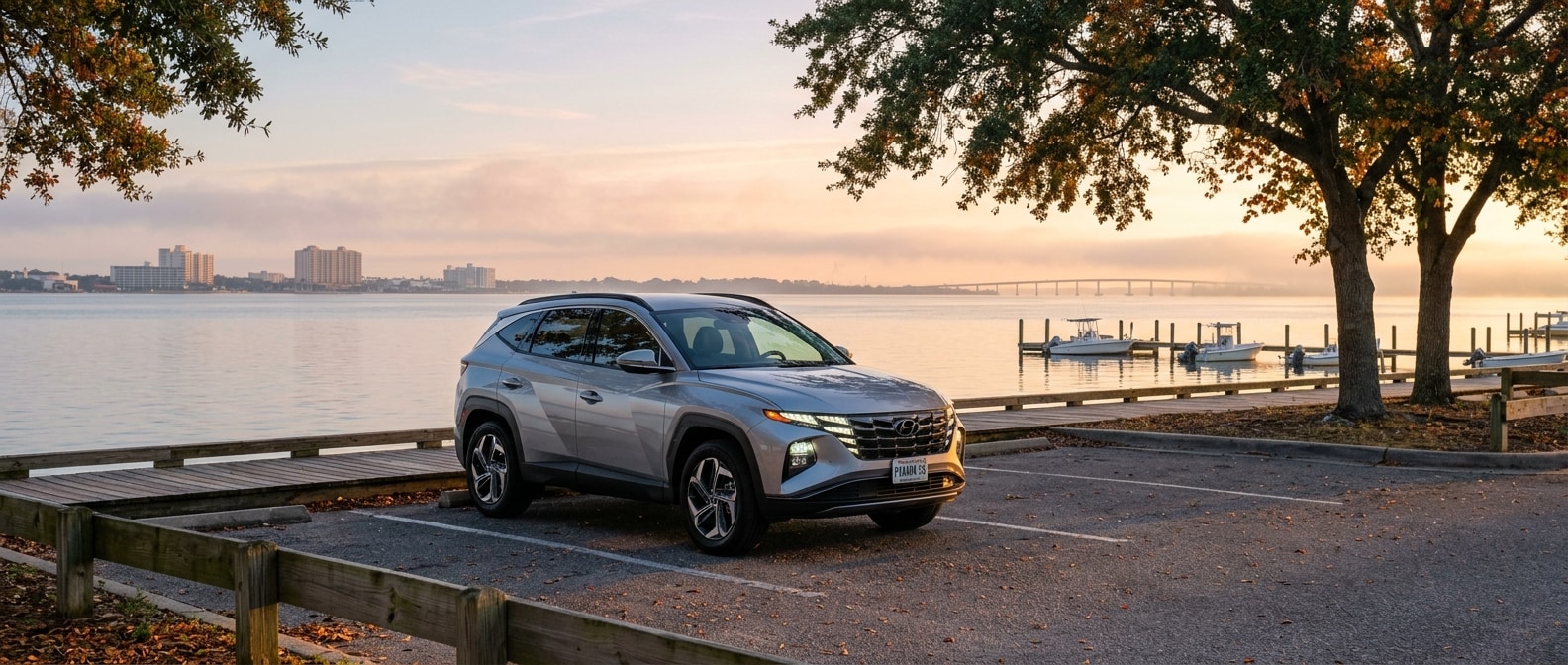
October in Panama City doesn't announce itself with a dramatic color change or a frost warning. It arrives as a morning low of 61 degrees Fahrenheit on a Thursday, after months of starting every day already sweating. You step outside and it actually feels good. That first cool breath is also when you start noticing whether your SUV was built for this kind of driving or only for surviving summer.
The 2026 Hyundai Tucson fits this specific window well. In short, it's a compact SUV with a standard safety suite, a dual-zone climate system on the SEL and above, and a Hybrid variant that does some of its best efficiency work right at these mild fall temperatures. You won't mistake it for a large three-row hauler, and it won't replace a truck for anyone pulling a serious load. For the Gulf Coast commuter, the military family juggling carpool and base errands, or the couple who wants room for weekend gear without paying for more SUV than they use, it lands in exactly the right spot this time of year.
Browse the 2026 Tucson at Bay Hyundai
The 2026 Tucson Hybrid earns an EPA-estimated 38 MPG combined on the Blue SE trim, and mild fall temperatures are the sweet spot where hybrid efficiency actually performs closest to that rating.
Why Does the Tucson Fit Bay County's Fall Driving So Well?
The Tucson fits Bay County's fall because October here reads as transitional, with morning lows averaging around 61 to 66 degrees Fahrenheit, afternoons still climbing to 80 degrees Fahrenheit, and one or two brief cold fronts before the month ends. That daily swing shapes what you want from a vehicle more than people realize.
| Bay County October condition | Tucson feature that handles it | Why it matters here |
|---|---|---|
| Morning lows 61-66 degrees Fahrenheit, afternoon highs around 80 degrees Fahrenheit | Dual-zone automatic climate control (SEL and above) | Driver and passenger can set independent temps as the cab warms through the day |
| Thick morning coastal humidity | Standard front-defrost and rear window defroster | Clears that grey film fast, even before A/C is really needed |
| Occasional afternoon thunderstorms (3-8 rain days in October) | Forward Collision-Avoidance Assist with pedestrian and cyclist detection, standard on every trim | The system monitors and can apply braking in reduced-visibility conditions |
| Start-stop traffic on US-231 and 15th Street | Smart Cruise Control with Stop and Go, standard | Holds following distance and can bring the car to a complete stop, less fatigue on stop-and-go corridors |
| Mild temperatures (ideal hybrid range) | Tucson Hybrid powertrain, EPA 38 MPG combined (Blue SE) | Lithium-ion battery efficiency is best in moderate temps; cold weather reduces it, but Bay County's fall barely qualifies as cool |
| Occasional weekend trail or beach access road | XRT trim with Terrain Mode (Mud, Sand, Snow settings) | Sand mode is genuinely useful on Gulf Coast beach approach roads |
Every feature listed here is standard equipment or available on a named 2026 Tucson trim, and we've verified each one against Hyundai's published specifications. None of it is speculation.
The Hybrid's Sweet Spot Is This Weather, Exactly
The Tucson Hybrid's sweet spot really is this weather, because hybrid efficiency isn't uniform across temperatures the way general reviews imply, and Bay County's mild fall lands close to the conditions where the Blue SE's EPA estimate of 38 MPG combined shows up in real driving. Battery performance on lithium-ion systems drops in sustained cold (think December in Indiana, not October in Bay County), and excessive heat pushes the combustion engine to work harder. You won't see either extreme here in October.
The EPA rates the 2026 Tucson Hybrid Blue SE at 38 city / 38 highway / 38 combined. The SEL and higher hybrid trims come in at 36 city / 37 highway / 36 combined. That parity is unusual. It happens because the Tucson Hybrid's regenerative braking recovers energy during the deceleration that highway driving also produces, not just in stop-and-go. On a commute that mixes US-98 highway miles with surface-street stops, that balance works in your favor.
We should flag one tradeoff here. The Tucson Hybrid carries a lighter tow rating than the gas model. The 2026 gas Tucson is rated to tow up to 2,750 pounds. If you're pulling a small boat trailer or a jet ski rig out of Callaway or Lynn Haven regularly, the gas model is the version to look at. The hybrid is tuned for efficiency first.
A team note on fall comfort features: heated seats sound like overkill in Florida, and in the Gulf Coast market they're easy to write off in October. The SEL trim brings heated front seats standard. After five months in the heat, a 61-degree-Fahrenheit morning feels genuinely cool in the cabin, and the seats warm up well before the engine does. A small thing, but it registers every morning.
See current Tucson inventory at Bay Hyundai
What the Standard Safety Package Means for October Driving
Every 2026 Tucson trim comes with Hyundai SmartSense standard, so the driver-assist package other compact SUVs reserve for higher trims is baseline across the whole lineup, right down to the base SE, and it carries real weight on Bay County's wetter October roads. The suite includes Forward Collision-Avoidance Assist with pedestrian, cyclist, and junction turning detection; Blind-Spot Collision Warning; Lane Keeping Assist and Lane Following Assist; Smart Cruise Control with Stop and Go; Rear Cross-Traffic Collision-Avoidance Assist; Driver Attention Warning; and Safe Exit Warning.
October brings more rain than September in Bay County (roughly 3.6 inches on average across about 7 rain days). Those wet-road afternoons are when Forward Collision-Avoidance Assist and Rear Cross-Traffic Collision-Avoidance Assist earn their keep. Backing out of a crowded lot with poor sightlines during an afternoon shower is exactly what Rear Cross-Traffic assist was built for, and it's the kind of moment you don't plan for.
A few things worth knowing about SmartSense trim-by-trim:
- Forward Collision-Avoidance Assist, Blind-Spot Collision Warning, Lane Keeping Assist, and Rear Cross-Traffic Collision-Avoidance Assist are standard on every trim, including the base SE
- Highway Driving Assist (adds steering support on the highway, not just speed-holding) is available at the SEL Premium level
- Blind-Spot View Monitor (shows a live camera feed of the adjacent lane in the instrument cluster when you signal) is available on the Limited
- The Tucson Limited adds a heated steering wheel, ventilated front seats, and heated rear seats
The Size Makes Sense for This Market
The Tucson's size makes sense for this market because it slots between the smaller Hyundai Kona and the larger Santa Fe, giving you 38.7 cubic feet of cargo space behind the rear seats for beach chairs, a cooler, and gear bags, without the bulk you'd fight in beach-town parking. Fold the seats and that opens to 74.8 cubic feet. It maneuvers easily in tight beach-town parking, in the grid of downtown Panama City, and in base housing lots that weren't designed with large three-row SUVs in mind.
Pull all of that together and you get the practical reason the Tucson fits Bay County in October. It's sized right for daily use here, it stays comfortable at the transitional temperatures fall actually brings, and the safety suite ships standard rather than as an upgrade you negotiate for.
Categories:
Social


