

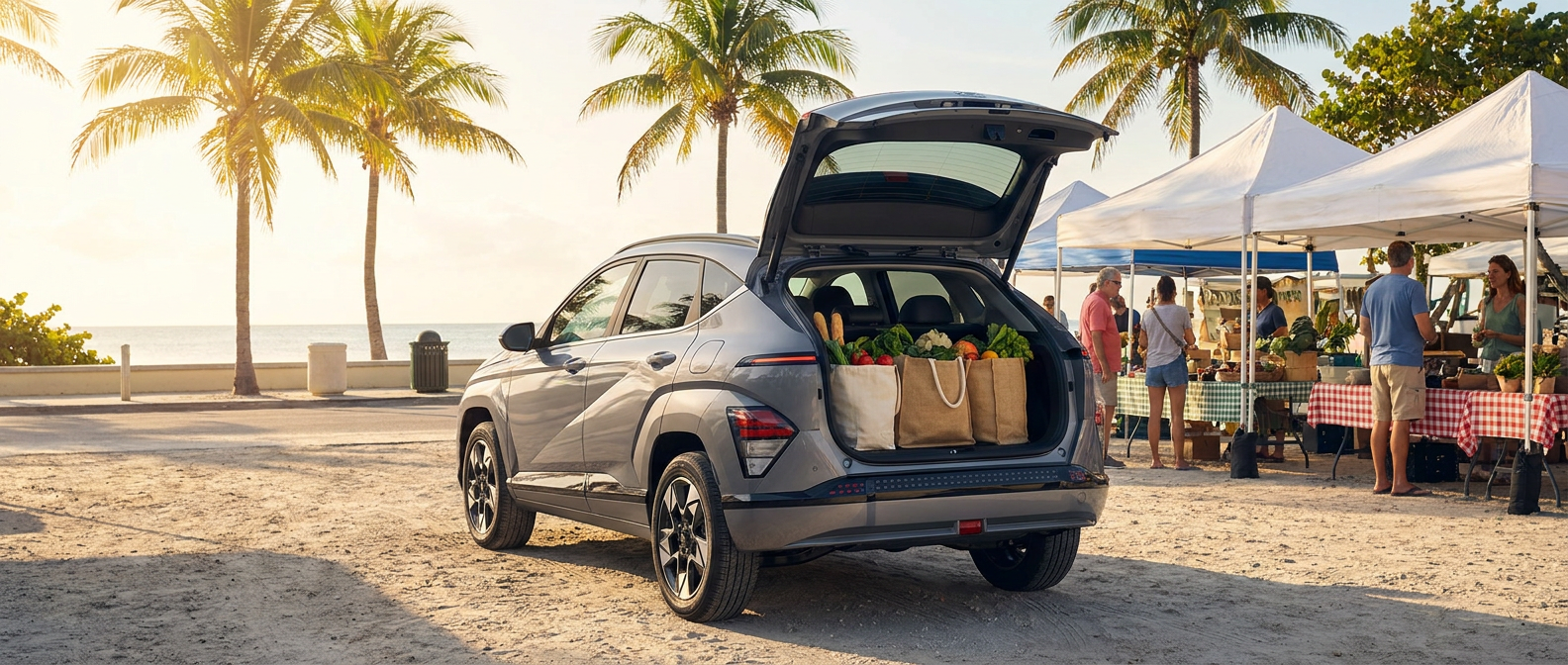
October is quietly one of the best months to run the Kona Electric around Panama City. The tourists have largely cleared out, the AC runs maybe 20 minutes total instead of all day, and stop-and-go city driving feeds charge back into the battery through regenerative braking. You'll notice the difference the first errand day you run.
Browse available Kona Electric models at Bay Hyundai to see what's in stock right now, then run through this checklist before your next errand day.
What Goes on the Checklist?
The checklist covers five areas for a multi-stop errand day this fall, and while it isn't complicated, each item earns its spot. We built it around charge state, cabin pre-conditioning, regen settings, cargo, and your charging backup plan.
| Item | Why It Matters for Local Errand Days |
|---|---|
| Charge to 80% the night before | Lithium-ion batteries prefer not sitting at 100% for extended periods; 80% gives you well over 200 miles (SEL/Limited trim) for any realistic Panama City errand loop |
| Confirm regen braking is set to a higher paddle level | Stop-and-go on 23rd Street and Harrison Avenue recaptures meaningful energy; the Kona's paddle shifters let you dial in one-pedal driving |
| Pre-condition the cabin at home | Cooling the interior while still plugged in costs you nothing from the battery; do it before you unplug |
| Pack reusable bags in the 25.5-cubic-foot cargo area | The Kona's flat load floor makes grocery runs genuinely practical; check that nothing loose is blocking rear visibility |
| Locate your nearest Level 2 backup charger | A topped-up Kona needs this rarely, but knowing one location gives you a real fallback |
| Check tire pressure | Underinflation increases rolling resistance and reduces efficiency; Hyundai specifies the correct pressure on the driver's door jamb |
| Review your errand route order | Clustering stops geographically cuts total miles; plan farthest stop first while the battery is fullest |
Why These Items Are Worth Understanding
Charge management asks much less of you in October than it did in July, and the reason sits in the weather and the way you drive, not in the car itself. You'll see why each item earns its place once you look at the mechanism behind it.
The charge-to-80 rule is a real pattern, not fussiness. The EPA rates the 2025 Kona Electric SEL and Limited at 261 miles of range on a full charge (the SE Standard Range sits at 200 miles EPA-estimated). Eighty percent of 261 miles is over 200 miles. A typical Panama City errand loop (Trader Joe's, Target, the post office, the pharmacy, dry cleaner) rarely runs more than 25 to 35 miles. The margin is enormous. Charging only to 80% preserves long-term battery health without costing you anything you'll notice on local errands.
The AC penalty drops sharply in October. Climate load is the single biggest reason fall errand days feel different. When Panama City sits at 95 degrees in July, the Kona's climate system works hard and pulls real energy from the battery. October afternoon highs check your Kona's seasonal service needs here run from the mid-70s to around 80 degrees Fahrenheit. Climate load drops significantly, and the EPA efficiency figures (the 2025 Kona Electric SEL earns 129 MPGe city from the EPA) are derived under conditions much closer to what you're actually driving in right now. Summer was the outlier. October is closer to the EPA's test environment.
Regenerative braking is doing real work on Panama City errands. The Kona Electric uses paddle-shifted regenerative braking levels. On surface streets with traffic lights (think the stretch along 23rd Street or the Harrison Avenue corridor), every deceleration recaptures kinetic energy as electricity, and you'll feel the car doing it. A compact city EV genuinely outperforms its highway numbers here. The EPA's city MPGe for the 2025 SEL is 129, which is higher than the 103-highway figure precisely because of this effect.
Cargo space is underrated on this vehicle. The Kona Electric offers 25.5 cubic feet of cargo space with the rear seats up. That's enough room for a full Costco run or a farmers market sweep, and you won't need to get creative with the packing. The flat load floor helps.
Tire pressure is a real efficiency lever. The EPA tests EVs at the manufacturer-specified tire pressure. Underinflation increases rolling resistance, which reduces range in a measurable way. It's the simplest item on this list and the one most likely to be overlooked.
See Current Kona Electric Offers
Planning the Errand Route: A Print-and-Go Recap
Route planning sits last on the checklist, and though it reads like an afterthought, it may be the single biggest efficiency lever you've got on a fall errand day around Panama City. Your Kona Electric runs most efficiently in the first half of any drive, while the battery is fuller and the thermal management system is at its most settled state. Put your farthest stop first. Cluster your stops on one side of town before crossing to the other side. See all available Kona Electric inventory near the end of a loop rather than adding an out-and-back detour.
For Panama City specifically, the post-tourist clearing on US-98 between Panama City and Panama City Beach means October lets you cover that corridor at real road speed instead of crawling, which you couldn't do in July. Sustained moderate-speed driving (not stop-and-go, not highway sprint) is where the Kona Electric performs at its most efficient, and that corridor delivers it.
The honest tradeoff is simple enough. If you have a genuinely unusual day (two hours of highway driving plus a full errand loop), you'll want to start with a fuller charge and maybe plan a brief top-up stop. The 2025 Kona Electric SE's 200-mile EPA range is comfortable for local errands, less so for a combined highway day-trip and errand run. The SEL or Limited trim's 261-mile range starts to earn its keep then. Know which trim you have and plan around it.
If your driving needs have grown, the IONIQ 5 is worth a look for longer range and ultra-fast charging capability.
Frequently Asked Questions
Does the Kona Electric lose significant range running errands in Panama City in October?
Short errand loops in Panama City (20 to 40 miles round trip) barely register on the 2025 Kona Electric's EPA-estimated range of 200 miles for the SE or 261 miles for the SEL and Limited. October's mild temperatures (average highs around 80 degrees Fahrenheit) also mean the climate system works much less hard than during summer months, keeping real-world efficiency close to the EPA ratings. Plan your charge level and route as the checklist describes, and range anxiety shouldn't enter the picture for typical local errands.
How often do I actually need to charge for a normal Panama City errand day?
For most Panama City errand loops (grocery runs, pharmacy, school pickup, farmers market), you'll use somewhere between 10 and 30 miles of range. The 2025 Kona Electric SEL and Limited offer 261 miles of EPA-estimated range. If you plug in at home overnight and start at 80%, you have well over 200 miles available. For a typical day of local stops, you won't need a public charge at all. The checklist recommends knowing your nearest Level 2 backup location simply as a contingency, not because you'll routinely need it.


