

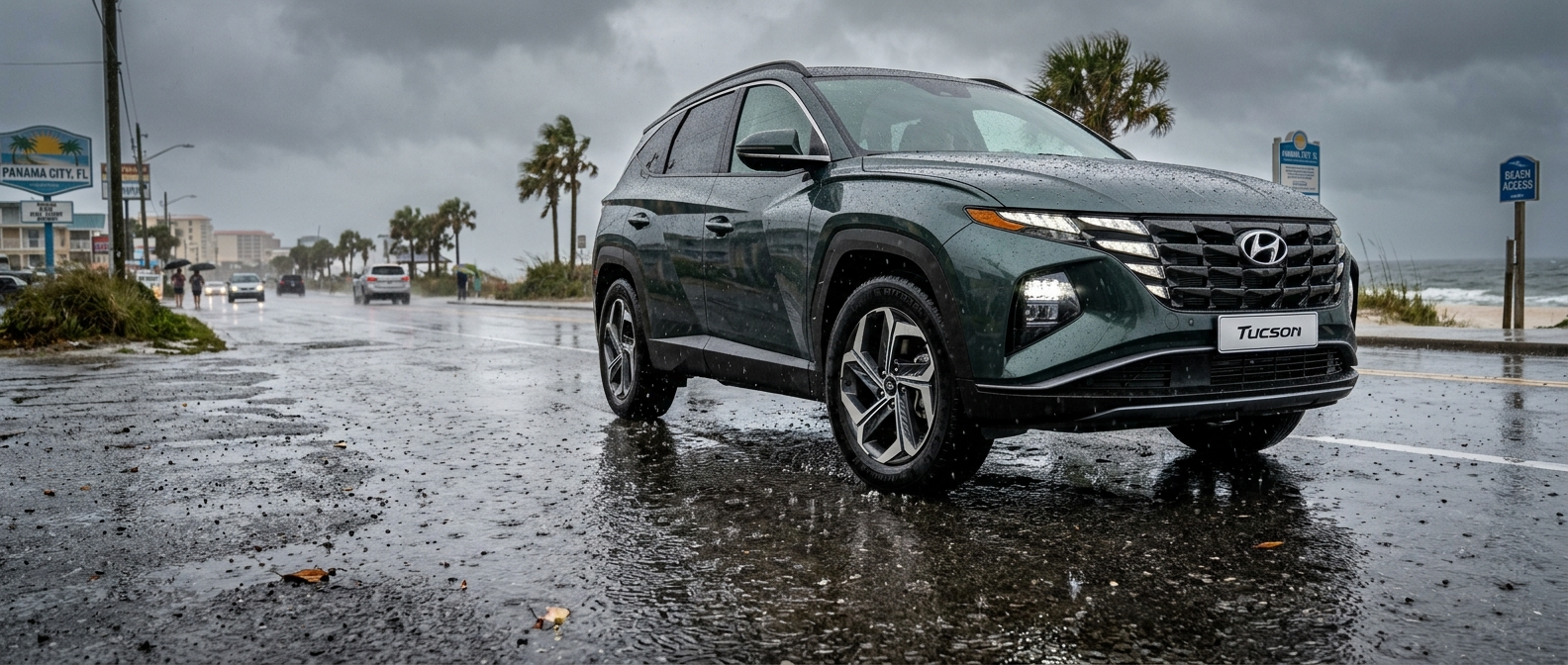
October feels like the exhale after summer. The temperatures ease off, and those daily thunderstorms finally let up. It's an easy month to forget your tires exist, and that's exactly when we start paying closer attention to them.
The Atlantic hurricane season runs June 1 through November 30. As of today you've still got five weeks of official season left, and Panama City averages 60 inches of rain per year against a U.S. average of 38 inches. Rain season in Bay County doesn't close out with summer. It runs year-round, and October adds a wrinkle summer doesn't have. The temperatures are finally dropping, and that quietly bleeds pressure out of your tires while you're focused on other things.
Which brings us to the point. Your Hyundai almost certainly needs a tread check, a pressure reset, and possibly a rotation right now, before the back half of rain season catches you with worn rubber and soft tires on a standing-water road.
Book that check at Bay Hyundai
Will Your Tires Actually Hold Up on a Wet Bay County Road?
The answer comes down to two numbers, your current tread depth and your current inflation, and the catch is that both drift over a season even when nothing feels different from the driver's seat. Plenty of us go months without checking either, which is exactly how a tire crosses the line while the ride still feels fine.
Measure your tires against this readiness table before November hits:
| What We Check | The Action Threshold | Why It Matters Here |
|---|---|---|
| Tread depth | 4/32" is your real action point, not 2/32" | Groove volume determines how fast water clears the contact patch |
| Tire pressure | Match the door-jamb placard exactly | Underinflation collapses the groove and reduces water-channeling capacity |
| Rotation interval | Every 7,500 miles (FWD/RWD); every 5,000 miles (AWD) | Uneven wear creates tread-depth mismatches that matter most on wet roads |
| Sidewall condition | No bulges, cuts, or sidewall cracking | Gulf Coast humidity and heat accelerate rubber degradation |
| Tread wear pattern | Even across the full width | Uneven wear signals an alignment or inflation issue before tires fail outright |
In the United States, the Department of Transportation sets a baseline minimum tire tread depth of 2/32 of an inch for most passenger vehicles. That number is the legal floor, not your safety number on a rainy US-98. Research keeps showing that wet-weather stopping performance degrades well before tires reach 2/32 of an inch, and AAA testing at 60 mph found that tires worn to 4/32 of an inch required an average of 87 additional feet to stop on a wet road compared to new tires.
Eighty-seven feet is roughly five car lengths. Picture that on a wet road, at highway speed, with a driver ahead of you braking hard. We're not comfortable with that margin.
NHTSA puts the starting tread on most passenger tires at about 10/32", with wet traction beginning to drop sharply once they wear to 4/32". On a dry Panama City day, you won't feel the difference between the two. Your Hyundai's ability to clear standing water from the contact patch is another story, and that difference is measurable. It shows up the first time you hit a puddle at speed.
The Tucson's AWD system has an extra reason to care about this number. On AWD Hyundai models, a tread depth difference greater than 2/32 inch between front and rear tires can stress the all-wheel-drive coupling, so staying on the rotation schedule protects those drivetrain components. Grip is only half of it. The other half is not wearing out a drivetrain component because the front tires ran six months past their rotation due date.
How to Load Up Your Service Visit Correctly
One appointment can cover everything on the readiness table above, from the pressure reset to the tread measurement to the rotation, as long as you come in with the right number in hand and we work through it in order. Skip a step and the visit still helps, though you'll lose some of the protection you came for.
If you're driving a Santa Fe or any other Hyundai, bring your door-jamb placard number with you (it's on the sticker along the driver's door frame edge). We set your pressure to that number. The figure stamped on the tire sidewall is the maximum the tire can hold, a different thing entirely, and mixing up the two is one of the more common pressure mistakes we see.
On the rotation front, the 2026 Hyundai Tucson needs tire rotations every 7,500 miles, which is critical for protecting AWD Tucson drivetrain components from uneven tread wear. The Elantra follows a similar 7,500-to-8,000-mile rotation schedule. If you've been driving through a full Bay County summer on the same tire positions, October is exactly when you should be rotating.
A proper October tire service appointment runs like this.
- Check cold pressure against the placard. Not the sidewall max. Not a general "35 PSI" estimate. The placard number for your specific Hyundai, which varies by model and trim.
- Measure tread depth at four points per tire. Depth varies across the width of the tire, especially on FWD models where the outside shoulder carries extra cornering load. One measurement per tire can miss a localized bald spot.
- Inspect sidewalls for cracking or bulging. Gulf Coast heat and humidity speed up rubber aging, and a sidewall that looks acceptable from five feet away can show stress fractures up close.
- Rotate per the factory pattern. FWD Hyundais typically use a forward-cross or X-pattern; AWD models use a different pattern. The wrong pattern can actually create the tread-depth mismatch you're trying to prevent.
- Check wheel alignment if wear is uneven. A tire wearing faster on one edge is an alignment symptom. Rotating a misaligned car just moves the problem to a fresh tire position.
Schedule Your Tire Check at Bay Hyundai
One More Thing October Does to Your Tires
October does something to your tires that summer never did, and it comes down to air behaving like air as the thermometer slides. Through the hot months, Panama City stays warm enough that tire pressure holds fairly steady, but as temperatures start to drop through October, NHTSA guidance puts the loss at roughly one PSI for every 10-degree Fahrenheit drop in temperature. A 20-degree swing between a hot afternoon and a cool morning (which Bay County starts seeing in October) can quietly pull two or three PSI out of your tires by the time you start your commute.
Your Hyundai's TPMS light is set to trigger at a significant underinflation threshold, so it won't warn you about a two-PSI drop. The system reads that as normal. But two to three PSI of underinflation on a tire that's already at 4/32" of tread depth compounds the water-channeling problem. The tread grooves help displace water to maintain road contact, and an underinflated tire flattens the contact patch in a way that keeps those grooves from doing that job as well.
The fix is simple. Check pressure when the tires are cold, reset to placard, and plan to do it again in December, when temperatures drop further. It takes about three minutes and costs you nothing but the time.
The Job Is Done Before the Season Ends
The Atlantic hurricane season runs from June 1 through November 30 each year, and Bay County has already seen what that range can deliver in 2026, so sorting your tires now means the job is finished before the hardest weather can test it. You've got a month and a half of active season ahead, and the roads stay wet well into fall even without named storms.
The checklist isn't complicated. Tread at 4/32" or better, pressure matched to the placard, rotation current for your model's interval, sidewalls clean. Those four items cover the real exposure, and everything else is details.
If your tires are at or past the replacement point, we can also talk about what's on the lot while you're in for service. Sometimes the service appointment is the moment you realize a new vehicle makes more sense than a new set of tires on a high-mileage car. We won't push that conversation, but we won't ignore it either.
We're on West 15th in Panama City at 641 W 15th St. Our service team is the right call when you want the tread depth measured correctly and the rotation done on the factory pattern, not just spun from front to back and called good.


