

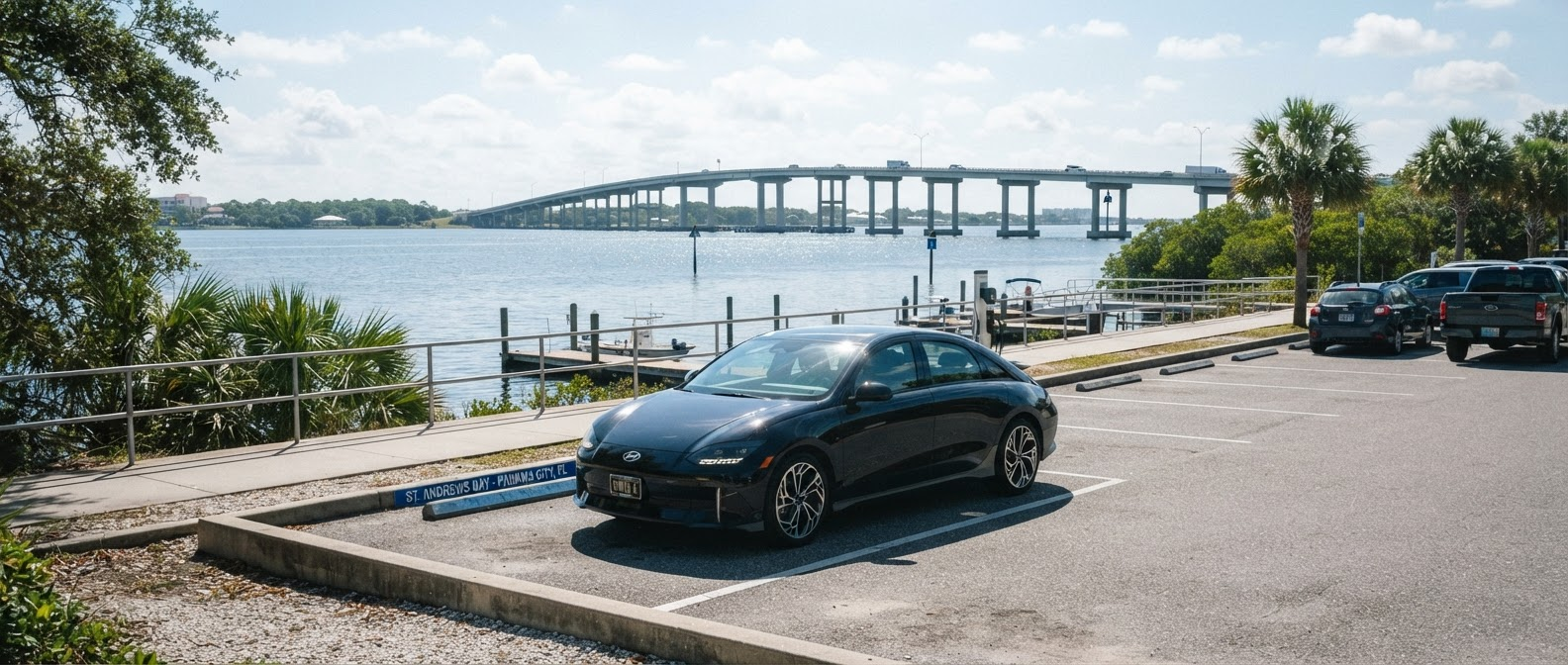
Live on the beach side and commute into Panama City for work every day? The 2025 Hyundai IONIQ 6 fits that run about as well as any car we'd steer you toward. The drive is short, the range dwarfs what you'll actually use, and you'll cover a week of round trips on a single home charge. One caveat belongs up front. The sedan itself was discontinued in the US for the 2026 model year, so the 2025 units on dealer lots are the last standard IONIQ 6 sedans available new. For the right buyer, that window matters.
Below you'll find the practical breakdown, including where to charge, how to think about parking downtown, and what to prep before your first commute week.
Browse our 2025 IONIQ 6 inventory at Bay Hyundai and see what's still on the lot.
When Should You Charge, and How Much Range Do You Actually Need?
Charging cadence matters far more than range on this commute, and the straight answer is that you'll plug in rarely at home while the battery coasts through the week, with tourist-season traffic on US 98 being the only thing that nudges exactly when you choose to top off. The road distance from Panama City Beach to Panama City along US 98 across the Hathaway Bridge is about 10 miles each way. The round trip runs roughly 20 miles. The EPA rates the 2025 IONIQ 6 SE Long Range RWD at up to 342 miles of estimated range on the 77.4 kWh battery. Even the Standard Range configuration carries an EPA-estimated 240 miles.
So the daily commute eats somewhere between 6 and 9 percent of your battery on the Long Range trim. You can drive Monday through Friday and you'll still roll home Friday evening with plenty of charge to spare, assuming you start each Monday at full.
The logistics question that matters is charging cadence, not range anxiety.
| Scenario | Charging approach | Where it happens | Practical note |
|---|---|---|---|
| Monday start, home charged | Plug in Sunday night, Level 2 (240V) | Your garage or carport | Hyundai lists ~7-8 hours for a full replenish on Level 2 |
| Standard Range on US 98 during tourist season | Top off mid-week if running under 100 miles remaining | Any DC fast charger station near US 98 | 10-80% in about 18 minutes on a 350 kW charger, per Hyundai |
| Road trip added on Friday | Charge Thursday night OR hit a fast charger during lunch break | Downtown Panama City or near US 98 corridor | The 800V architecture handles 350 kW fast chargers efficiently |
| Full-week worry-free | Home Level 2 nightly, treat it like a phone | Driveway | Most consistent approach for a 20-mile round trip |
The IONIQ 6 runs on Hyundai's 800V E-GMP platform. The same architecture allows a 10-to-80-percent DC fast charge in roughly 18 minutes on a compatible 350 kW charger. In practical terms, if you ever do need a mid-week top-up, it's a lunch-break errand, not a half-day one.
The US 98 Corridor and What the IONIQ 6 Does With It
Compare the IONIQ 5 if you want more cargo room, but for the solo or dual-commuter scenario, the IONIQ 6 sedan is the one to study.
US 98, known locally as Back Beach Road, is the primary east-west corridor through Panama City Beach, and FDOT counts more than 55,000 drivers on it daily. For most of the commute it's a stop-and-go slog that periodically makes you wish for a different reality. The Hathaway Bridge is the only road crossing over St. Andrews Bay, so there's no alternate when traffic backs up.
The IONIQ 6's efficiency architecture pays off here in a way that's easy to miss. The car is built around a 0.21 drag coefficient (Hyundai's published figure, among the most aerodynamic in this segment), and its regenerative braking recaptures energy on every deceleration. Stop-and-go on US 98 won't drain efficiency the way it does in a conventional car. A gas car burning fuel at idle turns a 20-minute bridge backup into wasted money. In the IONIQ 6, much of that kinetic energy flows back into the battery.
Turning diameter comes in at 38.8 feet. You're working with a sedan, not a crossover, so the tighter surface lots near downtown Panama City are easy to navigate. Parallel spots on Harrison Avenue or the municipal decks near the Bay County Courthouse area handle it without drama. You're not threading a Palisade into a skinny spot.
The IONIQ 9 is worth a look if your commute includes hauling family members or equipment. Different vehicle, different use case.
Your Pre-Week Commute Checklist
The Hyundai Sonata is the conventional sedan alternative if you're weighing options. But if you're going with the IONIQ 6, line these up before your first week of commuting:
- [ ] Confirm your home outlet situation. A standard 120V outlet works, just slowly. A 240V Level 2 setup makes the nightly routine effortless, with a licensed electrician installing the outlet and a compatible Level 2 charger handling the rest.
- [ ] Set your departure charge target. For a 20-mile round trip on the Long Range battery, leaving home at 80 percent is plenty. You don't need to chase 100 percent nightly on a DC fast charger.
- [ ] Identify one DC fast charger near your workplace. You probably won't use it weekly, but knowing where it sits removes the one variable that makes new EV owners anxious.
- [ ] Check the US 98 / Hathaway Bridge traffic pattern for your departure window. Leaving PCB before 7:30 a.m. or after 8:30 a.m. usually means a meaningfully different drive time, and you'll watch the Hathaway Bridge back up fast once the morning rush lands. The IONIQ 6 won't fix Bay County traffic. No car does.
- [ ] Enable preconditioning on cold mornings or hot Florida afternoons. The IONIQ 6 supports battery preconditioning. It matters more for DC fast charging efficiency than for cabin climate. Set it to start before departure so the cabin's comfortable and the battery sits at optimal temperature.
- [ ] Walk your planned downtown parking spots once before your first day. The IONIQ 6 is 191.1 inches long, Hyundai's listed dimension. Most standard spaces in the Panama City municipal lots run 18 to 20 feet, so it fits comfortably with room for a clean door swing.
- [ ] Note the regenerative braking paddle behavior. In heavy Hathaway Bridge traffic, the steering-wheel paddles let you set strong regen and often coast to a stop without touching the brake pedal. It takes a drive or two to get comfortable. Then it's automatic.
See Current IONIQ 6 Offers at Bay Hyundai
One limitation deserves naming directly. The 2025 IONIQ 6 is the last standard sedan in the US market for this nameplate. Hyundai confirmed the non-N version won't return for 2026. Supply is whatever remains in the pipeline now. If you've been watching this car and waiting, the wait has a genuine end point. None of that is a sales pitch. It's the actual market situation.
The IONIQ 6 N is coming in limited quantities and priced at a different level entirely. It's a different car for a different buyer. For the professional commuting the US 98 corridor daily, the 2025 standard IONIQ 6 is the practical choice, while it lasts.


