

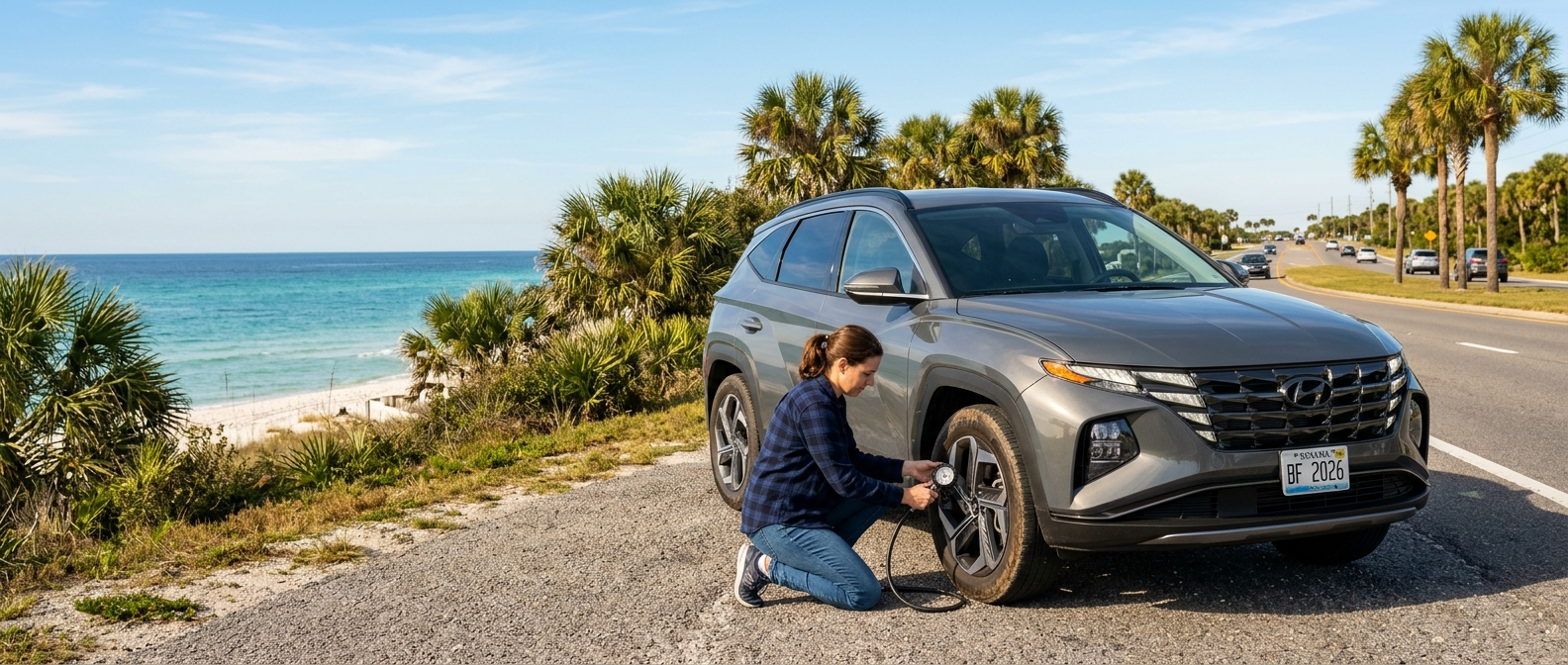
Fall is the best time of year to drive this stretch of the Panhandle. The summer crowds clear out, temperatures settle into the low-to-mid 70s, and US-98 east toward Tyndall and beyond turns genuinely pleasant. That same temperature shift, though, is exactly when your tires and brakes earn a quick look before you go.
October mornings in Panama City can drop 15 to 20 degrees cooler than August nights. Per the basic physics of tire inflation, that kind of drop costs you roughly 1 to 2 psi. On a Tucson or Palisade that's supposed to sit at 35 psi, a couple of pounds under spec doesn't feel dramatic until you're braking hard on wet pavement after an afternoon rain shower. It matters. So does knowing what your brakes are telling you when they squeal on the way out of a Pier Park parking garage.
This guide hands you the specific numbers for your Hyundai, the tread thresholds that matter, and what each brake sound means, so you can head out on US-98 with a clear head instead of a guessing game.
- Check tire pressure cold (before you drive): 35 psi for the 2026 Tucson, 35-36 psi for the 2026 Palisade, and 35-36 psi for the 2026 Santa Fe, always read the driver's door jamb placard for your specific trim.
- Florida law sets the minimum tread depth at 2/32 of an inch, but safety guidance recommends replacing tires at 4/32 of an inch on wet-road routes like US-98 where afternoon rain is routine in fall.
- New brake pads start at 10-12 mm; a squealing wear indicator means service is approaching; grinding means stop and call us.
- October temperature swings on the Gulf Coast can drop tire pressure by 1-2 psi versus your summer reading. Recheck now, not after the light comes on.
- Our service team can check both at once during a multi-point inspection before your next weekend run.
Schedule a pre-trip service check at Bay Hyundai
What Actually Matters When Choosing Your Pre-Trip Checks?
Tire pressure, tread depth, and brake pad condition are the three variables that shift over the life of your vehicle and feed into each other on the road, so checking one while you ignore the other two leaves you covered on paper and short in practice. Checking one and skipping the rest is like packing sunscreen and forgetting water. For Gulf Coast fall driving, they stack up like this.
| Check | What to Look For | Key Spec | Gulf Coast Tradeoff |
|---|---|---|---|
| Tire pressure (cold) | Psi matching door jamb placard | 35 psi (Tucson), 35-36 psi (Palisade/Santa Fe) | Fall temps drop 1 psi per 10 degrees F; check mornings, not after driving |
| Tread depth (wet grip) | Use penny (Lincoln's head = 2/32") or quarter (Washington's head = 4/32") | Florida legal minimum 2/32"; replace at 4/32" for wet roads | US-98 sees afternoon rain showers year-round; 2/32" is the legal floor, not the comfort zone |
| Brake pad thickness | Listen for squeal (warning indicator) or grind (metal-on-metal) | New pads: 10-12 mm; service threshold: 3-4 mm | Stop-and-go through Pier Park and beach connectors accelerates front pad wear faster than highway miles alone |
| Sidewall and DOT age | Look for cracking, bulges, date code | Replace tires 6+ years old regardless of tread | Gulf Coast UV and heat degrade rubber compounds, so age matters even when tread looks fine |
The Tread Depth Question Is More Interesting Than It Sounds
Florida law sets the minimum tread depth at 2/32 of an inch, measured in the major grooves of the tire, and that same point is where the built-in wear bars on your tires sit flush with the surface, which is the signal the tire is spent. A penny tells you when you're there. Insert it into a groove with Lincoln's head pointing down, and if you can see all of his head, you're at or below the legal limit.
Hyundai Tucson drivers have an easy habit to build. Flip to a quarter instead of a penny. A quarter gets you to 4/32 of an inch, and at that mark Washington's head is just disappearing. That's the practical replacement point for wet-road driving, above the legal minimum. The reason it matters is plain enough. Wet stopping distance climbs measurably as tread wears from 4/32 down toward the 2/32 mark, because the grooves that channel water away from the contact patch get shallower. On a road that catches afternoon rain showers in October, that difference shows up in real braking distance, not just in test data.
The tradeoff is worth naming. A tire at 3/32 of an inch is legal and will pass a visual check. But run US-98 at highway speed and let it rain (it will), and you're working with less margin than a fresh or moderately worn tire gives you.
Tire Pressure: Read the Door Jamb, Not the Tire Sidewall
The pressure spec you want lives on the door jamb placard rather than the tire sidewall, and the two numbers are easy to confuse because both are printed in psi, yet only one is right for daily driving while the other is simply the tire's ceiling. The sidewall figure is the maximum pressure the tire can hold, while the door jamb figure is the recommended operating pressure for your vehicle. Those are two different numbers.
The correct spec for your Hyundai sits on the door jamb placard, a sticker inside the driver's door frame. The specs for three common Hyundai models read like this.
- 2026 Hyundai Tucson: 35 psi front and rear (across most trims and tire sizes)
- 2026 Hyundai Palisade: 35-36 psi front and rear (varies by trim and wheel size; larger 20- and 21-inch fitments tend toward the higher end)
- 2026 Hyundai Santa Fe: 35-36 psi front and rear (check your specific trim, as the 235/60R18 fitment on base trims runs 35 psi)
October is the month this bites hardest here. A tire that read 35 psi back in August, with morning temps in the low 80s, might read 33-34 psi on a 65-degree October morning. Tire pressure drops approximately 1 psi for every 10 degrees Fahrenheit of temperature decrease. None of that signals a problem with the tires. The drop is just physics at work, which also means your TPMS light can flicker on a cool morning without anything being wrong, so top up to spec before the weekend rather than waiting to see if the light clears itself.
Check pressure when the tires are cold, meaning the vehicle has sat parked for at least three hours. A tire warmed up by even a short drive reads higher than its true cold pressure, and you'll underinflate if you trust a warm reading.
Schedule a Tire Pressure and Brake Check
Match the Gear to How You Actually Drive on US-98
Brake wear plays out as a slow progression rather than a single sudden event, and the system gives you audible cues about where you sit along that progression as long as you know what to listen for, and the two cues that matter are quick to learn. Catch them early and a brake job stays routine. Ignore them and it gets expensive.
New passenger-vehicle brake pads start at roughly 10 to 12 mm of friction material, and it wears down over time. By around 3 to 4 mm, most vehicle manufacturers consider the pad at its service threshold. At that point the wear indicator, a small metal tab built into the pad, begins contacting the rotor surface and throws off the familiar high-pitched squeal you hear when you brake from low speed. That squeal is the system working exactly as designed. It's warning you the pads need attention soon, not that anything has failed yet.
Grinding is a different conversation. Metal-on-metal contact means the friction material is gone, and the backing plate is now riding the rotor directly, which wears both parts and can cut into stopping ability. Palisade and Santa Fe drivers running a full load of passengers and gear should pay extra attention here. Added weight raises the thermal and mechanical load on the brakes, so a loaded fall road trip is a good reason to check the pads before you leave rather than after.
US-98 runs along the Gulf Coast through Panama City. One more pattern is worth flagging. City and beach-access driving (think the Pier Park area, the marina connectors, St. Andrews State Park entry roads) loads the front brakes with far more stop-and-go than a clean highway cruise. If your US-98 runs lean coastal, lots of stops and starts, the front pads wear faster than highway-only miles would predict. Weigh that in when you're deciding whether to put off a brake check or knock it out now.
Our service team runs a multi-point inspection that covers tires and brakes in one pass. Do it before the first fall road trip. You don't want to be 40 miles east of Panama City wondering what that noise is.
Frequently Asked Questions
Do I need to adjust my Hyundai's tire pressure when the weather cools down in fall?
Yes, and it's worth doing now if you haven't recently. Tire pressure drops approximately 1 psi for every 10 degree Fahrenheit decrease in ambient temperature. Panama City falls from summer highs into October mornings in the low-to-mid 60s, which can pull 2-3 psi out of a tire that was at spec in August. That doesn't mean anything is wrong with your tires. It's a normal response to temperature change. The fix is simple: check cold pressure against the door jamb placard for your specific Hyundai trim, top up to spec, and recheck before any longer US-98 run. Hyundai's TPMS system will alert you when pressure drops about 25 percent below placard spec, but that's a low-pressure alert, not a pre-trip precision check.
How do I know if my brake pads need replacement before a weekend drive?
The most reliable signal is sound. A high-pitched squeal when braking at low speed is your wear indicator tab doing its job. It's telling you the pads are approaching the service threshold (around 3 to 4 mm of friction material remaining). That means schedule service, not stop immediately. A grinding or metal-on-metal sound during braking is more urgent and means the friction material is effectively gone and the backing plate is contacting the rotor. For a visual check, you can often see the pad through the wheel spokes on most Hyundai models, if the friction material looks thinner than a pencil eraser, bring it in. When in doubt before a longer fall drive, our service team checks pad thickness as part of the pre-trip inspection alongside tire pressure and tread depth.


