

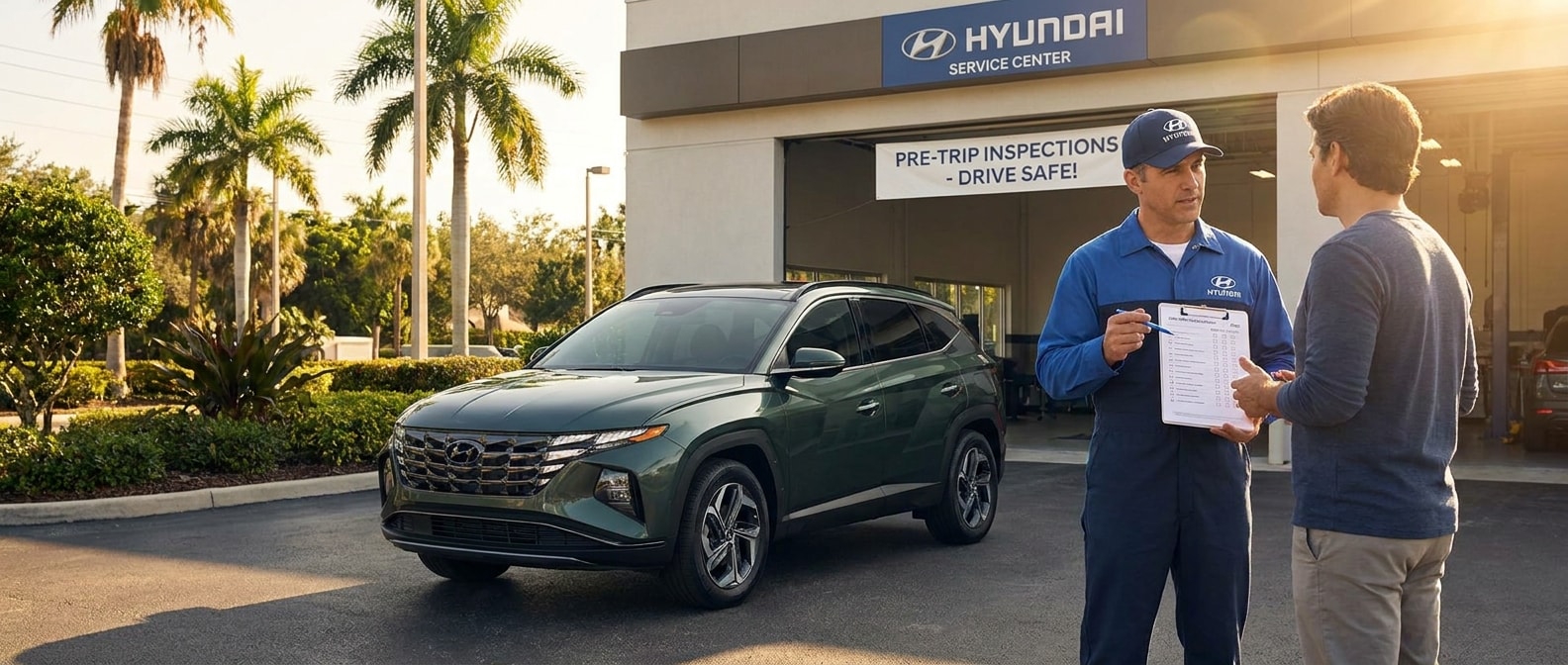
Holiday travel season is six weeks away, and US-231 north toward I-10 is going to be busy. What follows is the list our service team runs before any Hyundai takes on a long highway stretch, and we've tuned it to what Gulf Coast heat really does to a car, the kind of thing generic national guides never mention.
Get your Hyundai ready before the rush. Schedule service at Bay Hyundai
What Goes on the Checklist?
The checklist below is the full print-and-go version, and each line addresses something that fails at a higher rate here in Bay County than on the same vehicle in a cooler climate, so it's worth understanding before you pack the car and head north. Take a photo or bookmark it.
Your pre-holiday Hyundai service checklist:
- [ ] Battery load test. Check voltage AND cold-cranking amps, not just voltage
- [ ] Tire pressure (cold check). Verify against the door-jamb placard PSI, not the tire sidewall
- [ ] Tire tread depth. Use the quarter test or ask us; anything under 4/32 deserves a conversation before a highway run
- [ ] Engine oil level and condition. Confirm you're within the interval for your driving pattern (Normal vs. Severe schedule)
- [ ] Cabin air filter inspection, especially if the A/C has smelled musty lately
- [ ] Brake fluid condition. Brake fluid absorbs moisture; Gulf Coast humidity accelerates that
- [ ] Wiper blades. November in the Panhandle brings rain; worn blades streak badly
- [ ] All exterior lights. Brake lights, turn signals, headlights; a five-minute walk-around catches what you miss driving
- [ ] Coolant level and condition. Confirm the color hasn't gone brown or rusty-looking
- [ ] HVAC function check. Run both heat and A/C; you'll need both on a December drive that starts at 72 degrees in Panama City and ends in 40 degrees somewhere in Georgia
Why Each Item Matters for Gulf Coast Driving
Plenty of these items show up on every generic pre-trip list, and they earn their spot, but the Gulf Coast context reshuffles the priority order, and that reshuffle is exactly why we front-load the battery and tires ahead of everything else before a long drive.
The battery issue is real and it's specific to Florida. AAA data shows batteries in hot Florida climates typically last around three years, versus five years or longer in cooler northern climates. The cause is chemistry. Heat speeds up the internal reactions inside a lead-acid battery, and humidity corrodes the terminals on top of it. A battery sitting at two and a half years old (right in that Florida danger zone) might crank your car fine on a Tuesday morning in Panama City, then struggle once the temperature drops 30 degrees after you've driven four hours north. Cold weather takes the blame, though heat already did the quiet damage, and the cold drive just brings it to the surface. A load test catches that weakness before you leave, where a plain voltage check wouldn't.
See the 2026 Tucson lineup at Bay Hyundai or browse the Santa Fe
Tire pressure is where Florida physics plays tricks on drivers. Tire pressure changes by approximately 1 PSI for every 10 degree Fahrenheit change in temperature, per NHTSA tire-safety guidance. After a summer of Bay County heat, a tire that read correctly in the cool morning can show 4-6 PSI higher once you've run it on hot pavement.
Drivers see that high reading, decide the tire's overinflated, bleed some air out, and finish underinflated once everything cools overnight. NHTSA identifies underinflation as a leading cause of tire failure.
When the tires are cold, before driving or after the car has sat parked for at least three hours, check the pressure and set it to the PSI on your driver's door placard, not the number on the tire sidewall, which is the maximum the tire can handle rather than your target.
The cabin air filter is the easy one to let slide in Bay County. Hyundai recommends replacing it every 12,000 miles or 12 months. In a humid coastal environment, the filter media collects mold spores and salt-air particulates faster than that standard interval assumes. If your A/C has carried that faintly musty smell at startup, the filter's overdue. It also drives how well the defroster performs, since a clogged filter chokes airflow to the windshield, and that matters on the Georgia stretch.
The Item-by-Item Breakdown
| Checklist Item | Why It Matters for Bay County Drivers |
|---|---|
| Battery load test | Gulf Coast heat reduces Florida battery life to roughly 3 years; a load test reveals internal weakness that a voltage check misses |
| Tire pressure (cold check) | Pressure shifts ~1 PSI per 10 degree temp change; always check cold against the door placard PSI |
| Tread depth | Worn tread means longer stopping distances in standing water; Panhandle November rain is real |
| Engine oil | Stop-and-go Bay County traffic often qualifies as "severe" driving per Hyundai's schedule (every 5,000 miles or 6 months) |
| Cabin air filter | Coastal humidity accelerates mold growth in filter media; Hyundai recommends replacement every 12,000 miles or 12 months |
| Brake fluid | Moisture absorption in humid climates degrades brake fluid condition faster than the calendar suggests |
| Wiper blades | Winter rain from cold fronts hits the Panhandle; a streaking blade at highway speed is a visibility problem |
| Lights | Brake and turn signal failures are among the most common equipment-related traffic stops |
| Coolant | Discolored coolant has degraded corrosion inhibitors and needs to be addressed before a long run |
| HVAC (heat + A/C) | A December trip north will use both; discovering the heater core issue in Alabama is the expensive version of finding it in the bay |
Schedule Your Pre-Holiday Service Appointment
A Note on Hyundai's Maintenance Schedules (This Changed for 2026 Models)
If you bought a 2026 Hyundai, the one change worth knowing before a pre-holiday oil change is that Hyundai ended its Complimentary Maintenance Program for 2026 model year vehicles and beyond, though owners of 2020 through 2025 models still hold their coverage. Drivers who purchased 2020 through 2025 models still have coverage for oil and filter changes, tire rotations, and multi-point inspections for three years or 36,000 miles, whichever comes first. For 2026 and newer Hyundais, pre-paid maintenance plans are available as an optional purchase. Whether your pre-holiday oil change is covered depends on which bucket you're in. Check your paperwork, or just ask us.
Check your service coverage and book your appointment
Beyond the coverage question, Hyundai publishes two maintenance tracks. The Normal schedule, oil every 7,500 miles or 12 months, suits steady highway driving in moderate climates. The Severe schedule, every 5,000 miles or 6 months, kicks in when conditions push the vehicle harder, meaning frequent short trips, stop-and-go traffic, or ambient heat above 90 degrees Fahrenheit. If your daily driving runs through Panama City traffic, you're almost certainly on the Severe schedule, so your real oil interval runs shorter than a windshield sticker set for Normal conditions might suggest.
Your Print-and-Go Pre-Holiday Recap
The short version below belongs on the refrigerator or in the glove box, and the trick is to run through it at least two weeks before you leave rather than the day before, so we've got time to order a part if something needs one and you're not the car in the right lane with hazards on somewhere between Bonifay and Dothan.
- Battery load test (especially if it's 2+ years old)
- Cold tire pressure check (morning, before you drive, against the door placard)
- Tread depth and tire condition
- Oil level and confirm which schedule applies (Normal or Severe)
- Cabin air filter (smell-check plus visual)
- Brake fluid condition
- Wiper blades (both front and rear if equipped)
- All exterior lights
- Coolant level and color
- Heat and A/C function (run both)
Give yourself the full two-week window, because service bays get busy the week before Thanksgiving. Northwest Florida Beaches International Airport sees some of its heaviest traffic of the year during that stretch, and the vehicles people drive to drop off family follow the same surge pattern on the roads. Getting in ahead of the rush is easier, and it's the version of this that actually happens before you leave instead of after.
Frequently Asked Questions
Does Gulf Coast heat mean I need more frequent oil changes in my Hyundai?
It often does. Hyundai's Severe maintenance schedule shortens oil change intervals to every 5,000 miles or every 6 months, against every 7,500 miles or 12 months on the Normal schedule. Severe conditions include frequent stop-and-go traffic, ambient temperatures consistently above 90 degrees Fahrenheit, and repeated short trips. Plenty of everyday Bay County driving checks those boxes. If you're not sure which schedule fits your vehicle and driving pattern, our service team can pull your last service record and walk you through it at your next visit.
My car is a 2026 Hyundai. Is my pre-holiday oil change covered under complimentary maintenance?
No. Hyundai ended its Complimentary Maintenance Program for model year 2026 vehicles and beyond, effective from early 2025. Owners of 2020 through 2025 model year Hyundais keep coverage for oil and filter changes, tire rotations, and multi-point inspections for three years or 36,000 miles from the original purchase date, whichever comes first. If you drove home a 2026 model, ask our service team about the available pre-paid maintenance plan options.


