

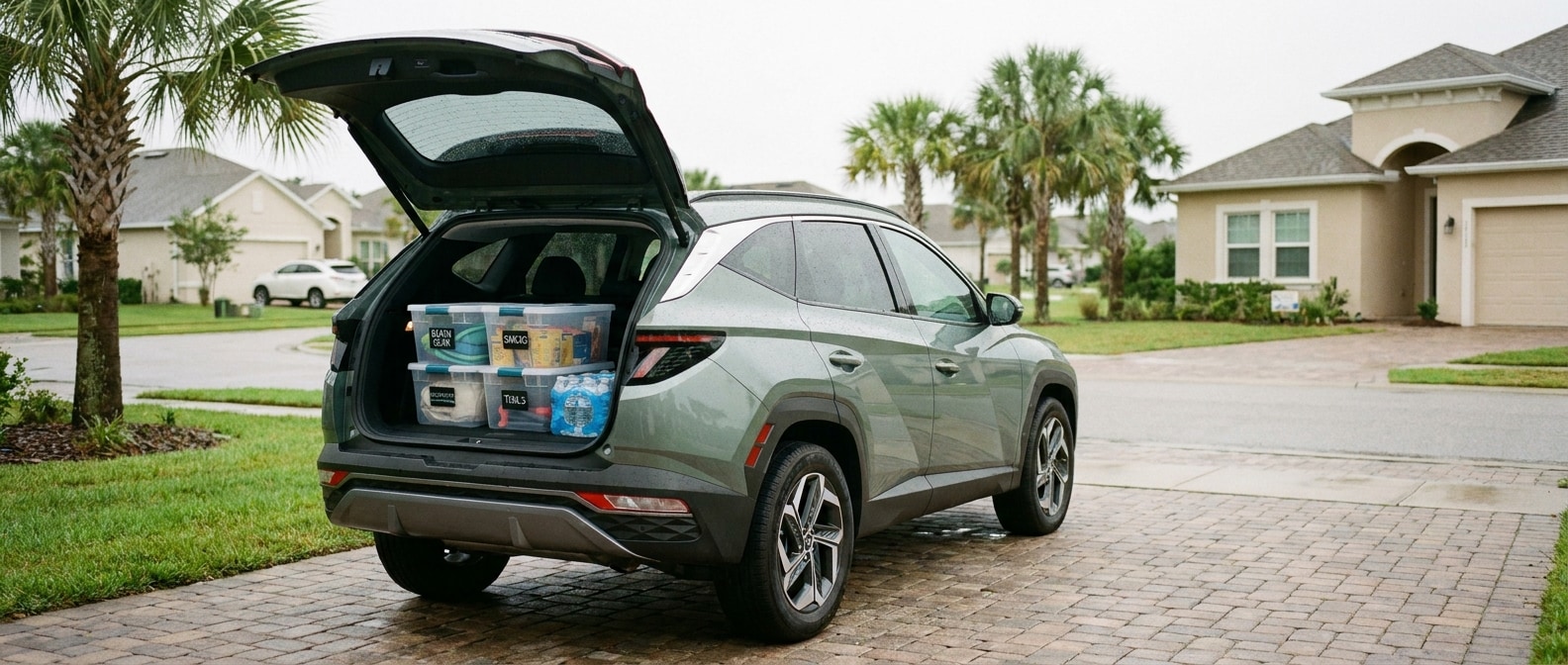
Getting a vehicle ready for hurricane season in Panama City comes down to four unglamorous things: fuel, tires, battery, and a service check done before the season rather than during it. That is the entire list. Atlantic hurricane season runs June 1 through November 30, so this is a predictable annual routine here, the same way that drivers in other parts of the country get a vehicle ready for winter every October.
One thing worth saying up front, because it is not our lane. Bay County emergency management and the City of Panama City are the authorities on travel guidance and on what residents should do during a storm. Follow them. What we can help with is the part we actually know, which is making sure the vehicle is ready whenever you decide to use it. If it has been a while since anyone looked at yours, that starts with a service appointment.
What goes on the readiness checklist?
Two lists. The first one you work through once, early in the season. The second is a short habit you keep while the season is open.
Once, before the season:
- Tires checked for tread depth and cold inflation pressure, including the spare. Gulf Coast heat and UV exposure age rubber faster than a mild climate does, and worn tires are the most common reason for an unplanned roadside stop.
- Battery tested under load at a shop. Humidity accelerates terminal corrosion, and a battery that reads fine in spring can struggle later in the season once the air conditioning, lights, and wipers are all working at once.
- Brakes, fluid levels, wiper blades, and exterior lights inspected. This is an ordinary service visit, not a special one.
- A basic supply kit loaded into the cargo area and left there. Water, non-perishable food, a flashlight with spare batteries, a first aid kit, and any medications your household needs.
- Documents copied. Insurance, registration, and identification photographed and stored on two devices, with paper copies in a waterproof container.
- Some cash kept on hand. Card readers depend on power and connectivity, and both can be interrupted.
As a habit while the season is open:
- Keep the tank above half. Refuel on a normal errand rather than making a special trip, and you will never be caught low. When a lot of people are traveling at the same time, fuel simply takes longer to find.
- Keep a phone charger and a charged power bank in the vehicle.
- Keep cargo organized rather than piled. A stable, low load keeps your sightlines clear and makes it easy to find what you packed.
- Check the tire pressure monthly. It takes two minutes at any air pump.
Why these four items and not a longer list
Because everything else is a variation on them, and a checklist nobody finishes is worse than a short one everybody does.
Fuel is a habit, not a task. The half-tank rule works because it removes the decision entirely. This is also where a hybrid quietly earns its keep. The 2026 Tucson Hybrid carries a 13.7-gallon tank and standard HTRAC all-wheel drive across the lineup, and Hyundai's EPA-estimated figures reach 38 mpg combined on the Blue SE trim, with other trims estimated at 36 mpg combined. Those are EPA estimates rather than a promise, and stop-and-go driving will land under them, but the efficiency advantage is real in exactly the low-speed conditions where a conventional engine does its worst.
Tires and battery are the two parts that age quietly. Neither one warns you gradually. They both work until they do not, and both are cheap to check and inconvenient to ignore. A shop can load-test a battery in a few minutes and tell you whether it has a season left in it.
Cargo room and clearance are about the other eleven months too. Ground clearance on the 2026 Tucson runs 7.1 inches in front-wheel drive and 8.3 inches on the all-wheel-drive configuration, per Hyundai's press specifications. That extra clearance helps on debris-scattered pavement. It is not a reason to drive through standing water, whatever the number says, and local officials are the ones who tell you which roads are open. For households that need genuine space, the Palisade seats seven or eight depending on trim and offers 19.1 cubic feet behind the third row, 46.3 behind the second, and up to 86.7 with both rear rows folded.
| Checklist item | Why it is on the list |
|---|---|
| Tires and spare inspected | Heat and UV age rubber faster on the Gulf Coast; worn tires are the top cause of unplanned roadside stops |
| Battery load-tested | Humidity corrodes terminals, and electrical load climbs when A/C, lights, and wipers all run together |
| Tank kept above half | Removes the decision entirely, and fuel takes longer to find when many people travel at once |
| Service visit before the season | Brakes, fluids, wipers, and lights checked once, on your schedule, not on short notice |
| Supply kit stored in the cargo area | Water, food, flashlight, first aid, and medications stay with the vehicle instead of on a list |
| Documents copied to two devices | Paper copies can be damaged, and connectivity can be interrupted |
| Cargo organized and low | Clear sightlines, and you can find what you packed |
Schedule a Pre-Season Service Check
Which Hyundai SUV suits your household
There is no single right answer here, only the right fit for how you use the vehicle the rest of the year.
The 2026 Tucson Hybrid is the efficiency pick, and standard all-wheel drive across the lineup makes it an easy year-round choice. The tradeoff is size. It is a compact SUV, so a household of five and a full load of gear will find it tight.
The 2026 Santa Fe splits the difference, with three-row seating in a mid-size footprint. Hyundai rates the gas front-wheel-drive configuration to tow up to 4,500 pounds when properly equipped, and the gas all-wheel-drive to 3,500 pounds, while the Hybrid is rated to 2,000 pounds. If towing matters to you, that difference is the whole decision.
The Palisade is the choice for larger households, with the most passenger and cargo room of the three. Its fuel economy is the lowest of the three, so the half-tank habit matters more here, not less.
The short version
Four things, once a season, and one habit. Get the tires and spare checked. Get the battery load-tested. Book the service visit early rather than late. Put the supply kit in the cargo area and leave it there. Then keep the tank above half from June through November and stop thinking about it.
For anything beyond the vehicle, follow Bay County emergency management and the City of Panama City. They publish the guidance that actually matters, and it is kept current.
Our service team is here before the season and after it. If your Hyundai has been exposed to salt water or standing water at any point, bring it in and have it inspected before you start it, because water reaching the intake or the electrical system is a problem worth catching early. If you are weighing whether the SUV you have still fits your household, come talk it through with us. There is no rush and no script.
Common questions about hurricane season vehicle prep
When should I get my Hyundai SUV ready for hurricane season?
Early, and once. Atlantic hurricane season runs June 1 through November 30, so the practical move is to book the service visit in late spring and treat it as an annual appointment rather than something you arrange on short notice. Have the tires and spare checked, the battery load-tested, and the brakes, fluids, wipers, and lights inspected in the same visit. After that, the only ongoing habit is keeping the fuel tank above half through the season.
Which Hyundai SUV goes the furthest on a tank?
The 2026 Tucson Hybrid leads the SUV lineup on efficiency, pairing a 13.7-gallon tank with EPA-estimated figures that reach 38 mpg combined on the Blue SE trim and 36 mpg combined on the other trims, all with standard all-wheel drive. Those are EPA estimates and real-world results vary with driving conditions, particularly in stop-and-go traffic. The Santa Fe Hybrid is the next step up in size while keeping strong efficiency for a mid-size three-row, and the Palisade trades fuel economy for the most passenger and cargo space of the three.


