

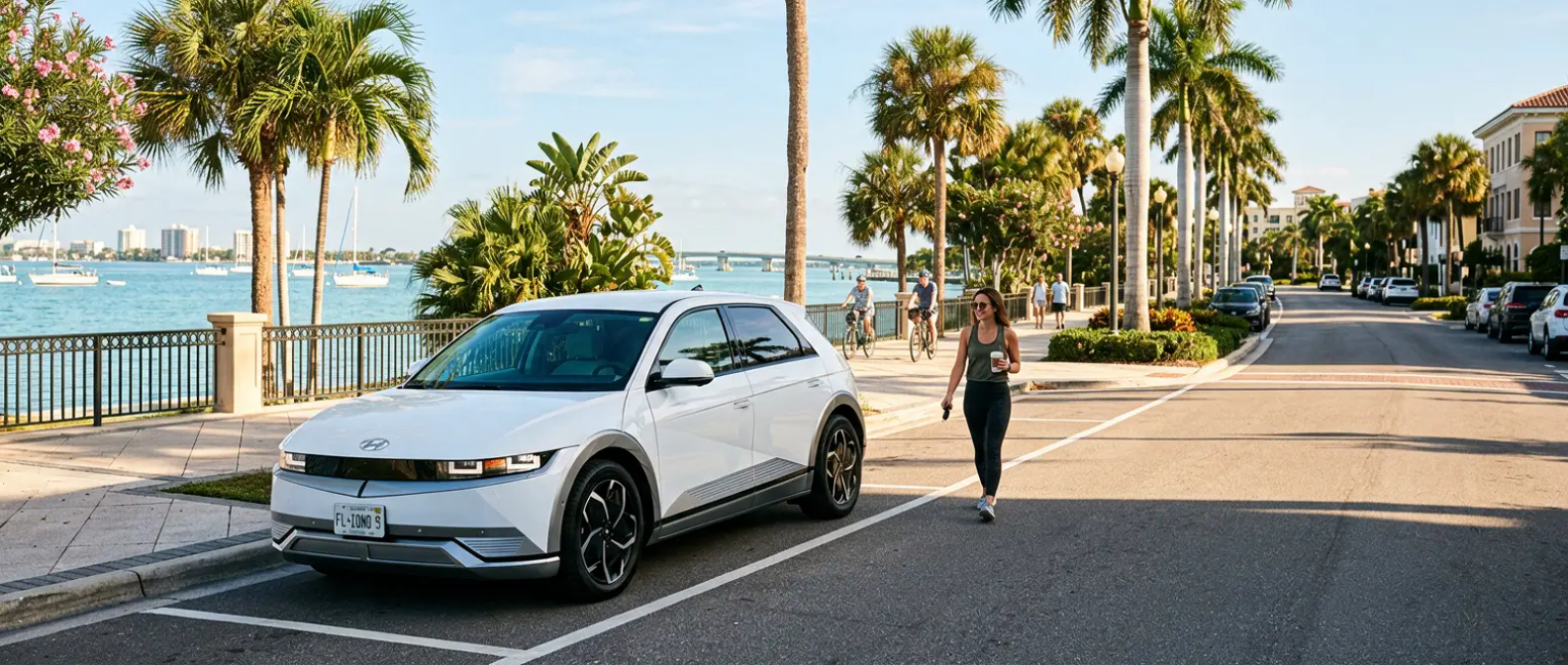
Plenty of shoppers look at the 2026 Hyundai IONIQ 5 and think "that's a lot of range for someone who mostly drives around Bay County." A fair thought, and one we hear a version of on our lot. But the math on local EV ownership runs in the opposite direction from what you'd guess.
A gas car gets worse mileage in the city than on the highway. The IONIQ 5 gets better mileage in the city. That flip matters more than it sounds. It's the core reason a mostly-local driver in Panama City is getting the most out of this vehicle.
Browse the 2026 IONIQ 5 at Bay Hyundai
- The myth: a long-range EV like the IONIQ 5 is built for road-trippers and doesn't make sense for local commuters.
- The reality: EVs recover energy through regenerative braking on every stop, and the EPA rates the 2026 IONIQ 5 at 131 MPGe in city driving versus 100 MPGe on the highway (efficiency is higher, not lower, in local conditions).
- Panama City's average commute is about 24 minutes (U.S. Census Bureau data), which means a typical round trip barely dents the battery.
- Home charging overnight on a Level 2 outlet restores the full charge in roughly 5 hours 40 minutes (Standard Range) or 7 hours 20 minutes (long-range 84 kWh).
- The IONIQ 5's Vehicle-to-Load (V2L) system outputs up to 3.6 kW, which is a genuinely practical feature in a coastal market that sees power outages.
Is the IONIQ 5's Range Actually Wasted on Local Drivers?
No, and the EPA data explains why in a single line, because the efficiency numbers point the exact opposite direction from what a lifetime of driving gas cars trains you to expect. Read the ratings and the whole worry unwinds.
The 2026 IONIQ 5 Standard Range earns an EPA rating of 131 MPGe in city driving. Its highway figure is 100 MPGe. Nobody talks about that inversion, and it matters. This vehicle is more efficient on the roads you drive every day in Panama City than it is on I-10 headed toward Pensacola. A conventional gas engine burns more fuel at low speeds thanks to idling and stop-and-go inefficiency. The IONIQ 5's electric motor and regenerative braking do the reverse. Every time you slow for a light on 23rd Street or ease off the accelerator approaching a parking lot, the system converts that kinetic energy back into electricity.
Below, we've laid the full picture out against the claims we hear most:
| The Claim | What's Actually True |
|---|---|
| "I don't drive far enough to need that range." | The EPA rates the 2026 IONIQ 5 at 131 MPGe city (local stop-and-go is where the efficiency peaks, not the highway). |
| "Long-range EVs waste electricity on short trips." | Regenerative braking recovers energy on every deceleration; short trips with frequent stops maximize that recovery. |
| "I'll barely use the battery before I need to charge." | Panama City's average commute is around 24 minutes each way (U.S. Census Bureau). A full-charge IONIQ 5 handles that for weeks between charges at home. |
| "Charging in a coastal town with outages is a headache." | The IONIQ 5's V2L system outputs up to 3.6 kW from the second-row port, useful when the grid isn't cooperating. |
| "All that range hardware drives up the weight and reduces city efficiency." | The 84 kWh long-range RWD IONIQ 5 earns 129 MPGe city and 100 MPGe highway (EPA). The efficiency advantage in city driving holds even at the larger battery. |
| "You need a fast charger nearby to make this practical." | On a standard 240V home outlet (Level 2), the Standard Range charges fully in about 5 hours 40 minutes overnight. You wake up to a full charge every morning. |
How the Charging Math Works for a Panama City Commute
The average commute in Panama City runs about 24 minutes each way, according to U.S. Census Bureau data, which at typical local speeds works out to a round trip well under 30 miles on most days. The 2026 IONIQ 5 Standard Range carries an EPA-estimated 245 miles. Run that math and you'd use roughly 10-12% of the battery on a normal workday round-trip. The long-range RWD version, rated at up to 318 miles by Hyundai, pushes that percentage even lower.
On the ground here, the practical reality is simple. You're not managing range anxiety on a local EV. Really you're managing a charging schedule that looks a lot like plugging in your phone at night.
Interested in a sleeker sedan profile? See the IONIQ 6 as well
Charging options for Panama City households:
- A standard 120V outlet (Level 1) adds roughly 4-5 miles per hour of charge, which covers a short commute overnight without any installation.
- A 240V Level 2 home charger brings the Standard Range from 10% to full in about 5 hours and 40 minutes.
- The 84 kWh battery takes around 7 hours and 20 minutes on Level 2, per Hyundai's published specs.
- If you're near a DC fast charger, the IONIQ 5's 800-volt architecture can bring the battery from 10% to 80% in approximately 20 minutes using a 350 kW charger.
See current IONIQ 5 inventory at Bay Hyundai
Now the honest trade-off, and we'll say it plainly. If you regularly drive 200+ miles in a single day without a charging stop, the IONIQ 5 demands more planning than a gas vehicle. That's real. But for someone whose daily radius stays inside Bay County, that limitation just doesn't touch your life. The use case where an EV asks the most of you is the one you're not doing.
What the V2L Feature Means for Gulf Coast Drivers
The IONIQ 5 earns a point here that rarely lands in national EV coverage, and it's worth slowing down on. The Vehicle-to-Load (V2L) system lets you draw up to 3.6 kW of AC power directly from the battery through a port located under the second-row seats, using an available adapter. That output runs a box fan, charges phones and laptops, powers a projector, or handles a small appliance when the grid is down.
Drivers in Bay County have reason to pause on this. September in this part of Florida means the back half of hurricane season. Grid outages in coastal communities can last hours or longer after a significant storm. The IONIQ 5 is not an emergency generator and we won't pretend otherwise, but 3.6 kW from a vehicle you're already charging at home is a meaningful convenience a gas car can't offer. It also means tailgates, camping at Florida Caverns State Park, and beach days where you need power for gear aren't hostage to finding an outlet.
Explore financing options at Bay Hyundai
The V2L feature works even with the vehicle off, and that's the part that surprises people when we show them. Park, connect the adapter, done.
So What Should You Actually Do Before You Decide?
Map your daily driving honestly before anything else. If your typical day keeps you within Panama City, Panama City Beach, Lynn Haven, or Callaway (all normal Bay County travel), the range question resolves itself in a hurry. You're a strong local-driver candidate for the IONIQ 5.
The questions that actually matter for your situation are about charging access at home, your comfort with an upfront cost higher than a comparable gas vehicle, and whether you value the day-to-day simplicity of never stopping for gas. Those are real considerations. Range isn't one of them for a local driver.
Start with a test drive to get a feel for the regenerative braking paddles and the instant torque on Bay County roads, then ask us about the specific trim that fits your commute. The Standard Range at 245 miles of EPA-estimated range is a genuinely capable choice for a local-first buyer. The long-range RWD at 318 miles EPA gives you room for the occasional Destin run or Tallahassee trip without any anxiety.
Both are solid choices for different versions of a Panama City lifestyle.
Frequently Asked Questions
Does the IONIQ 5 make sense if I mostly drive under 30 miles a day?
Yes, and it's actually where the efficiency works best. The EPA rates the 2026 IONIQ 5 Standard Range at 131 MPGe in city driving, which is higher than its 100 MPGe highway figure. Short, local trips with frequent stops let the regenerative braking system recover energy continuously, which is the opposite of how a gasoline engine behaves. A daily round-trip well under 30 miles uses roughly 10-12% of the battery in the Standard Range model, so a full overnight charge on a standard 240V outlet covers multiple days of local driving.
What if there's a power outage and I can't charge the IONIQ 5 at home?
The IONIQ 5 has Vehicle-to-Load (V2L) capability that works in the other direction, outputting up to 3.6 kW of AC power from the second-row port using an available adapter, even when the vehicle is switched off. A charged battery then provides usable power for phones, fans, and small appliances during an outage. For charging itself during extended grid outages, DC fast chargers at public stations run on commercial power separate from residential grid sections, so they may remain available when home charging isn't possible. That said, charging planning during a major storm event is a real consideration, and we recommend discussing home-charging setup and backup options when you visit us.


