

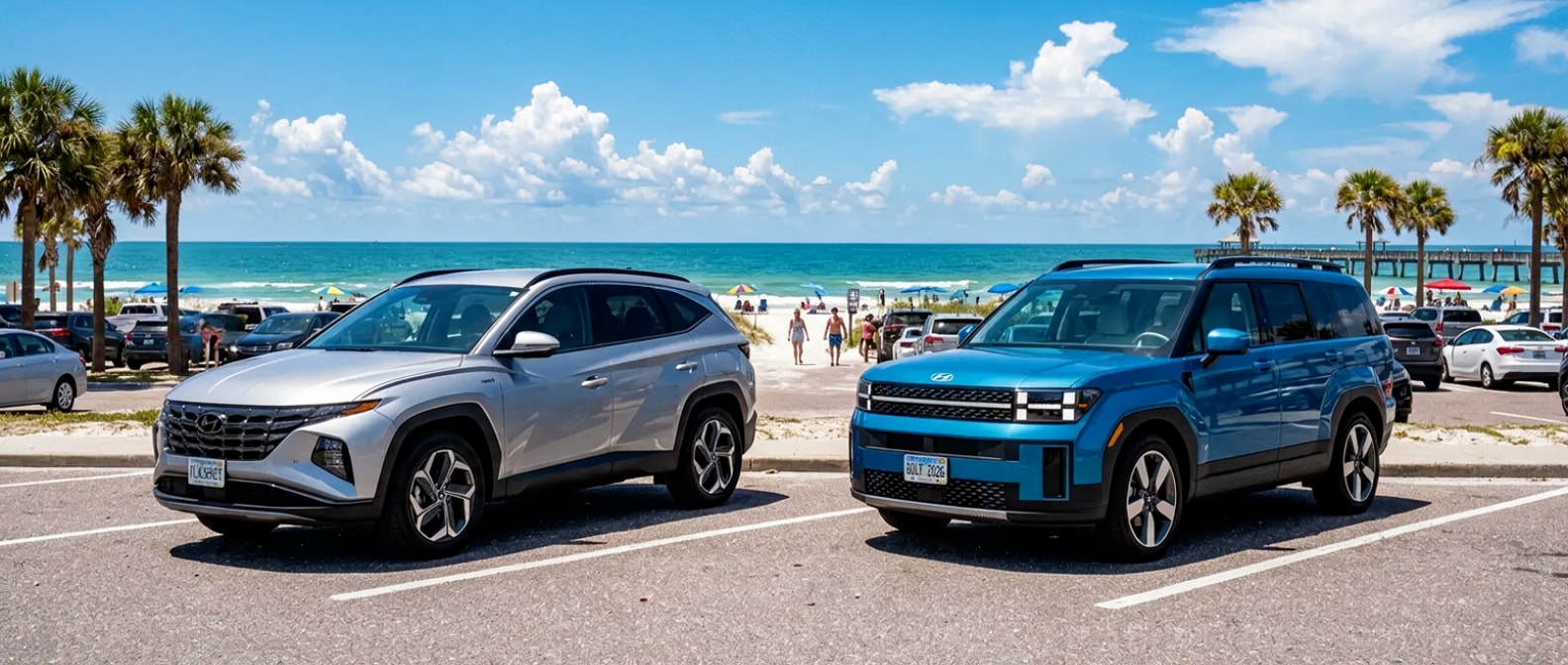
They share a powertrain. They carry the same Hyundai hybrid badge. And yet the 2026 Tucson Hybrid and the 2026 Santa Fe Hybrid land at different EPA fuel economy estimates, and the reason why tells you a lot about which one belongs in your driveway on West 15th Street rather than the other.
Short answer, if fuel savings per mile is your main goal and you don't need a third row of seats, the Tucson Hybrid wins on EPA-estimated mpg. Hauling more than five people, or need serious cargo room while still wanting strong hybrid efficiency for a vehicle that size? The Santa Fe Hybrid earns its keep. The tradeoff here is genuine. Let's walk through how the technology works, what the numbers mean for Panama City driving specifically, and which vehicle fits which buyer.
How Does the Hybrid System Actually Work?
Regenerative braking is the reason Panama City traffic works in your favor rather than against you, whichever of these hybrids you're in. When you slow down, the system is banking energy that a plain gas engine would throw away. So the crawl on Front Beach Road isn't wasted.
Both the 2026 Tucson Hybrid and the 2026 Santa Fe Hybrid pair a turbocharged 1.6-liter four-cylinder gasoline engine with an electric motor, connected through a six-speed automatic transmission. Hyundai rates the combined output at 231 horsepower and 271 lb-ft of torque for both vehicles. Architecturally, they're the same machine in two different bodies.
Lift off the accelerator or press the brake pedal, and the electric motor runs in reverse, acting as a generator that converts your forward momentum into electricity and stores it in the onboard lithium-ion battery. That energy then assists the engine during acceleration, reducing how hard the gasoline engine has to work. The slower you drive and the more often you decelerate, the more energy gets captured. A standard gasoline engine works the opposite way, since highway cruising is efficient while city idling wastes fuel. That's exactly why EPA city mpg ratings for hybrids can match or even beat their highway ratings.
| Feature | 2026 Tucson Hybrid | 2026 Santa Fe Hybrid |
|---|---|---|
| Engine | 1.6L turbo 4-cyl hybrid | 1.6L turbo 4-cyl hybrid |
| Combined system output | 231 hp / 271 lb-ft torque | 231 hp / 271 lb-ft torque |
| Transmission | 6-speed automatic | 6-speed automatic |
| Drivetrain | HTRAC AWD (standard all trims) | FWD or HTRAC AWD |
| EPA est. mpg (best trim, city/hwy/combined) | 38 / 38 / 38 (Blue SE) | 37 / 36 / 36 (FWD trims) |
| EPA est. mpg (upper trims, city/hwy/combined) | 36 / 37 / 36 (SEL and above) | 35 / 34 / 34 (AWD trims) |
| Fuel tank | 13.7 gallons | 17.7 gallons |
| Seating | 5 passengers (2 rows) | Up to 7 passengers (3 rows) |
| Cargo behind rear seats | ~38 cu ft | 40.5 cu ft (3rd row folded) / 79.6 cu ft (both rows folded) |
| EPA-est. range (best trim) | ~521 miles | ~637 miles (FWD) |
That 38/38/38 figure for the Tucson Hybrid Blue SE is genuinely unusual for an SUV. Most vehicles rate better on the highway than in the city, because engines run cleanest at steady speeds. The Tucson Hybrid's essentially equal city and highway ratings show how effective the regenerative braking system is at recapturing energy in low-speed driving. The Santa Fe Hybrid posts 37 city and 36 highway in FWD form. That still beats most gasoline competitors, though the heavier body carries a small efficiency cost at low speeds.
Which One Makes More Sense for Driving Here?
Panama City runs stop-and-go for a good chunk of the year, and for these two hybrids that's a feature worth having. Consider it a spec.
US-98 through downtown and out toward Panama City Beach is a genuine hybrid advantage zone. Front Beach Road during the summer tourist season can stack up bumper-to-bumper, especially on weekend afternoons. The Lynn Haven-to-downtown commute along Highway 77 has its own rhythm of traffic lights and school-zone slowdowns. Every one of those deceleration events is the hybrid system doing its job, recovering energy that a gasoline engine would simply convert to heat and lose.
We see buyers come in having compared the Tucson Hybrid and Santa Fe Hybrid strictly on the combined mpg number, which is a reasonable starting point. But the figure that matters most for Bay County driving is the city rating, because that's where a lot of your miles actually go between May and September. The Tucson Hybrid's EPA-estimated 38 city mpg (Blue SE) and the Santa Fe Hybrid's EPA-estimated 37 city mpg (FWD) sit closer than they look in isolation. The more consequential split shows up at AWD configurations. The Tucson Hybrid comes with HTRAC all-wheel drive standard across every trim, while the Santa Fe Hybrid AWD drops to an EPA-estimated 35 city / 34 highway / 34 combined mpg.
Here's the honest tradeoff, and we'll say it plainly. If you regularly carry five or more people, the Santa Fe Hybrid is the only one of these two that gives you a third row. The Tucson Hybrid is a two-row, five-passenger vehicle. That's no knock on it. Plenty of buyers don't need a third row, and the Tucson Hybrid's more compact footprint makes tighter parking situations easier to handle. But if you're ferrying kids and their teammates, or you need occasional seven-passenger capacity, the Santa Fe Hybrid offers that and still hits an EPA-estimated 36 combined mpg in FWD form. Strong efficiency for a midsize SUV with three rows.
Browse the Santa Fe Hybrid and compare what fits your family's headcount, not just your tank.
See Current Hyundai Hybrid Offers
Key Terms Worth Knowing
| Term | What it actually means |
|---|---|
| Regenerative braking | The electric motor runs backward during deceleration, capturing kinetic energy as electricity and storing it in the battery instead of losing it as heat |
| HTRAC AWD | Hyundai's all-wheel drive system that distributes torque between front and rear axles (both hybrids use a mechanically simpler electronically-controlled version compared to full-time mechanical AWD) |
| Combined mpg | A weighted EPA average: 55% city-cycle and 45% highway-cycle test results blended into a single comparison figure |
| EPA-estimated range | Calculated from tank size multiplied by combined mpg rating; the Tucson Hybrid Blue SE's 13.7-gallon tank at 38 combined mpg yields an EPA-estimated 521 miles; the Santa Fe Hybrid FWD's 17.7-gallon tank at 36 combined mpg yields an EPA-estimated 637 miles |
What This Means for Your Next Vehicle
The fuel savings story here isn't a photo finish. The Tucson Hybrid edges ahead on per-mile efficiency, and the gap grows if you compare both in AWD configurations, with the Santa Fe Hybrid AWD at an EPA-estimated 34 combined mpg versus the Tucson Hybrid (all trims AWD-standard) at 36 to 38 combined mpg depending on trim.
Chasing the highest mpg number, though, can send you home with the wrong vehicle. If you genuinely need three rows (for a growing family, for military-housing carpools, for a household that takes road trips with another couple), the Santa Fe Hybrid's 14.6 cubic feet behind the third row and 40.5 cubic feet with it folded give you real utility. The Tucson Hybrid can't match that. The Santa Fe Hybrid's 17.7-gallon tank also means fewer fill-up stops on a run to Pensacola or Tallahassee, even if the per-mile rate is a touch lower.
Our team's practical read is that a lot of buyers comparing these two are single-household or two-adult families who don't actually need seven seats. For them, the Tucson Hybrid's combination of higher EPA-estimated mpg, standard AWD across all trims, and a more manageable footprint makes it the sharper daily-driver choice. If that description fits you, the efficiency math works in its favor, especially in the low-speed, stop-and-go driving Bay County traffic delivers from May through Labor Day.
See our current new Hyundai inventory to check what's in stock in both hybrid lines right now.
Frequently Asked Questions
Do the Tucson Hybrid and Santa Fe Hybrid use the same engine?
Yes. Both the 2026 Hyundai Tucson Hybrid and the 2026 Hyundai Santa Fe Hybrid use the same core hybrid powertrain: a 1.6-liter turbocharged four-cylinder gasoline engine paired with an electric motor, producing a combined 231 horsepower and 271 lb-ft of torque, routed through a six-speed automatic transmission. The difference in EPA-estimated fuel economy between the two comes from the size and weight of the vehicle body, not from any difference in the engines or hybrid architecture.
Which hybrid gets better fuel economy in city driving?
The 2026 Tucson Hybrid leads in city driving. The EPA estimates 38 city mpg for the Tucson Hybrid Blue SE trim and 36 city mpg for the upper Tucson Hybrid trims (all of which come with standard HTRAC AWD). The 2026 Santa Fe Hybrid in front-wheel-drive form earns an EPA-estimated 37 city mpg, dropping to 35 city mpg in AWD configuration. Because Panama City driving involves significant stop-and-go traffic on corridors like US-98 and Front Beach Road, the city rating is the number that has the most real-world impact on what you'll actually spend at the pump.


