

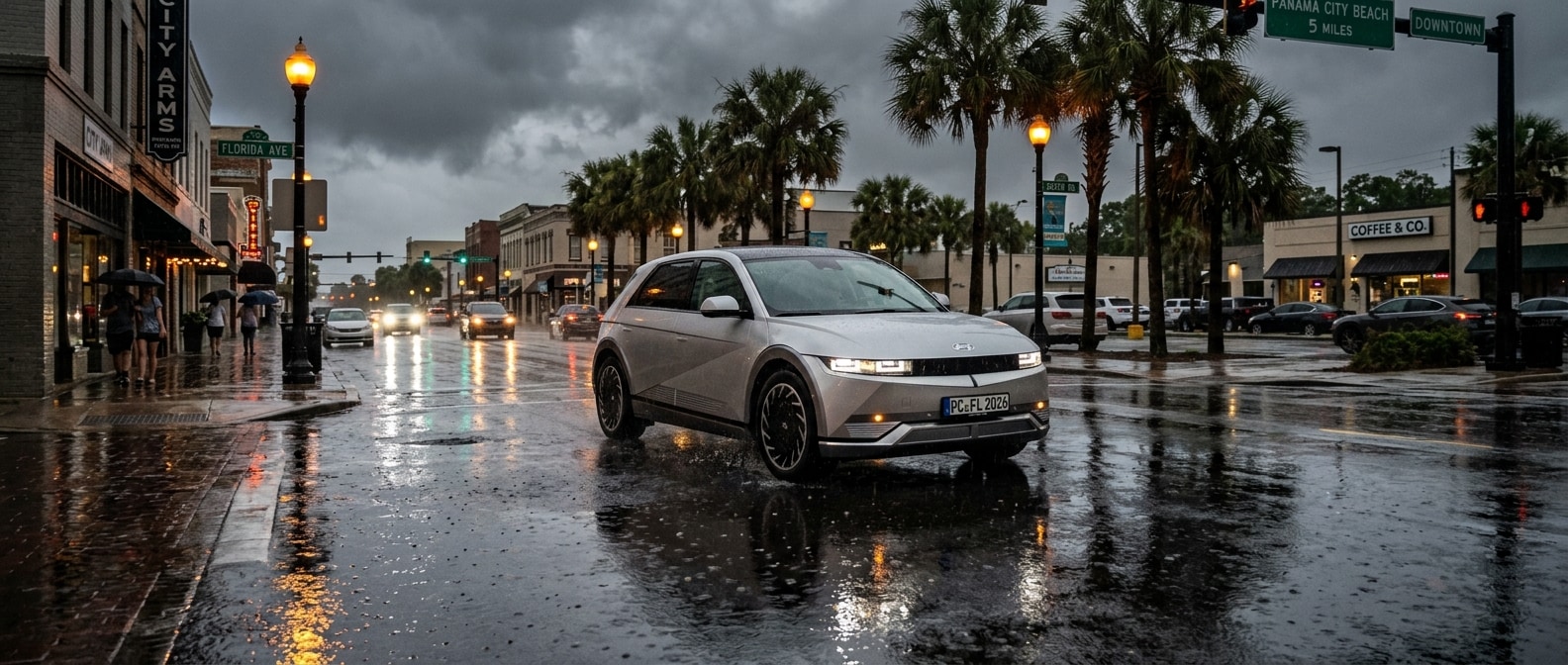
Your Hyundai made it through the detour. It runs. Nothing looks wrong. Here's the answer from our team, and it's a plain one. "Running fine" and "no damage" aren't the same thing after standing water (for EV and hybrid owners especially, that gap matters more than most guides let on).
The IONIQ 5 and every hybrid in our lineup carry high-voltage battery systems that the generic "check your oil and move on" advice was never written for. This post is for Bay County drivers who rerouted through water on Front Beach Road, CR-2321, East Highway 390, or any of the low-lying corridors that flood during our Gulf Coast storm season, and who are now wondering whether to book service or just keep driving.
What should you actually do when your Hyundai seems fine after a flooded detour?
Bring it in for a documented inspection even when everything feels normal, because the salt and moisture in Gulf Coast floodwater tend to do their damage slowly, over several days, rather than announcing themselves all at once, and that delay is exactly the trap. The short version is simple. The longer one explains what we're checking and why.
Standing water on Bay County streets carries two things you won't find in the water at home. Salt from the Gulf air, and whatever runoff the road surface has collected. Salt accelerates corrosion on exposed electrical connectors. On a conventional gas vehicle, that shows up as a brake-line and undercarriage issue over time. On a Hyundai hybrid or EV, it can reach the high-voltage system. NHTSA states plainly that batteries in hybrid and electric vehicles are highly corrosive and should not be exposed to standing water, and that flooded vehicles may have high voltage and short circuits. Even a shallow-water detour warrants a look if the water reached the undercarriage.
The "just a puddle" scenario: What catches owners off-guard isn't full submersion. The everyday puddle does it, the one that puts six or eight inches of water across the road. Six inches reaches brake rotors, electrical connectors under the floor, and the drain channels around battery pack seals on an EV. Your car feels perfectly normal for days. Then a sensor fault shows up. Then a brake pulls slightly. The trouble isn't the drive through the water, it's the salt and moisture that settle in afterward.
| System checked | What we look for | Why it matters here |
|---|---|---|
| High-voltage battery seals (EV/hybrid) | Moisture ingress, connector corrosion | NHTSA flags flood exposure as a short-circuit and fire risk |
| Brake rotors and pads | Corrosion layer, brake fade after water cling | Salt-laced water corrodes rotor surfaces faster than fresh water |
| Undercarriage electrical connectors | Oxidation, moisture in terminals | Low-lying connections are first to see standing water |
| Engine/motor air intake path | Water presence, debris | Water drawn into an intake before it clears causes serious mechanical damage |
| Interior cabin and drain channels | Moisture under floor mats, mold potential | Humidity here makes trapped moisture a real problem year-round |
| Transmission and fluid reservoirs | Milky or discolored fluid | Water in a transmission leads to slipping before it leads to a warning light |
Schedule a Post-Storm Service Check
Where do you go when Bay County streets flood?
When Bay County floods, the intersection of Front Beach Road and Laurie Avenue, Resota Beach Road, CR-2321, and East Highway 390 near Mill Bayou Boulevard are the first to close or turn impassable, and drivers in Panama City and Panama City Beach know those names because they've been rerouted through them, or around them, during storm season.
Book a service appointment online and flag it as a post-flooding inspection so our team knows which systems to prioritize. If you also drive a Tucson Hybrid or Santa Fe Hybrid in the family, the same inspection checklist applies, the EV battery logic just differs slightly from those plug-in hybrid systems.
The Bay County Emergency Operations Center handles warnings and coordination during the storm. Bay County's Comprehensive Emergency Operations Plan focuses on warning systems and the National Weather Service, and it does not cover what happens to your vehicle after the water recedes.
- [ ] Water visible on floor mats or under seat cushions? Get it inspected before driving further.
- [ ] Warning lights appeared after the detour? Don't reset and ignore. Bring it in.
- [ ] Heard unusual sounds from the exhaust or undercarriage after startup? Exhaust pipes trap water; that sound matters.
- [ ] Brakes feel different or pull to one side? Salt-water cling on rotors changes brake behavior.
- [ ] Drove through water above the door sills? Don't treat it as a detour, treat it as a tow-first, inspect-second situation.
- [ ] EV or plug-in hybrid? Do not charge until a technician clears the high-voltage system.
- [ ] Insurance documentation, photograph any visible water lines in the cabin, trunk, or engine bay before the car dries.
Plan it this way: what to do in the first 72 hours after a flooded-street detour
The first 72 hours after the detour are the window that actually matters, long enough for salt to start working on connectors, short enough that catching it early keeps a cleanup from turning into a parts replacement, and that window is why the sequence below matters. Here's the practical sequence.
First, don't start the car if it stalled in water. Treat that as a hard stop. Water drawn into an engine during operation causes hydrolock, which is when water enters the cylinder and the piston has nowhere to go. The repair is severe. If your Hyundai stalled while going through water and you restarted it, tell us that explicitly when you call.
If the car drove through normally and you got home without incident, do a visual walk-around that evening. Look for:
- Water lines on the door jambs
- Fog inside any light housing
- Damp carpet
Those aren't just cosmetic signals. They tell us how high the water actually got.
Within 24 hours, give us a call. Nothing is guaranteed to fail. The reason to move fast is the window for catching salt-induced corrosion before it turns into a connector replacement, and that window is short. We'd rather run a quick inspection and confirm you're clear than see you back in three months, chasing a sensor fault that traces to a corroded terminal.
The honest tradeoff runs like this. If you drove through genuinely shallow water (ankle-deep or less, brief passage) and your vehicle is a conventional gasoline model with no warning lights and normal brake feel, you may be fine. The risk calculus is different on an EV or hybrid. NHTSA's guidance is direct and we follow it. When an EV has been exposed to flood conditions and you suspect any battery exposure, contact your dealer. We take that seriously and so should you.
Bay County storm season doesn't slow down in September. The National Weather Service issued a flood advisory for Central Bay County just yesterday, noting that flooding caused by excessive rainfall is expected, with minor flooding in low-lying and poor drainage areas. None of this is a once-a-year scenario for us here, it's the pattern we plan around.
Frequently Asked Questions
Can I drive my Hyundai IONIQ 5 or IONIQ 6 after going through standing water?
If the vehicle drove through without stalling and no warning lights appeared, you can usually drive it to our service center. Do not attempt to charge it before a technician has inspected the high-voltage battery system. NHTSA advises that EV and hybrid batteries should not be exposed to standing water, and that flooded vehicles can develop high-voltage short circuits. Get it inspected first; charge it after.
What's different about a hybrid or EV post-flood inspection versus a regular gas car?
On a hybrid like the Tucson Hybrid or Santa Fe Hybrid, and on a full EV like the IONIQ 5, the inspection includes a high-voltage battery system check that a standard gas-vehicle inspection does not cover. Our technicians verify the integrity of battery pack seals, high-voltage connectors, and the charging circuit in addition to the standard brake, fluid, and undercarriage checks. The stakes on an EV are higher because a compromised battery cell doesn't always show a warning light right away.
Should I file an insurance claim after driving through a flooded street detour?
That depends on what the inspection finds. Comprehensive auto insurance typically covers flood-related vehicle damage. Photograph any visible water lines in the cabin, trunk, or undercarriage before the car dries out, and call your insurance provider before authorizing any repairs. Our service team can provide documentation of what was found during the inspection, which is what most adjusters will need.


