


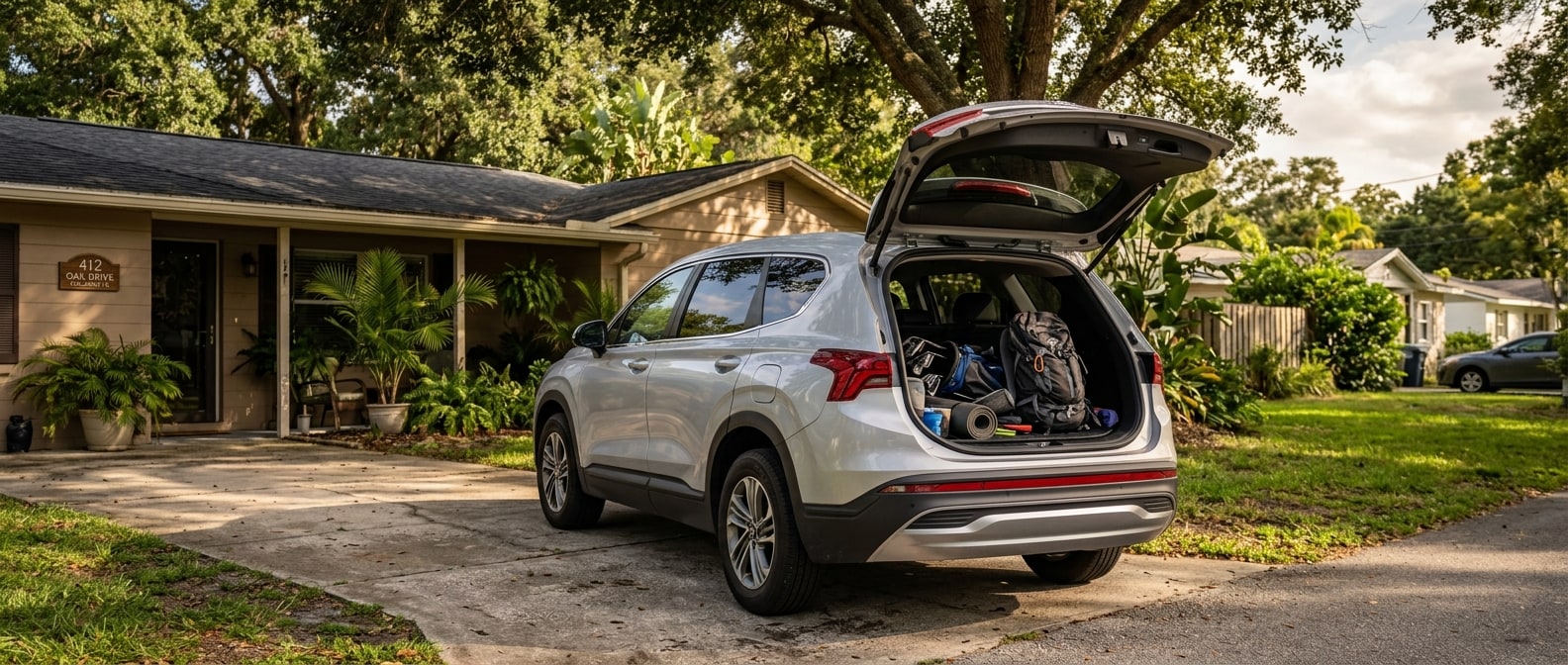
The right Hyundai SUV for your family in Callaway depends less on the model name and more on the specific years you're looking at, which is the part plenty of used-car guides skip. Buy the wrong window on a Tucson and you get the DCT transmission headaches that dogged the early third generation. Buy a pre-2019 Santa Fe Sport without checking VIN recall status and you may be inheriting a documented Theta II engine situation. Get the right years on either one, though, and you've got a solid family hauler that handles Bay County's heat and stop-and-go without drama.
We put this guide together because our team fields the same set of questions when families from Callaway and the surrounding areas come into Bay Hyundai. Which years are clean, which years carry baggage, and which model actually fits your headcount. The answers are specific, so here they are.
The short version
- Tucson sweet spot: 2020 and 2021 (third-gen 6-speed automatic, clean NHTSA complaint profiles (per NHTSA data the 2021 carries just 1 recall and approximately 55 owner complaints))
- Tucson years to avoid: 2016 and 2017 (7-speed dual-clutch transmission, 4 recalls and over 1,100 owner complaints on file per NHTSA for the 2016)
- Santa Fe sweet spot: 2019-2023 fourth generation with the Smartstream engine family (the generation that broke from the Theta II engine recall history)
- Santa Fe years to watch: 2013-2018 (third-gen Santa Fe Sport with Theta II engine and documented ABS module fire recall history, per NHTSA)
- Palisade sweet spot: 2022-2023 (facelifted generation, lower complaint counts than the 2020-2021 launch years)
- Three seats or two? Tucson fits families of four comfortably; Santa Fe handles five; Palisade is the one for six-plus or the family that also hauls gear regularly
Browse our current used Hyundai SUV inventory
Which years are the sweet spot for a used Hyundai Tucson?
The 2020 and 2021 Tucson are the clearest targets in the used market for Callaway families right now, and the reason comes down to one mechanical decision Hyundai made midway through the third generation. Starting with the 2019 model year, Hyundai replaced the 7-speed dual-clutch unit with a conventional 6-speed automatic. That swap matters because the earlier DCT had a well-documented pattern of shuddering and hesitation under load, especially in the kind of low-speed, high-heat stop-and-go driving that defines a Callaway-to-Panama-City commute along US-98 in July.
The 2021 is the cleanest year in that generation by a wide margin. Per NHTSA complaint data, the 2021 Tucson carries just 1 recall and approximately 55 owner complaints on file, the slimmest profile in the entire third-gen run. The 2020 is nearly as solid. Both give you a settled mechanical package, a 2.4-liter naturally aspirated engine that doesn't ask much maintenance-wise, and enough cabin space for two car seats and a stroller run to John B. Gore Park without anyone complaining about legroom.
There's a genuine tradeoff worth naming with the 2020-2021 cabin, which sits a generation behind in tech compared to the fourth-gen 2022-and-up Tucsons, meaning an older infotainment layout and fewer standard driver-assistance features. If modern connectivity is a priority that gap is real, but for a family that wants mechanical confidence without first-year-generation risk, the 2020-2021 window is where we'd start. More often than not.
| Model Year | Generation | Transmission | NHTSA Recalls | Approx. NHTSA Complaints | Sweet Spot? |
|---|---|---|---|---|---|
| 2016 | 3rd gen | 7-spd DCT (1.6T) / 6-spd auto (2.0) | 4 | 1,100+ | Avoid |
| 2017 | 3rd gen | 7-spd DCT (1.6T) / 6-spd auto (2.0) | Elevated | Elevated | Avoid |
| 2018 | 3rd gen | 6-spd auto | Moderate | Moderate | Proceed with inspection |
| 2019 | 3rd gen | 6-spd auto | 3 | 369 | Proceed with inspection |
| 2020 | 3rd gen | 6-spd auto | 1 | ~153 | Yes |
| 2021 | 3rd gen | 6-spd auto | 1 | ~55 | Yes (cleanest) |
| 2022 | 4th gen | Various | 3 | 433 | First-year caution |
| 2023 | 4th gen | Various | Moderate | Moderate | Solidifying |
See new Tucson models for reference on trim and feature comparisons
Which Tucson years should you watch out for?
Two ranges on the used Tucson deserve real caution, and while neither is an automatic no, both carry baggage worth naming plainly before you sign anything. The 2016 Tucson with the 1.6-liter turbocharged engine and 7-speed dual-clutch transmission is the year we'd steer families away from entirely. Per NHTSA complaint data, the 2016 alone accumulated 4 recalls and more than 1,100 owner complaints, largely concentrated in powertrain behavior like shuddering, hesitation, and delayed response under load. The 2017 carries similar concerns on the DCT-equipped trims.
The 2022 is a different kind of "watch out." It's the first year of the redesigned fourth generation, and first-model-year launches routinely carry more complaints than the same platform a year or two later. Per NHTSA data, the 2022 Tucson logged 3 recalls and 433 owner complaints, with powertrain and fuel system issues as the most common categories. None of that is a reason to rule it out, but it's a reason to run the VIN, get a pre-purchase inspection, and confirm all recalls are completed before you sign.
The practical move on any used Tucson is simple enough. Pull the VIN through NHTSA.gov before the test drive, and know that our team can check recall completion status on any vehicle we're showing you. A recall that's already been remedied at a dealer is a non-issue. One that's still open is a conversation worth having before the paperwork starts.
Compare used-eligible Santa Fe trims on our model page
Which years are the sweet spot for a used Hyundai Santa Fe?
The 2019 fourth generation is where the Santa Fe story turns a real corner for family buyers, though the older Sport years can still work if you do your homework on the paperwork first. The Smartstream engine family that debuted in 2019 is a clean break from the Theta II engine that defined the third-generation Santa Fe Sport's recall history. The 2019-and-up models don't carry the documented bearing failure risk that made 2013-2018 Santa Fe Sport ownership complicated. Start your search there for that reason alone.
Within the fourth generation, 2022 and 2023 are the years that have had time to mature. The 2021 refresh brought updated powertrains (including the hybrid option with a 1.6-liter turbocharged four-cylinder and combined 226 horsepower, standard HTRAC all-wheel drive) and restyled interior, but it also logged more recalls than 2020 as the refreshed hardware settled in. The 2022 and 2023 have lower NHTSA complaint volumes for the fourth gen, and the 2020 is a solid, lower-drama choice if budget is a consideration and you don't need the hybrid option.
For families in Callaway, the Santa Fe's real-world argument is the cabin. The second row slides. You get genuine five-passenger comfort without the squeeze that happens on longer hauls to Pensacola or Tallahassee. And the cargo floor behind that second row is actually usable when it's configured for passengers, which not every mid-size SUV manages well.
| Model Year | Generation | Engine | Key Notes | Verdict |
|---|---|---|---|---|
| 2013-2018 | 3rd gen (Sport) | Theta II 2.4L / 2.0T | Documented recall history; verify VIN for recall completion | Proceed with eyes open |
| 2019-2020 | 4th gen | Smartstream 2.4L | Clean engine break from Theta II era | Good window |
| 2021 | 4th gen (refresh) | 2.5L / 1.6T Hybrid | Refresh year; 10 recalls on file per NHTSA | Inspect carefully |
| 2022-2023 | 4th gen | 2.5L / 1.6T Hybrid | Lower complaint counts; hybrid available | Sweet spot |
Tip: If you're looking at any Santa Fe Sport from 2013-2018, pull the VIN at NHTSA.gov and Hyundai's recall portal before anything else. The Theta II engine recall (NHTSA tracking multiple campaigns) and the separate ABS module fire recall both affected this generation. A fully remedied vehicle isn't automatically a dealbreaker, but you need to confirm the work is documented and completed. Our service team can help you read that history on any unit we carry.
Which years work best for a used Hyundai Palisade?
The Palisade launched for the 2020 model year, so there's no long history to sort through, but the data still points to a clear best window for families who need three rows. What it shows is a steady improvement arc as the generation matured. The 2020 and 2021 carry the highest complaint counts in the lineup, driven in part by a wiper motor issue across those years (NHTSA issued recalls covering 2020-2021 Palisades for a windshield wiper motor that could fail). A 2021 recall also covered a tow hitch harness module that could accumulate debris and moisture. Confirm both are resolved on any specific vehicle before you get attached, since neither is a reason to panic on its own.
The 2022 facelifted Palisade is where we'd aim for families that need genuine three-row space. The complaint profile is meaningfully lower than the launch years. Per NHTSA data, the 2022 logged 5 recalls and 241 owner complaints, with seat belt and wiper issues as the most common categories (those recalls carry remedies and should be confirmed complete). Its 2023 sibling carries a similar profile. Both benefit from the facelift updates (revised front styling, upgraded materials, and improved standard equipment on mid-tier trims).
See the current Palisade lineup at Bay Hyundai
For larger Callaway families, the Palisade's pitch is straightforward. It's the only one of these three that seats seven or eight without a squeeze. The third row is genuinely usable for adult passengers, not just the emergency fold-up you get in some competitors. If your household is two adults and three-plus kids, or you're running carpool duty week in and week out, the Palisade is the one worth stretching for.
Which year fits which Callaway family?
Matching the right model to the right year is where this all comes together, and the best pick shifts a fair amount depending on your headcount and how far you drive. Here's how we'd frame it.
Family of four, daily driving, value-focused. The 2020 or 2021 Tucson is the call. Mechanically settled, simpler powertrain, lower running costs than the larger models, and enough interior space for two car seats and real-person second-row legroom. School runs, grocery loops, and the occasional weekend trip to Panama City Beach fit fine.
Family of five, mix of daily and road trips. The 2022 or 2023 Santa Fe hits the right balance. You get the fourth-gen Smartstream powertrain (no Theta II history), the option of the hybrid if you want EPA-estimated efficiency gains on longer Gulf Coast drives, and a second row that actually slides for passenger comfort. The 2019-2020 range works here too if you don't need the hybrid.
Family of six or more, or a household that hauls gear regularly. The 2022 or 2023 Palisade is the straightforward answer. Don't try to fit six people into a Tucson. The Palisade's third row does the job, and the rear cargo area is still workable even with all seats occupied.
On a tighter budget, need to go older. On a Tucson, stay in the 2018-2021 range and avoid the DCT-equipped 2016-2017. On a Santa Fe, skip the third-gen Sport unless you've fully verified the Theta II and ABS recall history via NHTSA. The 2019 and up is where the confidence floor sits.
There's one more thing worth naming, and it's specific to where we live. The Gulf Coast's June-through-September heat load is real. These vehicles will spend time sitting in full sun, running AC at full tilt, and idling in slow beach traffic, which is a legitimate stress test for older transmissions and cooling systems. A pre-purchase inspection from a Hyundai-trained technician isn't optional on a used vehicle in this climate. A skipped one is the difference between a good buy and an expensive lesson.
Get a Trade-In Value for Your Current Vehicle
Frequently Asked Questions
Is a used Hyundai Tucson reliable enough for a family car?
The answer depends directly on the model year. The 2020 and 2021 Tucson, both running the conventional 6-speed automatic transmission Hyundai introduced in the 2019 model year, have the cleanest NHTSA complaint profiles in the third generation. Per NHTSA data, the 2021 carries just 1 recall and approximately 55 owner complaints. The 2016 and 2017 models with the 7-speed dual-clutch transmission are the ones to approach with care, given 4 recalls and more than 1,100 complaints on file for 2016 alone. Stay in the 2019-2021 window and the reliability picture is solid.
What's the difference between the Hyundai Santa Fe and Tucson for a growing family?
Size and passenger capacity are the main distinctions. The Tucson is a compact SUV that fits four adults or two adults with two child seats comfortably; it's the right fit for smaller families or those who prioritize easier parking and lower running costs. The Santa Fe steps up to mid-size territory with a sliding second row and genuinely comfortable space for five. If your family has three kids or you regularly carry five adults, the Santa Fe is worth the price step. Neither seats more than five. If you need six or seven seats, the Palisade is the model to look at.
Do I need to worry about Hyundai's Theta II engine recall on a used Santa Fe?
Yes, if you're shopping a third-generation Santa Fe Sport (2013-2018). The Theta II 2.4-liter and 2.0-liter turbocharged engines in those model years carry a documented manufacturing recall history involving connecting rod bearing wear. The fourth-generation Santa Fe (2019 and up) uses the Smartstream engine family and does not share that recall history. For any pre-2019 Santa Fe Sport, run the specific VIN through NHTSA.gov and Hyundai's recall portal before buying; confirm all campaigns are remedied and documented. Our team can walk you through that check on any used vehicle we carry.
Categories:
Social


