

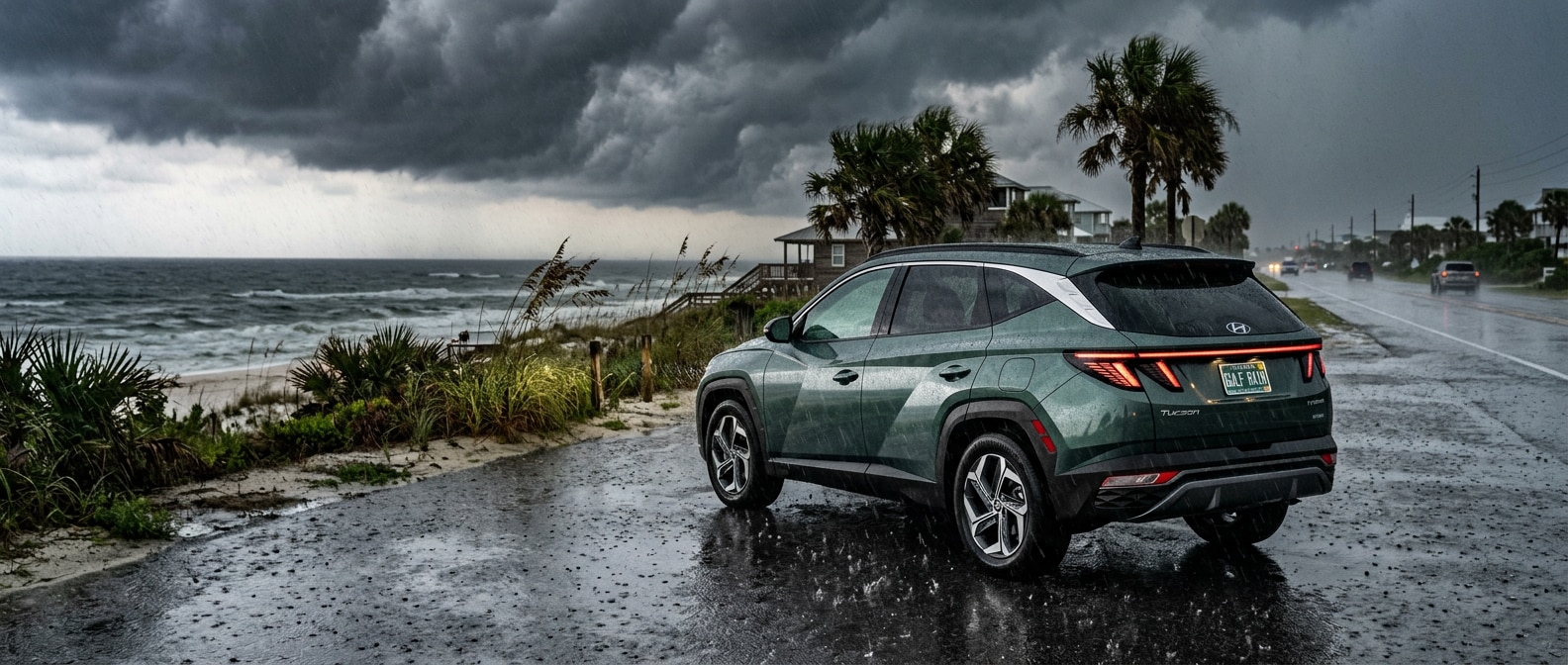
September in Panama City, FL, isn't a drizzle month. Tropical moisture, Gulf Coast heat, and a low-pressure system off the coast can team up to dump multiple inches of rain in a single afternoon. We see the results when a vehicle wasn't ready. Blown wipers, mushy pedals, tires that lose contact with the road before the driver reacts. Four checks separate a Hyundai that handles that rain with confidence from one that scares you on the way home.
The Tucson makes a good frame of reference here, though everything below applies to every Hyundai on our lot. Handle these before the next system spins up.
What to Do (and What to Skip) Before a Gulf Coast Downpour
Four checks carry most of the load before a downpour, and the table below pairs each one with the coastal reason it matters and the single bad habit that quietly undercuts it. None of these takes long to run, but skipping one can undo the other three the moment the road turns to standing water.
| Check | Do This | Don't Do This | Why It Matters Here |
|---|---|---|---|
| Tires | Verify tread at or above 4/32" using the quarter test | Trust the penny test alone as your signal | AAA testing at 60 mph showed tires at 4/32" need 87 additional feet to stop on a wet road compared to new tires; September squalls hit fast |
| Tire pressure | Use your door-jamb placard number, checked in the morning before driving | Use the max PSI molded into the sidewall | The sidewall number is the tire's maximum, not your target; underinflated tires reduce the contact patch that channels water away |
| Wiper blades | Replace any blade that chatters, streaks, or leaves a film | Wait until they stop working entirely | Gulf Coast UV and salt air eat through rubber faster than inland climates; blades that were fine in June may already be degraded |
| Brake fluid | Have a technician check moisture content if it's been over two years | Ignore it because the pedal feels normal | Brake fluid is hygroscopic. In Panama City's high-humidity summer, moisture absorption accelerates, and that moisture lowers the fluid's boiling point under hard braking |
The Technique That Changes Everything: Tires Are Your Real Defense
Wipers get the attention before a storm, but the tires decide whether your Hyundai stops or slides, so they earn the first look. A wet road with standing water needs your tread grooves to push water out from under the tire at speed, and that job falls apart once the rubber wears down. When tread drops below 4/32", those grooves can't displace water fast enough, and the tire starts to ride on top of the water film instead of cutting through it. Hydroplaning follows. It can happen at speeds as low as 35 mph, per NHTSA data, and it shows up in ordinary rain, not just catastrophic flooding.
Skip the penny test and reach for a quarter instead, since it fits this market better. Slip a quarter into a tread groove with Washington's head pointing in. If you can see the top of his head, you're at or below 4/32". The penny test only flags the moment you've already crossed the legal floor. On a Gulf Coast September highway, that's too late.
Pressure matters as much as tread depth. An underinflated tire deforms at the contact patch, which narrows the channel each groove can evacuate. Your door-jamb sticker carries the correct cold-pressure target for your specific Tucson Hybrid, Santa Fe, or whichever Hyundai you're driving. Check it in the morning before the car's been sitting in the sun (an hour on hot summer pavement adds real pressure to the reading).
Keep the Whole System Honest
Tires, wipers, and brake fluid don't fail in isolation, so the smart move before a squall is to treat them as one system rather than four separate errands. A vehicle with solid tread but degraded wiper blades still leaves you driving blind in a downpour on US-98. Check all four systems together, especially heading into September and October, when Panama City typically sees its most active tropical weather. Our service team at Bay Hyundai handles these checks in a single visit, so nothing slips through.
By the Bay Hyundai Team | September 2026


