


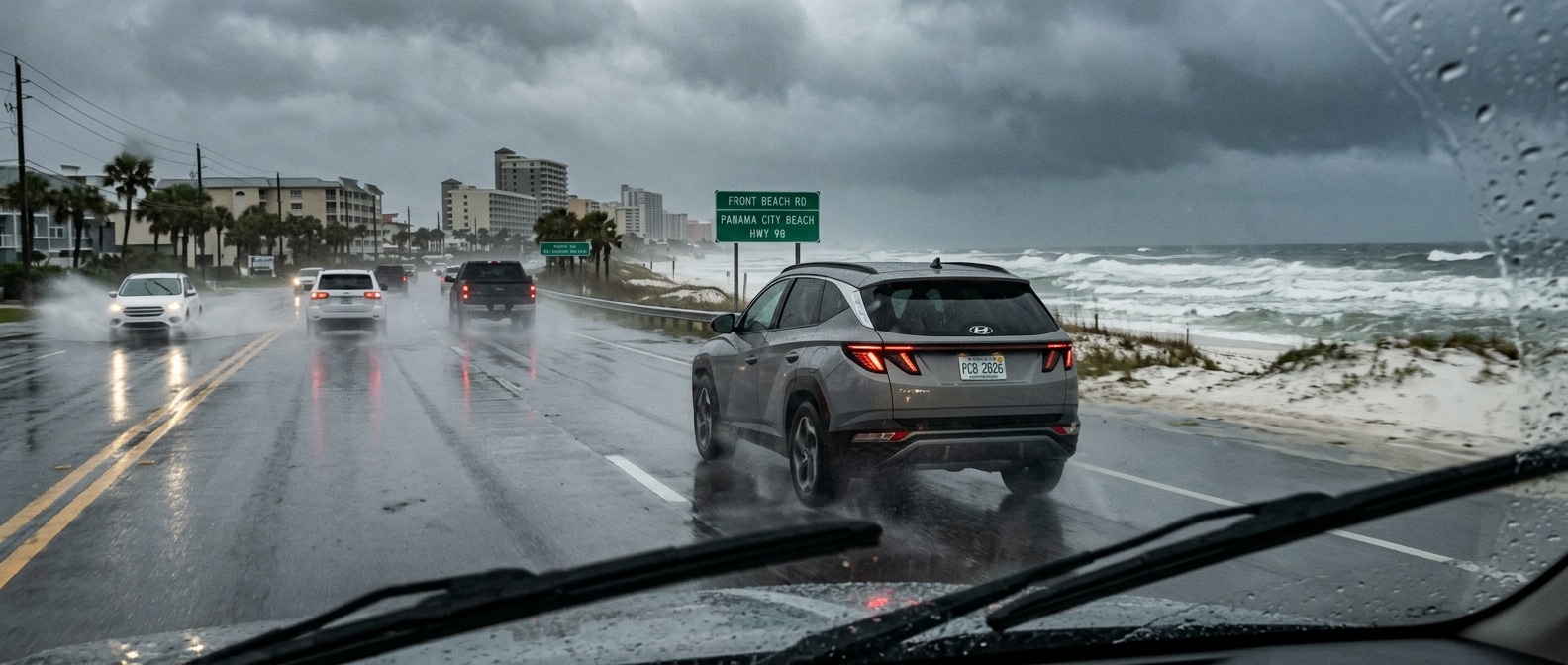
Not every system inside Hyundai SmartSense performs the same way once the rain picks up on Front Beach Road, and that's worth knowing before you lean on it. Two categories exist. The first group stays fully active regardless of conditions. The second group (the camera-and-radar-dependent assists) does meaningful work in moderate rain, though heavy Gulf Coast downpours can cut into their effectiveness for a while. Knowing which is which beats a brochure-style feature list, and that's what we'll walk through here.
Browse the 2026 Tucson lineup at Bay Hyundai
How Well Do These Systems Actually Work in Heavy Rain?
How well they hold up depends entirely on which layer of the system you're asking about, and the split is real: the electromechanical safety net works no matter the weather, while the camera-and-radar assists earn their keep in moderate rain but give ground in a true downpour. Across a typical year, Panama City gets roughly 59 inches of rain, with the Gulf Coast thunderstorm season running June through September. Front Beach Road sees some of the heaviest tourist and commuter traffic in the area right when afternoon rain squalls roll in off the water. So this question isn't theoretical.
Which layer you lean on changes everything about the answer.
| Safety Feature | Technology Behind It | Rain Performance | Key Limitation |
|---|---|---|---|
| Anti-lock Brakes (ABS) | Electromechanical, wheel-speed sensors | Fully active in all conditions | None |
| Electronic Stability Control (ESC) | Electromechanical, wheel-speed sensors | Fully active in all conditions | None |
| Forward Collision-Avoidance Assist (FCA) | Radar plus front camera | Radar holds up; camera can degrade in extreme spray | Per Hyundai's 2026 owner documentation, camera field of view is affected by wet-surface glare and road spray |
| Lane Keeping Assist (LKA) | Front camera reads lane markings | Functional in moderate rain; reduced in heavy spray | Faded pavement markings compound the effect |
| Lane Following Assist (LFA) | Front camera plus steering assist | Same as LKA | Designed for steady highway speeds, less suited to stop-and-go beach-road traffic |
| Driver Attention Warning (DAW) | Monitors steering patterns for fatigue signs | Unaffected by rain | Continues monitoring during slow coastal traffic |
| Blind-Spot Collision-Avoidance Assist (BCA) | Rear-corner radar | Performs well; radar is rain-tolerant | Bumper debris can reduce radar signal; rinse after beach driving |
The split matters. ABS and ESC are electromechanical, so they respond to wheel-speed sensor data rather than camera feeds. They work the same in a wall-of-water Thursday squall as they do on a clear January morning, and that foundational layer isn't going anywhere.
Per Hyundai's own 2026 owner documentation, radar performance can drop when rain accumulates directly on the bumper-mounted sensor, and the front camera's field of view can be briefly affected by glare reflected off wet road surfaces. FCA, LKA, and LFA depend on cameras and radar together, so both of those conditions touch them. Those aren't lawyer-written fine-print disclaimers. It comes down to physics, and the same limits apply to every manufacturer's camera-based ADAS system.
Which Features Need Your Help in Coastal Conditions?
Schedule a service appointment at Bay Hyundai
The camera-dependent features perform their best when you give them conditions to work with, and on Front Beach Road that means doing a little of the work yourself, because salt air and traffic spray are exactly what the sensors struggle to see through. Front Beach Road throws a specific mix at these sensors, salt air, road spray from surrounding traffic, and the kind of horizontal rain that Gulf squalls push off the water. A salt-and-grime-coated front bumper is exactly the condition that compromises radar sensing. Our team sees this pattern on Gulf Coast vehicles.
The tradeoff is straightforward. The SmartSense suite does real work here, and it comes standard across every 2026 Hyundai trim no matter which model you're driving. You're not paying extra for it. What the camera-assisted features ask in return is simple. Clean sensors. Functioning wiper blades. And the judgment to increase your following distance when the system signals it's operating at reduced capacity. Those instrument-cluster warnings mean something.
Per Hyundai's 2026 owner documentation, heavy rain, road spray, and wet-surface glare are identified conditions that can temporarily reduce camera and radar effectiveness. The always-active layer (ABS, ESC) is never affected.
- [ ] Inspect the front bumper for road grime, salt deposits, and bug accumulation before a rainy season drive
- [ ] Confirm wiper blades clear the full windshield arc without streaking (the front camera mounts behind the glass and reads through it)
- [ ] Add at least one extra car length of following distance during active rain; SmartSense supports your judgment, it doesn't replace it
- [ ] Watch the instrument cluster for system-temporarily-unavailable indicators; if FCA or LKA shows a caution, treat that segment as a manual-driving situation until the sensor clears
- [ ] After driving Front Beach Road in heavy spray or salt air, rinse the front bumper and rear-corner areas with fresh water to clear sensor zones
Schedule a Pre-Rainy-Season Service Check
Plan Your Rainy-Day Drive This Way
See 2026 Santa Fe inventory and 2026 Palisade options if road clearance and a higher seating position matter to you, since a congested, spray-heavy stretch of Front Beach Road is exactly where sitting higher pays off. On that kind of road, a taller seating position genuinely extends your sightline over the traffic-generated spray from trucks and SUVs ahead. It isn't a sales pitch, just a real ergonomic variable.
Here's how we'd plan a confident rainy-day drive.
- Lead with the foundation. Trust ABS and ESC completely. They don't need clear skies, and they're doing the heaviest wet-road safety work before you even think about the ADAS layer.
- Give the camera-assist layer what it needs. Clean bumper sensors, working wipers, and a clear windshield aren't optional. For a Gulf Coast vehicle exposed to salt air and beach-road spray, treating the sensor zones the same way you treat your windshield is the right standard of care.
- Use Smart Cruise Control with Stop and Go thoughtfully. On congested beach-road stretches, the radar-based system maintains your set following distance. In moderate rain, it performs well. In a true squall, manually extend your following distance and let the system support rather than lead.
- Understand the lane-marking variable. Some pavement on Front Beach Road and the surrounding corridors has less vivid lane striping than freshly paved asphalt. LKA reads those markings through the front camera. In heavy rain over faded lines, the system may pause its steering inputs. The system pausing there is expected, documented behavior.
- The rain stopping isn't the same as the road clearing. Traffic-generated spray persists for several minutes after a shower ends. Camera systems are still contending with wet conditions even when the sky looks clear. Keep your extra following distance until spray settles.
By the Bay Hyundai Team | September 2026
Frequently Asked Questions
Do Hyundai SmartSense features still work when it's raining hard?
The always-active electromechanical systems (ABS, Electronic Stability Control) are fully operational in all rain, including heavy Gulf Coast downpours. Camera-dependent features such as Lane Keeping Assist and Forward Collision-Avoidance Assist can see reduced effectiveness during extreme downpours or when road spray occludes the front camera or rain accumulates on the bumper-mounted radar sensor. Hyundai's 2026 owner documentation identifies these as known sensor limitations. Increasing your following distance and monitoring the instrument cluster for system-status warnings during heavy rain is the practical response.
Will Lane Keeping Assist keep me in my lane on a wet road?
Lane Keeping Assist reads painted lane markings through the front camera and provides gentle steering corrections. In moderate rain with clearly visible markings, it functions well. In heavy downpours, water sheeting across the windshield and road spray can temporarily reduce the camera's ability to read those markings, and the system may pause its steering inputs. Faded pavement markings compound this. Treat LKA as a fatigue-reducing support tool, not a substitute for active steering on a wet road.
Does rain block the radar the same way it affects the camera?
Radar and cameras respond to rain differently. The bumper-mounted radar sensor that supports FCA and Smart Cruise Control is more rain-tolerant than the front camera, but Hyundai's 2026 sensor documentation specifically identifies rain, dirt, and debris accumulating on the bumper area as conditions that reduce radar function. Keeping the front bumper clean after Gulf Coast driving (especially salt-air and beach-road spray) is the most practical step you can take to maintain consistent radar performance.
Categories:
Social


