

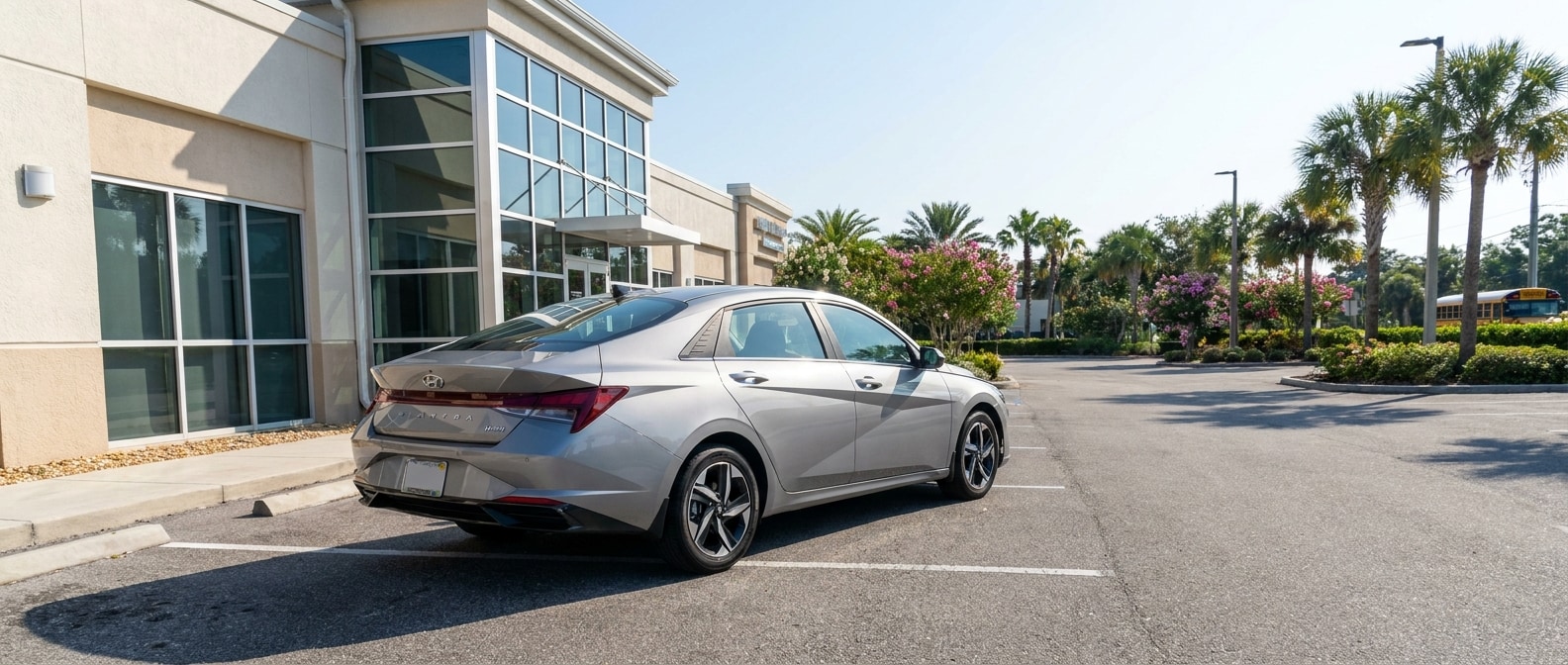
Commuting between Ascension Sacred Heart Bay on 23rd Street and home somewhere in Panama City, you're not really asking whether to buy an Elantra. You're asking which Elantra fits how you actually drive. Three distinctly different versions wear the same nameplate, and picking the wrong one's easy to do.
- Elantra Hybrid: The clear pick for teachers and nurses driving 25 or more miles round-trip daily (the EPA rates the Blue trim at 54 mpg combined, and regenerative braking recovers energy in the stop-and-go traffic along US-98).
- Elantra (gas): Makes sense if your commute's genuinely short and you want a lower entry point with a simpler, familiar drivetrain.
- Elantra N: A legitimate performance sedan with 276 hp. The EPA rates it at 21 city / 29 highway, and it costs significantly more. Not the commuter tool the other two are.
- One honest tradeoff: The Hybrid costs more upfront than the gas Elantra. If you're under 15 miles each way, that gap takes a long time to close at the pump.
- All three share the same exterior dimensions, Hyundai SmartSense safety suite (standard), and wireless Apple CarPlay. The platform's solid across the board.
Upfront investment versus miles-driven payoff is the core tradeoff here. The Hybrid earns back its price difference through fuel savings, though it needs the daily miles to get there. On a long Bay County commute, the math lands in your favor. On a short one, the gas Elantra's perfectly rational.
Browse 2026 Elantra Hybrid inventory at Bay Hyundai
How Do the Three Elantras Actually Compare?
The powertrain gap across these three runs wider than the shared badge suggests, since the Hybrid is a fundamentally different mechanical package from the gas Elantra and the N chases outright performance, which means the smart way to compare them is by fuel economy, price, and drive feel rather than by trim name. Same badge, three very different cars.
| Elantra (Gas) | Elantra Hybrid | Elantra N | |
|---|---|---|---|
| Horsepower | 147 hp | 139 hp combined | 276 hp |
| EPA City / Hwy MPG | 31 / 40 | 51 / 58 (Blue) | 21 / 29 |
| EPA Combined MPG | 35 | 54 (Blue) / 50 (SEL Sport, Limited) | 23-24 |
| Transmission | IVT (automatic) | 6-speed DCT | 6-speed manual or 8-speed DCT |
| Trims Available | SE, SEL Sport, SEL Sport Premium, Limited, N Line | Blue, SEL Sport, Limited | N |
| Fuel Tank | 14.0 gal | 11.0 gal | 12.4 gal |
| Best For | Short commuters, simple ownership | High-mile daily commuters | Performance enthusiasts |
All figures are EPA estimates for comparison purposes, and actual mileage varies with your habits and conditions. Yes, the Hybrid carries a smaller 11-gallon tank than the gas model, but its per-mile efficiency means fewer stops at the pump. The EPA estimates the Blue trim can travel over 630 miles on one tank at highway speeds.
Does the Elantra Hybrid Make Financial Sense for Bay County Shift Workers?
Whether the Hybrid pays off depends on your schedule and your daily distance, and for Bay County shift workers covering serious stop-and-go miles the answer leans yes, while a genuinely short commute tilts the value back toward the gas Elantra. The efficiency advantage is real. If you're driving US-98 through Panama City toward a morning shift, that's your profile.
Regenerative braking (the system that recovers kinetic energy every time you ease off the throttle or brake) works hardest in urban stop-and-go traffic. The EPA's city rating for the Hybrid Blue (51 mpg) actually beats its highway number (58 mpg is the high, though the city-versus-highway gap runs much narrower on hybrids than on gas cars). Hyundai tuned this drivetrain toward commute patterns rather than highway cruising. A nurse working three twelve-hour shifts a week and a teacher driving five days a week both rack up the kind of annual mileage where a 19-mpg combined advantage over the gas Elantra turns into something you can feel at the pump.
One honest caveat is worth naming. The Hybrid costs more than the base gas Elantra, so on truly short drives the fuel savings won't recoup that difference quickly, and a short commute keeps the gas Elantra a perfectly reasonable call.
See gas Elantra options and explore the Elantra N if you want to compare all three before deciding.
Which Elantra Fits Your Situation
Each version of the Elantra fits a genuinely different driver, so the right choice leans less on the badge and more on your daily mileage, your budget, and whether you prize efficiency or a spirited drive. Our team frames it at Bay Hyundai like this.
If you're a teacher at a Bay District Schools campus and live in Callaway, Lynn Haven, or Mexico Beach: Your round-trip likely runs well over 20 miles, maybe 30 to 40, which lands squarely in the usage profile the Hybrid's built for. The SmartSense suite (forward collision-avoidance with pedestrian detection, lane-keeping assist, driver attention warning, and blind-spot collision warning) comes standard on every Hybrid trim, so you get that safety layer without shopping up to a pricier trim.
If you're a nurse doing night shifts and value cabin quietness: The Hybrid's combined gas-electric operation runs quieter at low speeds than a gas engine idling on its own, and that's not sales talk. The electric motor carries low-speed loads before the gas engine kicks in, which cuts engine noise right in the speed ranges you live in inside a parking garage or a neighborhood at 2 a.m.
If you want the fun car and the commute is almost incidental: The Elantra N is a legitimately quick sports sedan, with 276 hp, 289 lb-ft of torque (as listed in Hyundai's specifications), and a 0-60 that CarBuzz pegs at roughly 4.8 to 5.5 seconds. The EPA rates it at 21 city / 29 highway, and it drinks premium fuel. Buying one's a decision to enjoy the drive, with the commute as an afterthought. No shame in that, just go in clear-eyed.
If budget is the primary driver and your commute is genuinely short: The standard gas Elantra (147 hp, EPA-rated at 31 city / 40 highway / 35 combined with the base 2.0L) is a capable, tech-rich sedan carrying the same SmartSense safety features and wireless connectivity. Think of it as a straightforward car that does exactly what it says.
Check our financing options to compare how the trim gap looks over your loan term.
Frequently Asked Questions
Does the Elantra Hybrid require plugging in to charge?
No. The 2026 Elantra Hybrid is a conventional self-charging hybrid rather than a plug-in (PHEV). The battery charges through regenerative braking and the onboard gasoline engine while you drive, so there's no external charging port and no station hunting. For Bay County drivers worried about EV infrastructure, that makes the Hybrid an easy step over from a gas-only car.
Which Elantra trim is most practical for a nurse or teacher doing 30 miles round-trip daily in Panama City?
The Elantra Hybrid Blue trim's the most straightforward choice for that commute profile. The EPA rates it at 54 mpg combined (the highest in the lineup), and it arrives standard with Hyundai SmartSense, wireless Apple CarPlay, and LED headlights. Step up to the SEL Sport or Limited and you add comfort and tech (a 10.25-inch dual-screen setup on the Limited, H-Tex leatherette seating) while giving back a few mpg (50 combined vs 54). If you commute in the dark during shift changes and want better seat comfort for long parking-lot waits, the Limited's upgrades earn their keep. For pure daily-driver efficiency, though, the Blue gets it done cleanly. By the Bay Hyundai Team | August 2026


