


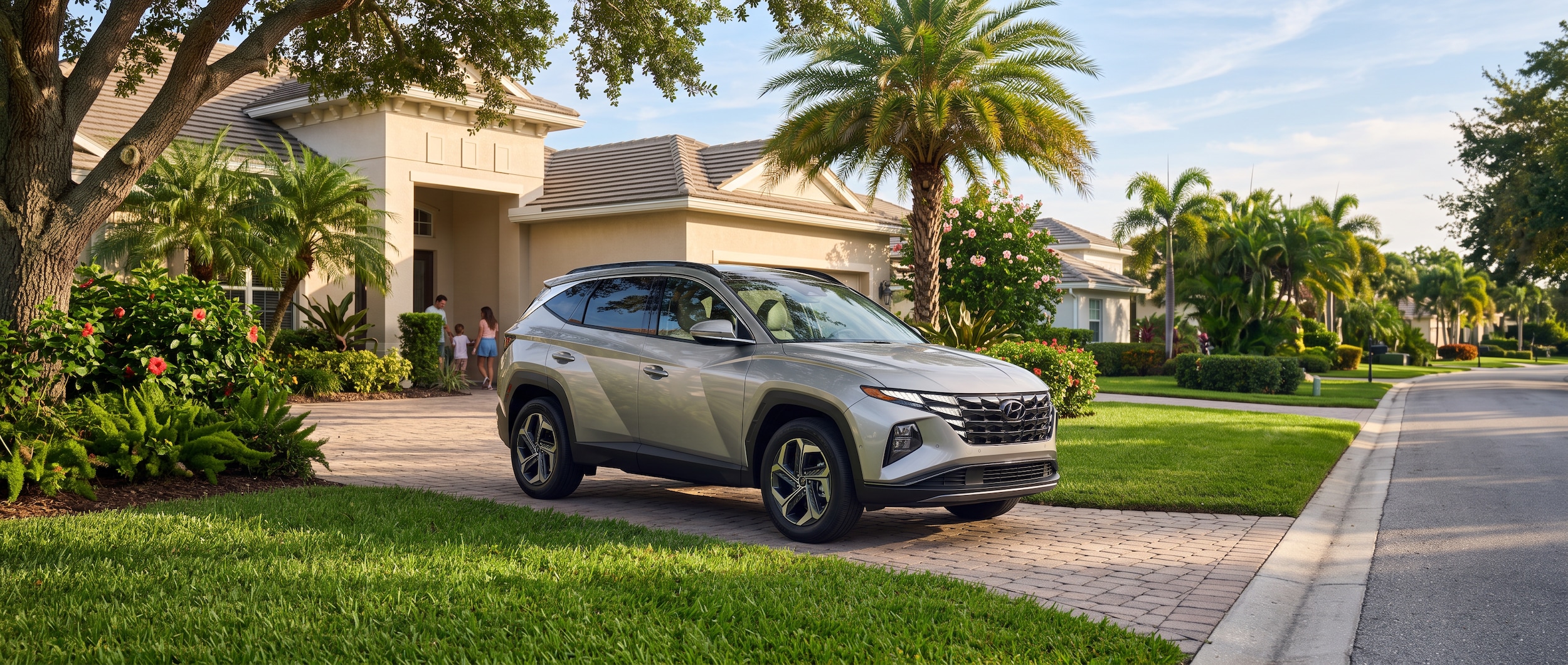
Three frustrations earn the 2026 Hyundai Tucson Hybrid its place in a Lynn Haven driveway, and none of them comes down to a single spec. Fuel costs on back-to-back school and work runs, summer tourist congestion on US-77, and the August heat that makes a parking lot genuinely dangerous for kids all line up with things this SUV was engineered to handle. We won't pretend it fits everyone. If you regularly haul more than five people or tow anything over 2,000 pounds, we'd steer you toward the Palisade Hybrid instead. For most families running the Panama City commute and weekend beach trips, though, the Tucson Hybrid hits the mark in ways a spec sheet can't quite explain.
What's Actually Going On With Your Family SUV?
Most family SUVs waste fuel in the exact conditions Lynn Haven drivers hit every day, and the weekly loop that causes it runs the same from house to house, from morning school drop through US-77 or US-390 south into Panama City for work, then back north, then errands, then maybe a beach run come the weekend. Stop-and-go, all of it. Sun-baked parking lots. Summer traffic that turns a 22-minute commute into 40 minutes when seasonal visitors hit the Panhandle roads. A conventional gas SUV just burns fuel sitting in that congestion (it doesn't do anything useful with the stopping).
The diagnosis isn't complicated once you see it. Your current SUV is a fuel consumer in exactly the conditions where the Tucson Hybrid is a fuel recapture machine.
| Family Pain Point | What's Causing It | How the Tucson Hybrid Addresses It |
|---|---|---|
| Gas costs spike during stop-and-go traffic | Conventional engine idles and brakes with no energy recovery | Regenerative braking charges the hybrid battery every time you slow; the electric motor handles low-speed pulls |
| Rear-seat cargo squeeze on family days | Assumption: hybrid battery eats trunk space | Tucson Hybrid's battery placement doesn't reduce cargo versus the gas model. Hyundai lists 38.7 cu ft behind the rear seats |
| Kids left in a hot parked SUV | Easy to forget in the rush, especially in August | Standard Rear Occupant Alert on every Hyundai SmartSense trim detects motion in the rear seat after you exit |
| Tourist-season congestion on Panhandle roads | High traffic density, frequent hard stops | HTRAC all-wheel drive works with the hybrid system to distribute torque smoothly; the 6-speed automatic (not a droning CVT) keeps the car composed |
| Rain and wet roads on beach days | Florida afternoon thunderstorms, slick surfaces | HTRAC AWD is standard on all four 2026 Tucson Hybrid trims, so you don't pay extra for it |
The Most Likely Culprit Is Stop-and-Go, and That's Where This Powertrain Shines
Stop-and-go traffic costs you more than time, and it's the clearest reason this powertrain earns its keep in Bay County, since the slow crawl is exactly the driving a hybrid turns to its advantage rather than wasting at the pump. Pull onto US-77 heading south on a Tuesday in late July, and you'll feel the difference between a gas SUV and a hybrid in your next fill-up.
Hyundai pairs a 1.6-liter turbocharged four-cylinder with an electric motor for a combined 231 horsepower and 271 lb-ft of torque. Every time the Tucson Hybrid slows (for a light, a school zone, a tourist who tapped the brakes in front of Bay Medical), regenerative braking converts that momentum back into battery charge. Then the electric motor handles the next low-speed pull off the line before the gas engine has to work hard. That cycle suits the driving Lynn Haven families do five days a week. The EPA rates the Blue SE at 38 mpg combined city and highway. Other trims come in at 36 mpg combined per EPA estimates.
Real-world results in mixed Gulf Coast driving land some owners closer to the low-to-mid 30s than the EPA peak. Warm weather and a blend of highway and stop-and-go account for most of that gap.
We'll level with you, though. Hyundai runs a 6-speed automatic transmission instead of the continuously variable transmission most competitors use, which gives a smoother, more responsive feel and hands back a few miles per gallon against the CVT hybrids in this segment. You trade a couple of mpg for a more natural driving experience. We think that's a fair swap for a lot of families, and you should know it going in.
The rear seat tells a similar story. A hybrid battery, the thinking goes, must shrink the cargo area. Not in this one. US News measured 41.3 inches of rear legroom in the Tucson Hybrid (near the top of the compact SUV segment), and Hyundai's packaging keeps cargo at 38.7 cubic feet behind the rear seat, opening to 74.5 cubic feet with the seats folded. Teenage kids fit back there. Travel bags fit. A week at the beach fits.
On summer heat and rear seats: Florida's August heat turns a parked car dangerous fast. The Tucson Hybrid's standard Hyundai SmartSense suite includes Rear Occupant Alert, which watches for movement in the rear seat after you exit and pings you through the horn and a notification. No system replaces your own attention, though it's a real, working safety net, and it comes on every trim at no additional cost.
The Print-and-Go Checklist: Is the Tucson Hybrid Right for Your Lynn Haven Family?
- [ ] Your household runs daily commutes between Lynn Haven and Panama City (US-77 / US-390 corridor)
- [ ] You carry two to four passengers regularly, not five plus a gear haul requiring three rows
- [ ] Weekend beach and errand driving is your main use case, not regular heavy towing over 2,000 lbs
- [ ] You want AWD standard on every trim without paying a separate option fee
- [ ] Summer heat and Florida afternoon rain are your main weather considerations (not ice or snow)
- [ ] You want a suite of driver-assistance features (forward collision avoidance, lane keeping, blind-spot warning) included standard
- [ ] Fuel efficiency is a priority, and you understand real-world results may fall below EPA estimates in mixed driving
- [ ] Cargo flexibility (38.7 cu ft behind the seats, 60/40 split-fold rear) fits your typical hauling pattern
Check three or more of those and you're looking at the right SUV. If towing or third-row seating checked your box, come have a different conversation with us about the Santa Fe Hybrid.
When to Handle It Yourself vs. When to Talk to Our Team
You can sort a lot of this yourself, and the specs are all verifiable, but figuring out whether a vehicle truly fits your family's real week rather than the imagined ideal one is the part we work through with you on the floor, and we'll walk you through every number. The question we find more useful is simpler. Write down the three drives you do every week that feel like the most wear on your budget or your patience.
If US-77 southbound in tourist season lands on that list, we should talk. If you're towing a boat every weekend or hauling seven people for a soccer carpool, we'll tell you straight the Tucson Hybrid isn't your answer, and we'll point you somewhere that is, no hard sell.
The SmartSense system on the 2026 Tucson Hybrid is also something we walk families through in person, because a brochure won't show you how Rear Occupant Alert actually works or how well the Forward Collision-Avoidance Assist performs in slow traffic. Give us ten minutes on the lot, and it genuinely changes the decision for a lot of parents.
Frequently Asked Questions
Does the 2026 Hyundai Tucson Hybrid actually get good gas mileage in Florida summer heat?
The EPA rates the 2026 Tucson Hybrid Blue SE at 38 mpg combined, with higher trims at 36 mpg combined. In the warm, mixed stop-and-go driving common around Lynn Haven and Panama City, some owners see real-world results closer to the low-to-mid 30s. Either way, that beats a conventional gas compact SUV by a meaningful margin, and the regenerative braking system means stop-and-go tourist traffic works in the hybrid's favor compared to a standard engine. Lighter-footed city driving tends to land closer to the EPA estimate.
Is HTRAC all-wheel drive worth it for a family in Lynn Haven where it never snows?
Yes, though not for snow. HTRAC AWD is standard on every 2026 Tucson Hybrid trim, so you're not paying extra for it. In a Gulf Coast market, the payoff shows up in Florida's afternoon thunderstorm season and on wet road surfaces, where the system distributes torque to maintain grip on slick pavement. It also pairs with the hybrid powertrain to deliver smooth power delivery at low speeds, which helps in the kind of stop-and-go traffic Bay County families deal with on summer weekends.
Categories:
Social


