


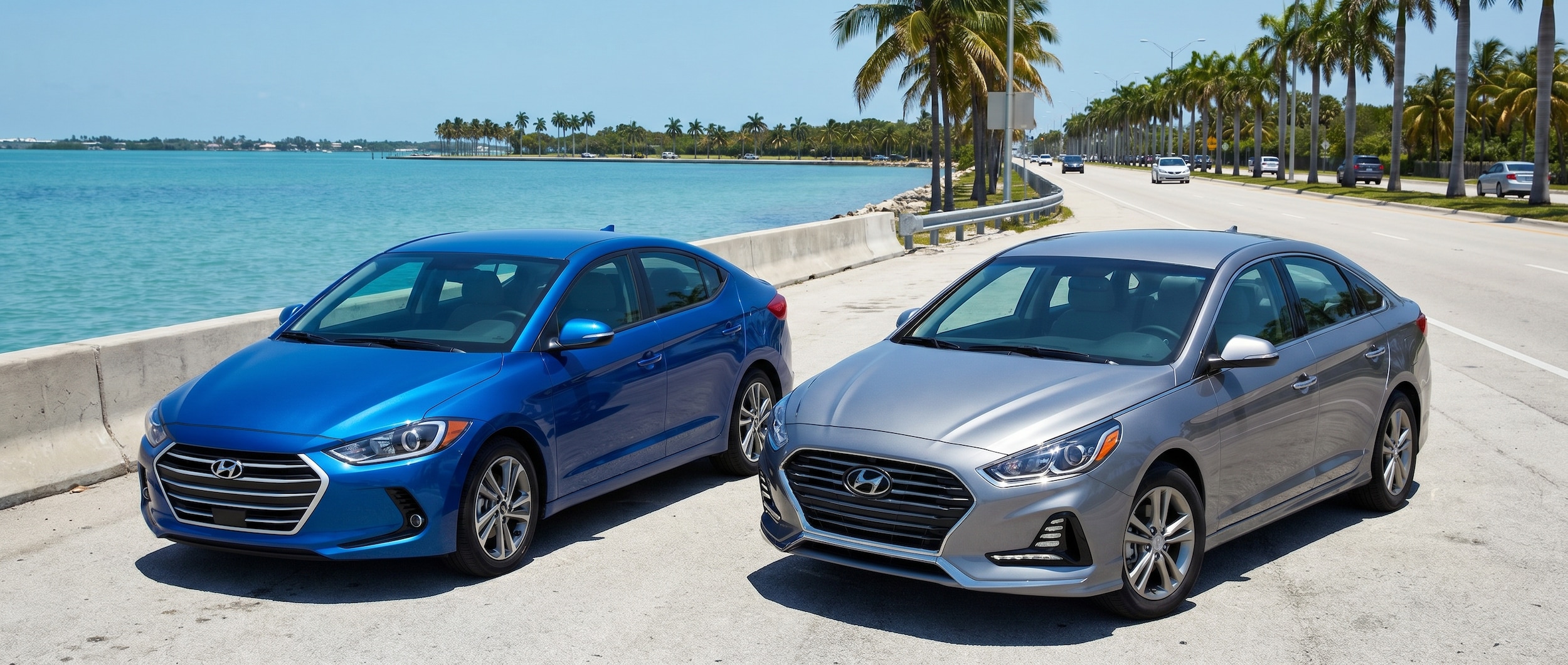
Both the 2026 Hyundai Elantra Hybrid and the Sonata Hybrid carry the word "hybrid" on the badge and self-charge as you drive -- no plugging in required. That shared label is also where a lot of buyers get tripped up, assuming the two cars deliver roughly the same fuel savings. They do not. The gap between them is meaningful, and it runs in opposite directions depending on whether your commute looks like Thomas Drive in July or a steady run on US-98.
The short answer: if most of your miles are stop-and-go coastal boulevard traffic, the Elantra Hybrid's EPA-estimated 54 MPG combined works harder for you. If you need more cabin for a family and your commute involves longer highway stretches, the Sonata Hybrid's 192 combined horsepower and midsize interior carry their weight.
The Elantra Hybrid earns its efficiency edge in city-style traffic, while the Sonata Hybrid trades some MPG for more power and rear-seat room -- a genuine trade-off, not a marketing one.
How Does the Hybrid Drivetrain Actually Work in Each Car?
Neither the Elantra Hybrid nor the Sonata Hybrid needs to be plugged in -- both recharge their battery packs automatically through regenerative braking every time you slow down or lift off the accelerator. That makes them especially well-suited to Panama City's summer driving rhythm, where stops at intersections along 23rd Street and slowdowns through the Pier Park corridor happen constantly from May through September.
The two systems share that principle but differ meaningfully in execution:
| 2026 Elantra Hybrid | 2026 Sonata Hybrid | |
|---|---|---|
| Engine | 1.6L Atkinson-cycle 4-cyl + electric motor | 2.0L GDI 4-cyl + 39 kW electric motor |
| Combined system power | 139 hp / 195 lb-ft torque | 192 hp / 181 lb-ft torque |
| Transmission | 6-speed dual-clutch | 6-speed automatic |
| EPA city / highway / combined (Blue trim) | 51 / 58 / 54 MPG | 47 / 56 / 51 MPG |
| EPA city / highway / combined (upper trims) | 49 / 52 / 50 MPG | 44 / 51 / 47 MPG |
| Self-charging (no plug-in) | Yes | Yes |
| Drive modes | Normal, Sport, Smart | Normal, Sport, Smart |
The Elantra Hybrid's smaller, lighter engine package is tuned specifically for maximum recovery efficiency in low-speed cycles -- which is exactly what the EPA city test measures, and what Panama City surface streets deliver. The Sonata Hybrid's larger 2.0L system prioritizes a more composed highway pull and mid-range power for merging; it recovers energy well, but its heavier platform means more energy spent moving the car in the first place.
Both systems include Hyundai SmartSense driver assistance as standard, including forward collision avoidance, lane-keeping assist, and blind-spot monitoring -- features that genuinely reduce fatigue on a commute like the Hathaway Bridge crossing, where lane changes through the bridge approach happen at steady highway pace.
Which One Do You Actually Need for a Panama City Commute?
Panama City commutes tend to be moderate in distance but high in thermal and traffic stress. A July drive from Lynn Haven toward downtown on US-231 runs into consistent stop-and-go before picking up on the highway segment -- exactly the mixed-use case where these two cars separate themselves.
The Elantra Hybrid fits you if:
- Your daily route is primarily surface streets, shopping corridors, or beach-town boulevard traffic
- You drive solo or with one regular passenger most of the time
- Getting the most MPG out of every gallon is your first criterion
- Parking at work, the commissary, or the beach lot is tight
The Sonata Hybrid fits you if:
- Your commute includes meaningful highway miles on US-98 where 192 horsepower gives confident merge room
- You regularly carry a back seat full of kids or carpool with colleagues
- You want the 12.3-inch standard touchscreen and a more spacious feel the moment you sit down
- Trunk space for beach gear, a stroller, or weekend luggage matters week to week
The EPA's city figure tells an honest story about stop-and-go efficiency: the Elantra Hybrid at 51 MPG city versus the Sonata Hybrid at 47 MPG city. That four-point gap compounds over a full year of Panama City driving. At the same time, the Sonata Hybrid's extra 53 horsepower is not a vanity number -- on a highway on-ramp, it reads as confidence.
The Sonata Hybrid also carries more room where it counts for a family. Its passenger volume reaches 104.4 cubic feet against the Elantra Hybrid's 99.4 cubic feet, and trunk space runs 15.6 cubic feet versus 14.2 cubic feet. The Sonata is also 9.2 inches longer overall, which shows up as front-seat legroom (46.1 inches in the Sonata versus 42.3 inches in the Elantra) -- a real consideration for taller drivers doing daily drives.
Worth knowing: The Elantra Hybrid's rear legroom actually measures 38.0 inches, compared to the Sonata's 34.8 inches in back. If your passengers are mostly in the rear seat, the compact car's geometry works in your favor.
See Current Hyundai Hybrid Offers
Hybrid Terms Worth Knowing
| Term | What it means |
|---|---|
| Regenerative braking | The system recaptures kinetic energy when you slow down and stores it in the battery, topping it off automatically -- no plug needed |
| Atkinson cycle | An engine design that improves thermal efficiency at light loads, trading peak power for better fuel economy; used in the Elantra Hybrid |
| Combined system output | The total horsepower of the gasoline engine and electric motor working together, not just the gas engine alone |
| EPA combined MPG | A blended city/highway estimate; the city figure weighs more heavily for stop-and-go-heavy commutes like Panama City surface streets |
What This Means for Your Next Vehicle
Both sedans share the same Hyundai SmartSense foundation and the same principle: the fuel economy you get back from stop lights compounds over 12,000 to 15,000 miles per year in ways that feel abstract in a spec sheet and very concrete at the pump. The decision is not which car is "more hybrid" -- they both are, and neither requires any infrastructure to maintain that system.
The practical split for Panama City: the Elantra Hybrid is the sharper efficiency tool for the driver who owns a straightforward daily commute on surface streets and wants to squeeze every mile per gallon the car will offer. The Sonata Hybrid is the right call when the commute is real but the car also has to be a family car, a road-trip car, and a vehicle comfortable on longer highway runs up US-98 toward Fort Walton or down toward Panama City Beach.
Bay Hyundai carries both. Sitting in each one -- even in the parking lot -- makes the size difference obvious in about thirty seconds.
Frequently Asked Questions
Do either the Elantra Hybrid or Sonata Hybrid need to be plugged in to charge?
No. Both are self-charging hybrids that use regenerative braking to replenish the battery pack automatically every time you decelerate. There is no charging cable, no home charger installation required, and no range anxiety tied to a wall outlet. The system manages itself entirely during normal driving.
Which hybrid gets better fuel economy in city stop-and-go traffic?
The 2026 Elantra Hybrid holds the efficiency edge in city-style driving. The EPA rates it at 51 MPG city in the Blue trim, compared to 47 MPG city for the Sonata Hybrid Blue. Both figures are EPA estimates and real-world results vary with driving habits, air conditioning load, and traffic patterns -- Panama City's summer heat and AC demand will reduce both figures somewhat -- but the gap between them holds consistently across the trim lineup.
Categories:
Social


