


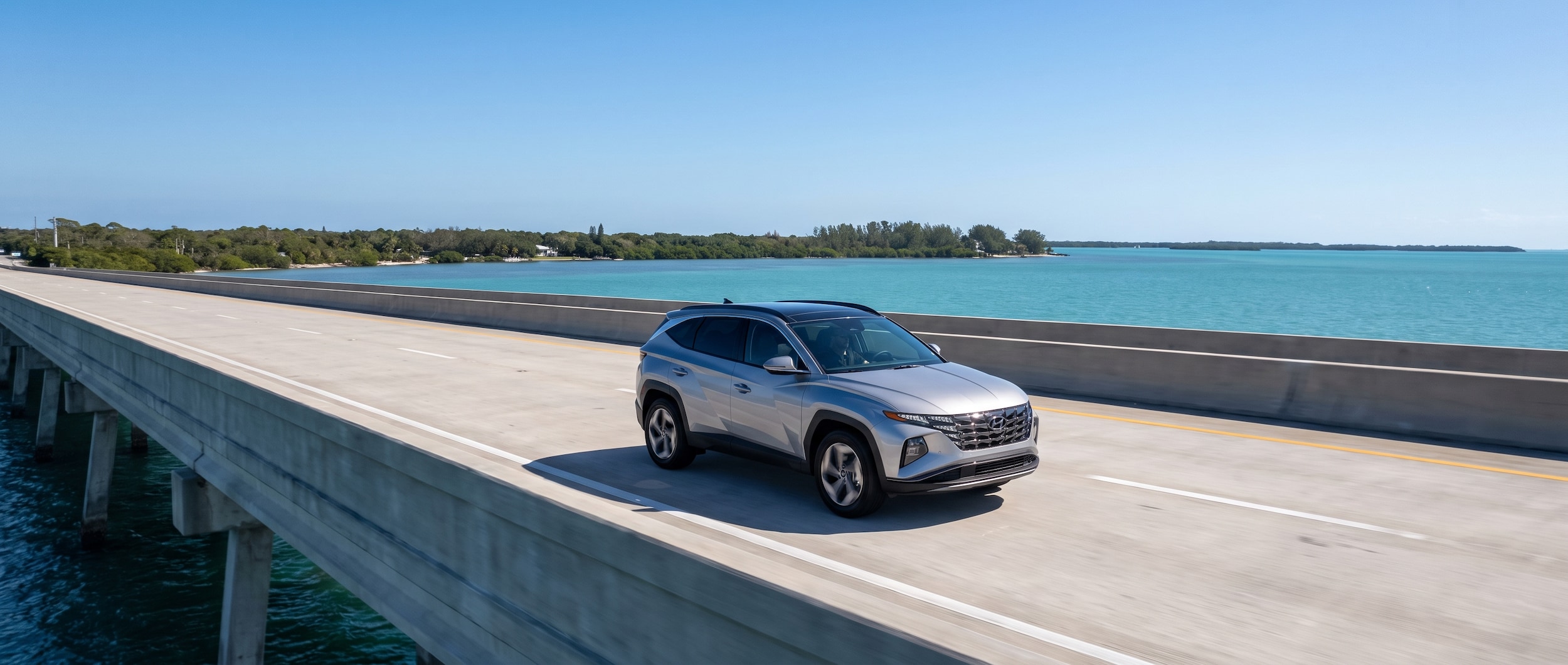
If you cross the Hathaway Bridge on US 98 regularly, you already know how it goes. The crossing itself runs fine. Come July, tourist traffic backs up on the Panama City approach, and a 10-minute run to the beach turns into 25 minutes of stop-and-go with the AC cranked and the sun pressing through the windshield. That combination is the actual test for an SUV in this market (not a highway fuel economy figure, but low-speed efficiency, cabin cooling load, and enough room to carry the people and gear you're crossing for).
The 2026 Tucson Hybrid is our top pick for most Hathaway Bridge regulars, and we'll walk through exactly why. The other three each earn a place for a specific kind of driver here.
The Rankings at a Glance
| Rank | Model | Best For | Standout Spec |
|---|---|---|---|
| 1 | 2026 Tucson Hybrid | Daily bridge commuters, small families | EPA-est. 38 mpg combined (Blue SE trim) |
| 2 | 2026 Santa Fe Hybrid | Families of 5-7, longer bay-area trips | EPA-est. 36 mpg combined (FWD) |
| 3 | 2026 Palisade Hybrid | Larger families, gear-heavy beach runs | 329 hp combined, 30+ mpg highway |
| 4 | 2026 Kona | Solo commuters, first-time buyers | EPA-est. 35 mpg hwy (2.0L FWD) |
The Tucson Hybrid Earns the Top Spot for One Specific Reason
The Tucson Hybrid takes our top spot because stop-and-go traffic is where a hybrid pays off, and the summer approach to the Hathaway Bridge delivers exactly that kind of driving on nearly every trip, with the one caveat that you're trading outright pep for the efficiency. The EPA rates the 2026 Tucson Hybrid Blue SE at 38 city / 38 highway / 38 combined mpg. That flat curve means you're not burning extra fuel whether you crawl the US 98 approach or move freely once you clear St. Andrews Bay. It matters here because July temperatures push into the low 90s and the AC runs hard every trip.
The tradeoff sits under the hood. The 2026 Tucson Hybrid pairs a 1.6-liter turbocharged four-cylinder with an integrated electric motor for 178 horsepower in most trims, which is composed and adequate without ever being exciting. Our read is that this fits the driver crossing the bridge five days a week for work or errands who wants the lowest fuel cost without stepping into EV territory. For a daily commuter, that's a sharp call. If you want a livelier drive, look elsewhere on the lot.
The Santa Fe Hybrid Moves More People Without Giving Up Efficiency
The Santa Fe Hybrid moves more people than the Tucson without giving up much fuel economy, and it becomes the pick once a full car of kids, beach chairs, and a cooler leaves the compact footprint feeling tight, with the honest limit that adults riding in its third row won't find much legroom. Once you've got that full car, the Tucson Hybrid's footprint starts to feel small in a hurry. The 2026 Santa Fe Hybrid steps up to genuine three-row capability while holding strong fuel economy. Hyundai lists it at 37 city / 36 highway / 36 combined mpg in front-wheel drive (impressive for a seven-passenger mid-size).
The caveat is worth stating plainly. Third-row legroom is tight for adults. Kids fit back there without complaint, adults less so. For a family of five with two adults and three kids, it's a better daily bridge vehicle than the Palisade when you cross often and still want meaningful fuel savings over a non-hybrid mid-size. The AWD option (HTRAC) trims fuel economy to around 35 mpg combined, per the EPA.
In Panama City, all-wheel drive isn't a weather necessity. If you head north toward the Panhandle hills or want extra confidence in a sudden summer squall on the bridge deck, it's a reasonable tradeoff to weigh.
Buying caution: Don't size up to the Santa Fe Hybrid just because the Tucson feels small on paper. If your regular bridge trip is solo or with one passenger, you're hauling a larger, heavier vehicle across every single time. The Tucson Hybrid's interior is roomier than its compact class suggests.
The 2026 Santa Fe Hybrid is EPA-rated at 36 mpg combined in FWD trim, making it one of the most fuel-efficient three-row SUVs Hyundai builds.
The Palisade Hybrid Is the Right Call When Passenger Count Comes First
The Palisade Hybrid becomes the right call when passenger count comes first, since it brings three rows, eight seats, and a hybrid powertrain that's new for 2026, and that space arrives in a larger vehicle costing more to buy and park than the two picks above. The 2026 Palisade Hybrid pairs a turbocharged 2.5-liter four-cylinder with two integrated electric motors for a combined 329 horsepower and 339 lb-ft of torque. Hyundai states a highway range of more than 620 miles and more than 30 mpg on the highway. For context, the non-hybrid Palisade's 3.5-liter V-6 is EPA-rated at 21 mpg combined. That gap is a genuine ownership difference for high-mileage Bay County drivers.
We reach for the Palisade Hybrid when your Hathaway Bridge trips routinely run with a full load (grandparents, teenagers, beach gear, maybe a trailer with a small boat for St. Andrews Bay). The 2026 Palisade Hybrid carries a 4,000-pound tow rating, so that scenario is genuinely supported. Its tradeoffs are plain. It's a bigger vehicle to park in Panama City Beach's tighter lots, and it costs more than the Tucson or Santa Fe Hybrid. If squeezing the most fuel savings from a daily 10-minute bridge crossing is the goal, the math tilts toward the smaller two. If you need the cabin space and want to move it efficiently, the Palisade Hybrid is a real solution now.
The Kona Keeps Things Practical for Solo Bridge Runs
The Kona keeps things practical for solo bridge runs, making a clean case for the single commuter or first-time buyer who wants a straightforward Hyundai SUV without the hybrid premium, as long as you accept that its non-hybrid setup won't recover energy from stop-and-go traffic the way the Tucson does. Not every Hathaway Bridge trip carries a full family. If you're a single commuter, a service member stationed at Tyndall Air Force Base running daily errands into Panama City Beach, or a first-time buyer who'd rather skip the hybrid premium, the 2026 Kona fits. The EPA rates its standard 2.0-liter four-cylinder front-wheel-drive setup at 28 city / 35 highway mpg. That highway figure works well for off-peak crossings when traffic clears and the bridge runs freely.
It's also the most maneuverable vehicle on this list. It parks without drama, handles the Panama City Beach strip without stress, and packs a solid tech suite into a compact body. The limitation to name is simple. The Kona doesn't recover energy from the stop-and-go approach traffic the way the Tucson Hybrid does. If your crossings are mostly peak-hour and you're logging serious miles, stepping up to the Tucson Hybrid returns a better outcome over time. If your needs are lighter and value matters more than the hybrid premium, the Kona does the job well.
Categories:
Social


