

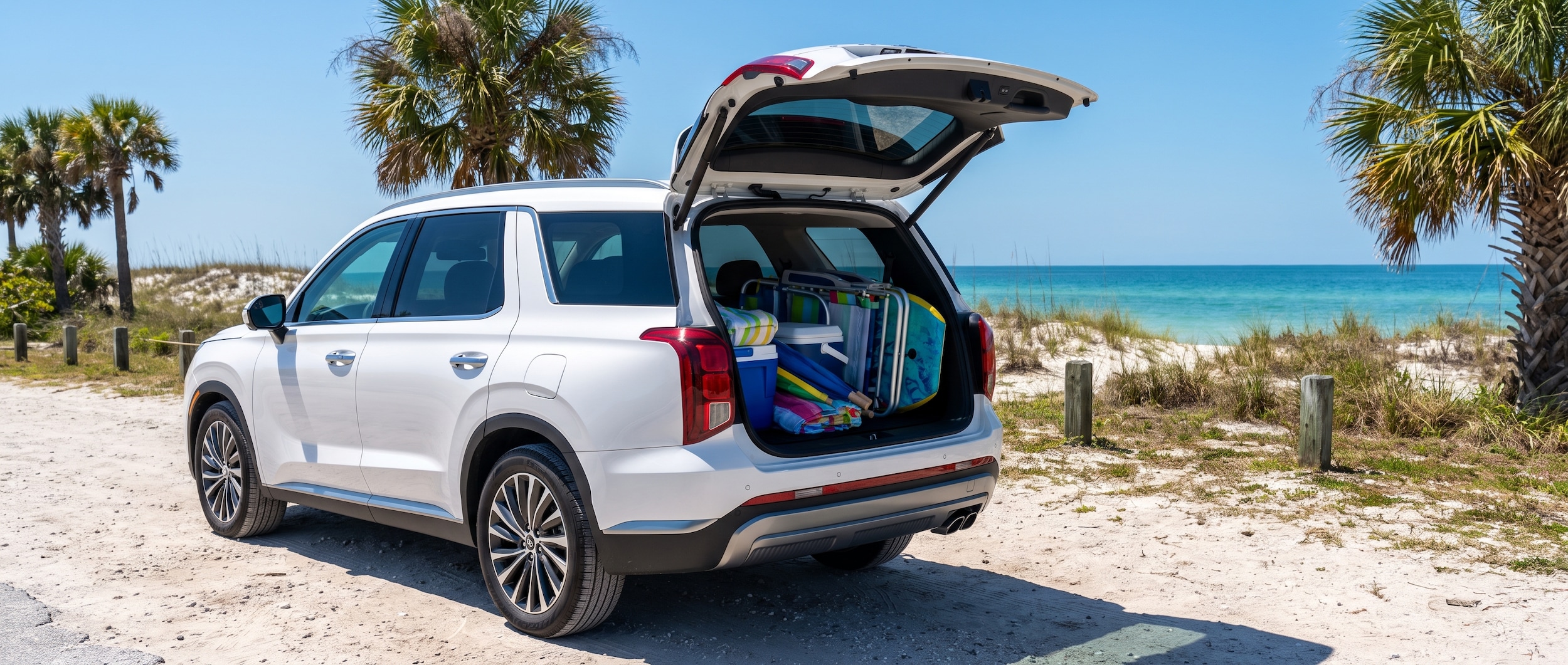
If your household runs five or more people and you need every seat filled on a Gulf Coast road trip, the 2026 Palisade is the straightforward choice -- it seats up to eight and carries more cargo when all those seats are occupied. But if your family tops out at six and fuel efficiency on the drive up US-231 to Tallahassee matters as much as interior space, the 2026 Santa Fe Hybrid deserves a serious look.
- The 2026 Palisade seats up to 8 (7 or 8 depending on trim); the 2026 Santa Fe seats up to 7 (6 or 7 depending on trim).
- Behind the 3rd row with everyone on board, the Palisade gives you 19.1 cu ft of cargo space vs. the Santa Fe's 14.6 cu ft -- a real difference when you're loading beach gear for the whole crew.
- The Santa Fe Hybrid earns an EPA-estimated 36 mpg combined (FWD) vs. the Palisade's 21 mpg combined (FWD) -- a significant gap for families watching fuel costs.
- Families of 5 or 6 who want strong efficiency: Santa Fe (especially the Hybrid). Families of 7 or 8, or anyone who needs that extra seat for carpools: Palisade.
- Both 2026 models arrive with Hyundai SmartSense safety suites standard and a 12.3-inch touchscreen.
The 2026 Palisade seats up to eight people -- a detail that may sound like marketing copy until you're actually trying to fit two adults, four kids, and a neighbor's child into one vehicle for a weekend at St. Andrews State Park.
What's the Real Difference Between These Two SUVs?
The short answer: the Palisade is a larger vehicle in every meaningful dimension, and the Santa Fe trades some of that size for a much more efficient drivetrain, especially in hybrid form. Both are true three-row Hyundai SUVs for 2026, but they are not interchangeable.
Here is how they compare on the factors that matter most for large families:
| Factor | 2026 Palisade | 2026 Santa Fe |
|---|---|---|
| Max seating | 7 or 8 | 6 or 7 |
| Cargo behind 3rd row | 19.1 cu ft | 14.6 cu ft |
| Cargo behind 2nd row | 46.3 cu ft | 40.5 cu ft |
| Max cargo (all rows folded) | 86.7 cu ft | 79.6 cu ft |
| Engine | 3.5L V6, 287 hp | 2.5L Turbo 4-cyl, 277 hp |
| Gas EPA combined (FWD) | 21 mpg | 24 mpg |
| Hybrid EPA combined (FWD) | 28 mpg (Hybrid) | 36 mpg (Hybrid) |
| 3rd row legroom | Not specified per row | 30 inches |
| Wheelbase | 116.9 inches | Shorter platform |
Hyundai lists the Palisade's cargo behind the 3rd row at 19.1 cubic feet; the Santa Fe comes in at 14.6 cubic feet by the same Hyundai specification sheet. That 4.5-cubic-foot gap is the difference between fitting a beach bag and a folded beach chair versus having to choose one.
Does the Third Row Actually Work for Kids on a Real Family Trip?
For the Santa Fe, Hyundai lists 30 inches of 3rd row legroom -- that is comfortable for children up to roughly middle-school age, tight for a full-grown adult on any trip longer than a short errand run. The second row, at 42.3 inches of legroom, is genuinely adult-friendly.
The Palisade's third row is roomier by design. Hyundai notes 43 inches of legroom in the second row and a cabin built to comfortably seat adults in the first two rows with adequate space for teens in the back. More practically, the Palisade comes standard on most trims with a Passenger Talk intercom system and a Rear Seat Quiet Mode -- features that do real work when you have five kids behind you on SR-390 heading to the beach.
For Lynn Haven families making the run down to the Gulf or along the US-231 corridor to visit family in Dothan, the Palisade's V6 also has more relaxed highway power delivery. The Santa Fe's 2.5-liter turbocharged engine produces 277 horsepower and feels quick off the line in everyday driving, but it's a different character: more energetic, less settled. Neither is wrong -- it depends on whether your family hauls heavy gear or prioritizes an efficient drive.
Browse current Bay Hyundai inventory to see which trims are available in both models right now.
Fuel Efficiency for Gulf Coast Commutes and Road Trips
The Santa Fe Hybrid is where this comparison tilts sharply. The EPA estimates 37 mpg city and 36 mpg highway for the FWD Santa Fe Hybrid -- a combined 36 mpg figure that puts it in a different category from any version of the Palisade. On the AWD Santa Fe Hybrid, that figure comes in at an EPA-estimated 35 mpg combined.
The 2026 Palisade Hybrid is also available and brings meaningfully better efficiency than the gas-only Palisade (the EPA rates the Palisade Hybrid at 28 mpg combined for FWD), though it does not close the gap with the Santa Fe Hybrid. The standard gas Palisade earns an EPA-estimated 21 mpg combined with FWD and 20 mpg combined with AWD.
For a Lynn Haven family driving the roughly 100-mile round trip to Destin for a beach day, the difference between 21 mpg and 36 mpg is tangible at the pump. The Santa Fe Hybrid makes a strong case when fuel cost is a real factor in the household budget.
Which Should You Choose?
This comes down to how many seats you actually need and whether fuel efficiency ranks above maximum capacity in your priorities.
Choose the 2026 Palisade if:
- Your family regularly fills 7 or 8 seats -- for carpools, visiting relatives, or blended households where headcount varies
- You load gear for everyone on beach days or weekend trips; that extra cargo behind row 3 matters
- You want the Passenger Talk intercom and Rear Seat Quiet Mode for managing a loud, full cabin
- Maximum towing ability is part of your requirement (the Palisade's V6 supports towing up to 5,000 lbs)
Choose the 2026 Santa Fe if:
- Your family tops out at 5 or 6 passengers most of the time
- You want the Hybrid powertrain's 36 mpg combined EPA estimate -- the most fuel-efficient option in this comparison by a significant margin
- A slightly smaller exterior footprint makes parking easier at Tyndall-area base housing or in a standard suburban garage
- You want IIHS Top Safety Pick+ recognition (the non-hybrid Santa Fe earned this rating from IIHS) and NHTSA's five-star overall safety rating (earned by the Santa Fe Hybrid)
Both are excellent family vehicles and both are available now at Bay Hyundai in Panama City.
Frequently Asked Questions
Can the Santa Fe third row fit a teenager comfortably?
Hyundai lists 30 inches of 3rd row legroom for the 2026 Santa Fe. That is comfortable for children and shorter teens but tight for adults on longer drives. If your family regularly seats teenagers or adults in the third row, the Palisade's roomier rear cabin is the better fit.
Does the 2026 Palisade Hybrid get better fuel economy than the Santa Fe Hybrid?
No. The EPA estimates 28 mpg combined for the 2026 Palisade Hybrid (FWD), compared to 36 mpg combined for the 2026 Santa Fe Hybrid (FWD). The Santa Fe Hybrid is meaningfully more fuel-efficient. If fuel economy is your top priority, the Santa Fe Hybrid wins this comparison outright.


