

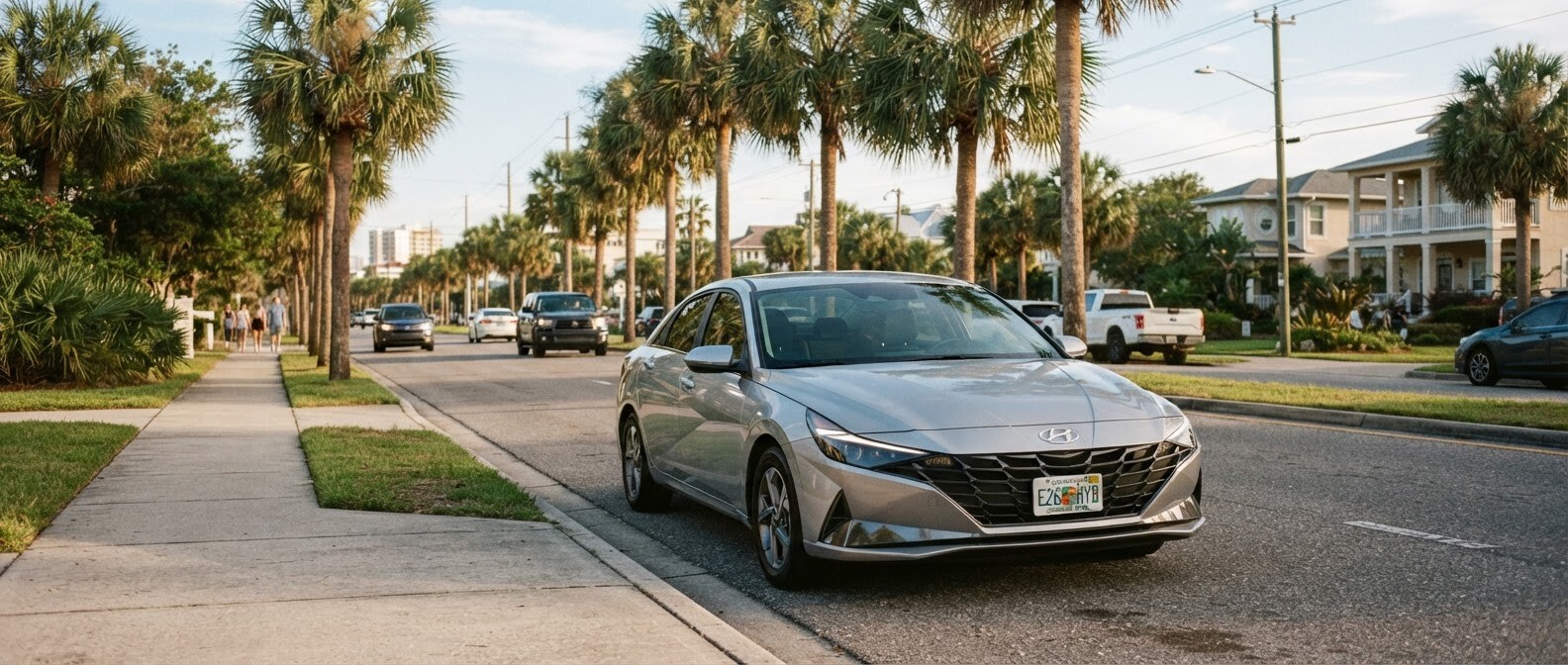
If your day runs through Panama City traffic, the Elantra Hybrid tends to justify itself faster than the sticker gap suggests. It isn't the right call for every driver, though. We'd rather you knew that up front.
- The 2026 Elantra Hybrid is rated at up to 54 mpg combined (Blue trim) versus up to 35 mpg combined for the standard Elantra, a gap that closes fast on a daily Bay County run
- The Hybrid's multilink rear suspension is a genuine comfort upgrade, not just an mpg footnote
- Both versions give you identical 14.2 cubic feet of cargo space, the hybrid battery doesn't eat into the trunk
- For stop-and-go Gulf Coast commuting, the Hybrid's regenerative braking works in your favor every time traffic stacks up
- If you mostly highway-drive and tend to swap vehicles every two to three years, the standard Elantra is the sharper short-term pick
What's the Real Difference Between These Two Elantras?
These two Elantras share a name, a body, and most of the cabin, so the family resemblance is strong, but the powertrains are genuinely different machines, and that single difference is what shapes how each one behaves once you're stuck in Bay County traffic. The 2026 Elantra Hybrid pairs a 1.6-liter four-cylinder with an electric motor for 139 combined horsepower and a 6-speed dual-clutch transmission. The standard Elantra runs a 2.0-liter four-cylinder producing 147 horsepower through a continuously variable transmission. In a city commute, the electric motor delivers torque right off the line, which is exactly where Bay County traffic asks for it. On paper it makes less power. In practice, you won't notice.
| Feature | 2026 Elantra Hybrid | 2026 Elantra (gas) |
|---|---|---|
| Engine | 1.6L 4-cyl hybrid | 2.0L 4-cyl |
| System output | 139 hp | 147 hp |
| Transmission | 6-speed dual-clutch | CVT |
| Best combined mpg | 54 mpg (Blue trim) | 35 mpg |
| Rear suspension | Multilink | Twist-beam |
| AWD available | No | No |
| Trunk space | 14.2 cu ft | 14.2 cu ft |
| Drivetrain | FWD | FWD |
Does the hybrid battery eat into the trunk? No, it doesn't. Both Elantras deliver 14.2 cubic feet, enough for a work bag, groceries, and gym gear without complaint.
Does the Fuel Economy Gap Actually Matter on a Bay County Commute?
Yes, it matters more here than it would on a plain interstate run, because the fuel economy gap pays off exactly in the stop-and-go conditions of a Bay County commute, and the spread is wide enough that you'll feel it. The 2026 Elantra Hybrid Blue trim is rated at 54 mpg combined (51 city, 58 highway). The standard Elantra comes in at up to 35 mpg combined. A 19-mpg spread is wider than most comparable hybrid matchups in this segment, and what makes it count for Bay County is the nature of the commute itself. Traffic along US-231, the McKenzie Avenue corridor, and the approaches to Tyndall Air Force Base all feature the kind of repeated acceleration-and-braking cycles where the Hybrid's regenerative system does its best work. Every time you slow down, the electric motor recaptures energy. The more lights and stop signs on your route, the harder that system works.
The standard Elantra isn't inefficient. 35 mpg combined is solid for a non-hybrid compact. It just doesn't get the bonus the Hybrid collects from slowing down. Browse current Elantra inventory at Bay Hyundai to see which trims are on the lot right now.
Ride Quality and What Gulf Coast Roads Actually Reveal
Ride quality is the quiet upgrade here, the one that never makes the spec-sheet headline but that you'll notice by the end of your first commuting week, and it comes down to the rear suspension, a multilink setup on the Hybrid against a twist-beam axle on the standard car. On smooth pavement, the two feel similar. On the kind of patched and thermally stressed road surfaces that Gulf Coast heat cycles produce year after year, the multilink absorbs small irregularities with more composure. Less shudder through the seat, less harshness through expansion joints.
No one's calling it a luxury suspension. But it's a real-world upgrade worth naming plainly, because it means the Hybrid isn't only about fuel savings. Daily comfort is part of the deal.
The Honest Tradeoffs (Because They're Real)
The Hybrid does cost more up front, and there's no way around that, but whether the premium is worth it comes down almost entirely to how long you plan to own the car and how many of those miles run through town. If you plan to keep the vehicle three years or fewer, you may not put enough miles on it to close the entry-cost gap through fuel savings alone. The math tilts hard toward the Hybrid on five-plus-year ownership timelines, longer if you keep it.
There's also a power caveat worth naming. The standard Elantra's 2.0-liter pulls more assertively at higher rpm. If you merge onto US-98 from a standing stop regularly and want a confident surge, the gas engine has the edge in sustained acceleration. The Hybrid's instant low-speed torque wins in town, and the gas Elantra's higher-rpm pull wins on the on-ramp.
Neither model offers AWD, and they're front-wheel drive only. Keep that in mind if your household wants all-weather confidence for road trips to the Carolinas or the Tennessee mountains. For most Bay County driving, no problem.
So Which Should You Choose?
The Elantra Hybrid fits you if your commute is city-heavy, you plan to own the car for five or more years, and fuel efficiency is a priority you're willing to pay a little more to have from day one. The 54-mpg combined estimate on the Blue trim and the multilink suspension make it the better daily tool for Bay County conditions specifically.
The standard Elantra fits you if the lower entry cost is the deciding factor, you drive primarily highway miles, or you cycle through vehicles every two to three years before the fuel savings have time to stack up. At 35 mpg combined, it's efficient in its own right. It just doesn't have the stop-and-go advantage the Hybrid builds its case on.
Both models include Hyundai's SmartSense suite as standard, which brings forward collision avoidance assist, lane keeping assist, blind spot collision warning, and rear cross-traffic alert. You don't give up safety technology to stay on budget. Explore financing options at Bay Hyundai when you're ready to run the numbers on either one.
Find Out What Your Trade-In Is Worth
Frequently Asked Questions About the Elantra Hybrid vs. Standard Elantra
Is the Elantra Hybrid worth the extra cost for a daily commute in Bay County?
For a mostly city and stop-and-go commute, the Elantra Hybrid's fuel efficiency tends to offset the higher entry cost over a five-plus-year ownership period. You're looking at a 54-mpg combined estimate against the standard Elantra's 35 mpg, and that gap gets meaningful on a daily Bay County route where traffic, school zones, and base-access congestion are part of the routine. For short-term owners or mostly-highway commuters, the standard Elantra's lower entry cost is the better fit.
Does the Elantra Hybrid have the same cargo space as the regular Elantra?
Yes. Both the 2026 Elantra Hybrid and the standard Elantra offer 14.2 cubic feet of trunk space. The hybrid battery pack doesn't cut into the cargo area, so you're not trading practicality for efficiency. Luggage, groceries, and work gear fit equally well in both.
Which Elantra is better for highway driving?
The standard Elantra pulls ahead for highway commutes. Its 2.0-liter engine delivers sustained acceleration at higher rpm, and that's what makes merges and passing smoother on the interstate. The Hybrid's strength is stop-and-go city driving, where regenerative braking captures energy and keeps fuel costs down.
What suspension difference should I expect between these two models?
The Elantra Hybrid rides on a multilink rear suspension, while the standard Elantra uses a twist-beam rear axle. On Bay County's patched and heat-stressed roads, the Hybrid's multilink absorbs small irregularities more smoothly, so you'll feel less harshness through expansion joints and less seat shudder over time.


