

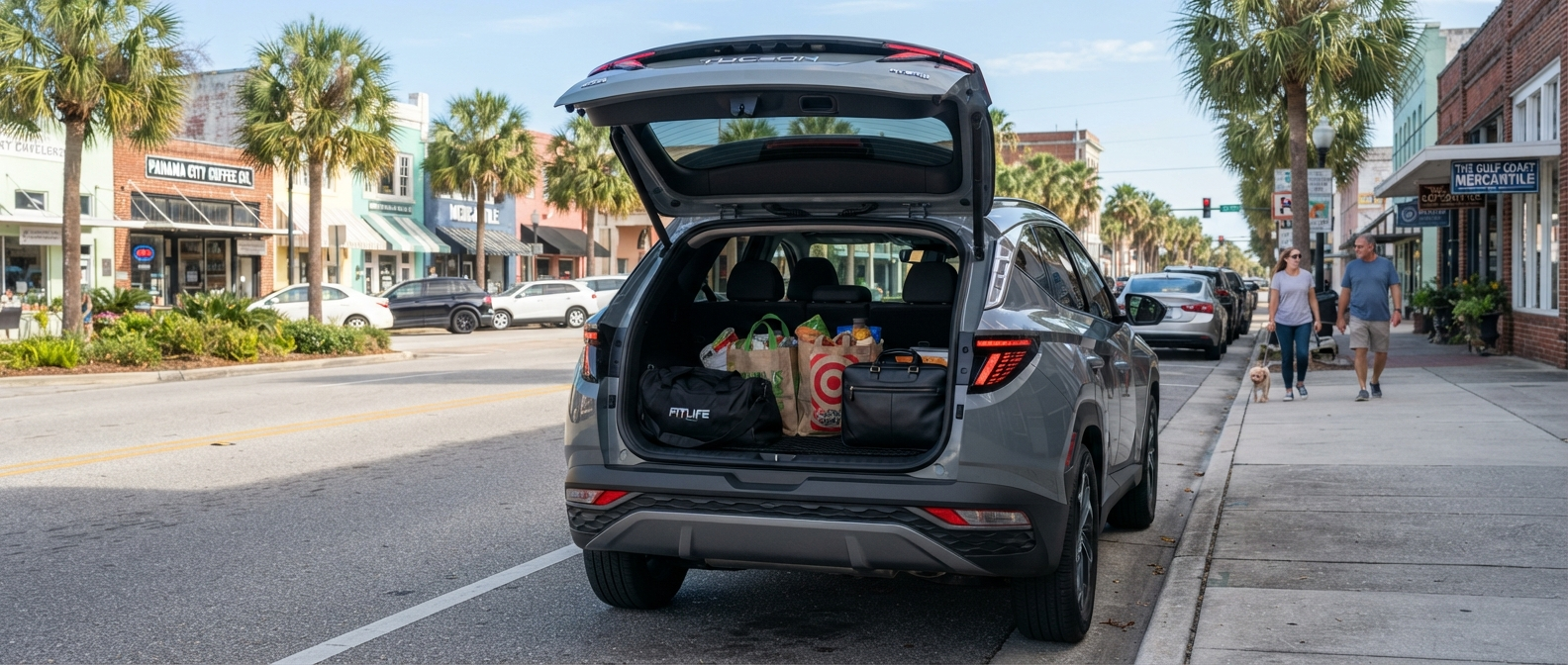
November on 15th Street in Panama City beats August. Barely. The signal timing at Harrison still does what it does, the mid-morning backup toward US-231 still stacks three or four lights deep on a bad day, and you've still got the laptop bag, the gym duffel, two bags of groceries from the stop on the way home, and whatever else life has decided you're hauling today. You're running a payload project.
The right 2026 Hyundai for this corridor isn't just the one with the best fuel economy number on paper. The pick that works is the one whose cargo space fits your actual daily load, whose hybrid system turns those red lights into free energy, and whose footprint makes the left onto Harrison feel like less of a commitment. We've pulled the verified specs for three models sitting on our lot right now, and we'll tell you where each one fits and where it doesn't.
The 2026 Elantra Hybrid is the place to start if you commute solo and pack light.
Will Your Gear Actually Fit?
Yes, probably, though it depends on the day's load and which model you pick. Stop-and-go on 15th Street is where hybrid regenerative braking earns its money back, but you still have to close the trunk first, so here's what the verified numbers say for each 2026 model, checked against Hyundai's published specs and EPA data.
| Model | Cargo (Seats Up) | Cargo (Folded) | EPA Combined mpg | Length |
|---|---|---|---|---|
| 2026 Elantra Hybrid | 14.2 cu ft | Partial fold (60/40) | 54 mpg (Blue trim) | 184.1 in |
| 2026 Sonata Hybrid | 15.6 cu ft | Partial fold (60/40) | 51 mpg (Blue trim) | 193.3 in |
| 2026 Tucson Hybrid | 38.7 cu ft | 74.5 cu ft | 38 mpg (Blue SE) | 182.7 in |
Numbers alone don't tell a commuter much, so here's what they translate to. The Elantra Hybrid's 14.2 cubic feet of trunk space handles a laptop bag, a gym duffel, and a day's worth of groceries without drama. It won't handle a folding table, a full week of Costco runs, or anything you can't pivot through a standard trunk opening. The Sonata Hybrid's 15.6 cubic feet sounds close to the Elantra, and in a side-by-side it is. The difference that counts is that the Sonata runs nine inches longer, with a wider trunk opening and a flatter load floor, which matters when you're sliding a flat box or a stroller in rather than wrestling it. The Tucson Hybrid plays in a different category, with 38.7 cubic feet behind the rear seats and 74.5 with them folded. If you're the one dropping a folding table at a school fundraiser on the way home, the Tucson is the only model here with a real answer.
Give the Tucson Hybrid its due. Its EPA-estimated 38 mpg combined (Blue SE trim) is genuinely good for a compact SUV. It's not 54 mpg. If your daily loop on 15th Street and back runs long enough that fuel economy moves the needle for you, the Elantra Hybrid is the sharper tool. If cargo needs keep climbing, pick the Tucson. It won't outgrow you.
Loading Up: How to Match the Model to the Day
Match the model to the heaviest day you actually drive rather than the average one, and you'll rarely regret it. The trap is picking the car first and discovering the cargo reality on week two, when the load that fit on paper won't pivot through the opening you bought. Work the other direction instead.
The Sonata Hybrid sits in a sweet spot that's easy to overlook. Picture a midsize sedan with 104.4 cubic feet of passenger volume (5 more than the Elantra), front legroom that fits a taller driver, and a trunk that takes longer items through its 60/40 fold. For the Panama City commuter who shares the car with a partner, needs rear seat room on school pickup days, and still wants close to sedan-class fuel economy at an EPA-estimated 51 mpg combined on the Blue trim, the Sonata Hybrid makes a lot of sense.
The 2026 Tucson Hybrid is worth a close look if your work involves any kind of gear transport. Tools, equipment cases, athletic bags for a team, the kind of load that doesn't survive being jammed through a sedan trunk opening. 38.7 cubic feet of SUV cargo space with a low liftover height handles all of it.
For drivers weighing a fully electric switch, the 2026 IONIQ 6 Long Range RWD carries an EPA-estimated range of up to 342 miles. Hold onto that number if you're a 15th Street commuter considering it. The range worry that comes up with EVs isn't a problem for a local loop. The question worth answering first is your charging setup at home.
How to Choose Before You Visit the Lot
Choosing well before you arrive is mostly about measuring your real load and your real route, which takes about ten minutes at home. Run through the five steps below and you'll spend your time on the lot driving instead of deciding. None of it needs a tape-measure genius, just an honest look at what rides with you.
- Measure what you haul. Seriously. Take the duffel, the laptop case, the reusable bags, whatever goes in the car every day, and stack them in one spot. If the pile comes to 14 cubic feet or less, an Elantra Hybrid handles it. If it's irregular or long, you're in Sonata Hybrid or Tucson Hybrid territory.
- Count the people, not just the driver. The Elantra Hybrid's rear seat fits two adults fine for an occasional passenger. If you regularly carry three adults, the Sonata Hybrid's 56.1 inches of rear shoulder room and 35 inches of rear leg room make a real difference.
- Calculate your actual weekly fuel use. At highway speeds the Elantra Hybrid Blue is EPA-rated at 58 mpg. Sonata Hybrid Blue comes in at 56 mpg highway. For the Tucson Hybrid Blue SE, the rating is 38 mpg city and 38 mpg highway. Run those against your real weekly mileage and the gap gets concrete fast.
- Think about parking. At 184 inches, the Elantra Hybrid is the easiest car on this list to tuck into a tighter downtown spot or a narrow home garage. The Sonata Hybrid at 193 inches is the longest. At 182.7 inches, the Tucson Hybrid is surprisingly compact for an SUV.
- If EV is on the table, check your charging access first. The IONIQ 6 is a real commuter choice for Panama City drivers who can charge at home. If that's not set up yet, the hybrid lineup fills at any pump and asks nothing special to run.
The Commute Is the Project. Here's What We Know.
West 15th Street in November genuinely drives better than August, and that difference matters for this choice because the heat has let up, the signal cadence hasn't changed, and the stop-and-go rhythm between Lisenby and Harrison is exactly the driving where hybrids recapture energy on every deceleration instead of burning it off as brake dust. Call it a verifiable mechanical advantage on this corridor, not a marketing line.
The 2026 Elantra Hybrid is the right answer if you commute solo, park in tight spots, and want the highest EPA efficiency number in the lineup at 54 mpg combined. It becomes the wrong answer if you need cargo flexibility or regular rear-seat room for a passenger your own size.
Choose the Sonata Hybrid if you want a midsize cabin, strong hybrid fuel economy at 51 mpg combined, and a trunk that takes more without stepping into SUV size. Browse our current new inventory to see what trims are on the lot today.
The Tucson Hybrid is the right answer if cargo is the actual constraint. 38.7 cubic feet of SUV space behind the rear seats, a liftgate instead of a trunk lid, and standard HTRAC all-wheel drive. Good at almost everything. Not the efficiency leader. We'll call that an honest trade.
Job done. Come take the one that fits your actual load out for a drive on 15th Street.


