

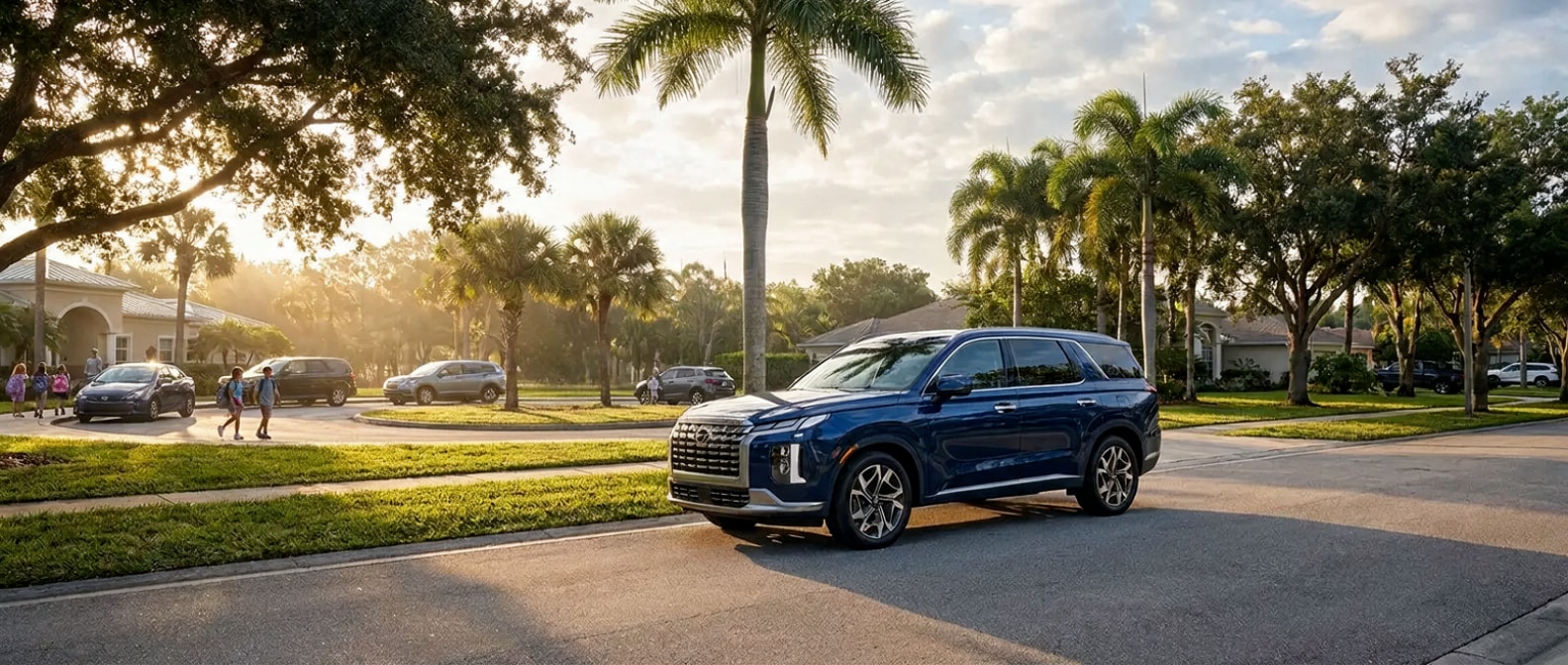
When families come in, the question usually isn't really "which Hyundai?" A better one sits underneath it. Do we actually need a third row, or are we just buying space we'll never use? Get that right, and the rest of the decision mostly makes itself.
The 2026 Hyundai Palisade sits at one end of this lineup, and the 2026 Tucson Hybrid sits at the other. Between them is the 2026 Santa Fe Hybrid, which lands in the trickiest spot to pin down. We'll share what we tell families coming in from Lynn Haven and the North Bay corridor, and why the row count drives everything from your EPA fuel economy to whether Saturday carpool is actually comfortable.
How Does the Row-Count Concept Actually Work in the Hyundai Lineup?
Each row tier in the Hyundai lineup works as a different vehicle philosophy rather than a simple size bump, so picking a tier means committing to a use case, with the Tucson built around efficiency and the Palisade built around seats you'll actually fill. The 2026 Tucson Hybrid is a dedicated five-passenger, two-row compact SUV. It seats five. The 2026 Santa Fe Hybrid adds a standard third row for up to seven passengers, though that third row folds into the floor when you don't need it. Step up to the 2026 Palisade and you get a genuine eight-passenger layout, with second-row legroom adults can actually tolerate on longer drives.
That matters in a concrete, numbers-on-paper way. The decision table lays it out.
| Feature | 2026 Tucson Hybrid | 2026 Santa Fe Hybrid | 2026 Palisade Hybrid |
|---|---|---|---|
| Seating | 5 passengers | Up to 7 passengers | Up to 8 passengers |
| Rows | 2 | 3 | 3 |
| Cargo behind last row | 38.7 cu ft | 14.6 cu ft | 19.1 cu ft |
| Max cargo (seats folded) | 74.5 cu ft | 79.6 cu ft | 86.7 cu ft |
| Second-row legroom | 41.3 in | 41.5 in | 42.0 in |
| EPA combined MPG (FWD) | Up to 38 mpg | Up to 36 mpg | Up to 34 mpg (Hybrid) |
| Best for | Daily commuters, 2-3 kids | Families needing occasional third row | Carpools, large families, 4+ kids |
One thing trips buyers up. The Santa Fe Hybrid's cargo space behind the third row is just 14.6 cubic feet. That's enough for a couple of backpacks. Fold that third row down and it opens to 79.6 cubic feet, which makes it properly practical. You're trading accessible cargo for occasional passenger flexibility. You don't get both.
Which One Do You Need for Life Near Lynn Haven and North Bay?
The 2026 Tucson Hybrid is the right answer for more families than you'd expect, because two rows cover the everyday school-run reality, though it runs out of room the moment you need to seat a sixth or seventh person. If you're doing school pickup at Mowat Middle School on Highway 390 with two kids and a soccer bag, you don't need a third row. You need the 38 mpg combined EPA estimate and a cargo area that handles gear without drama. The Tucson Hybrid's 38.7 cubic feet behind the rear seats swallows a stroller, a week's groceries, and a travel bag for a long weekend. Parking it at Mosley's drop-off circle? Not a struggle.
Check the Santa Fe Hybrid's third row yourself before you write it off. It's real seating for kids and a genuine occasional-use option for adults on short trips, but it isn't a stretch limousine. Second-row legroom at 41.5 inches is comfortable for adults. The third row, in its more compact configuration, suits elementary-age kids or a short hop better than adults on a long North Bay to Pensacola drive. If your family of five or six uses that third position a few times a month, the Santa Fe Hybrid is the right call. Packing adults back there every week? Go with the Palisade.
The Palisade is where the sizing genuinely changes. Second-row legroom stretches to 42 inches (per Hyundai's specifications), and the available captain's chairs in row two mean getting kids into the third row doesn't call for a gymnastic maneuver. Military families running a 25-to-40-minute commute to NSA Panama City, or the longer stretch to Tyndall Air Force Base, will feel the difference in daily comfort. On front-wheel-drive trims, the Palisade Hybrid returns an EPA-estimated 34 mpg combined, a real number for a three-row eight-passenger SUV. The gas-only V6 Palisade drinks fuel. At 21 mpg combined on FWD trims, it's a hard sell on the Highway 390 run twice a day.
Glossary: key terms in this decision
| Term | What it means in plain language |
|---|---|
| HEV (Hybrid Electric Vehicle) | Gas engine plus an electric motor; charges itself through braking, no plug needed |
| HTRAC AWD | Hyundai's all-wheel-drive system; distributes torque between front and rear axles as conditions change |
| EPA-estimated MPG | Fuel economy figure published by the federal Environmental Protection Agency for comparison; real-world results vary by driving style and conditions |
| Captain's chairs | Individual second-row seats separated by a walk-through aisle; makes third-row access easier, reduces capacity from 8 to 7 |
What This Means When You Walk Into Bay Hyundai
Family size and how often you fill every seat are the two questions that unlock the right Hyundai, and answering them straight keeps you from buying either far too much SUV or a little too little for the years ahead. Three kids with backpacks and an active weekly schedule? The Tucson Hybrid handles it with efficiency, and its cargo area surprises shoppers who haven't sat in the current generation. A household with four-plus kids, or one that runs regular carpools to Mosley High School events, or one that travels with extended family from out of state? The Santa Fe Hybrid or the 2026 Palisade Hybrid is the stronger recommendation.
The IIHS awarded the 2026 Palisade its TOP SAFETY PICK+ rating, the institute's highest designation. Worth knowing when you're making a choice centered on who's riding in the back rows.
One pattern our team sees on the floor. Buyers who come in expecting to want the largest SUV often land on the Santa Fe Hybrid once they sit in it and think through their actual week. The cargo-to-passenger trade-off is real. Buyers who underestimate their needs and start with the Tucson sometimes come back six months later when the carpool situation changes. Neither choice is wrong. The row count just needs to match your real life, not a hypothetical one.
When you're ready to sit in all three and compare them back-to-back, that's exactly what we're here for. We can also walk you through the hybrid vs. gas decision on the Palisade, a conversation worth having before you commit to a trim level.
Frequently Asked Questions
Is the Santa Fe Hybrid's third row actually usable for adults?
The 2026 Santa Fe Hybrid's third row is genuinely useful for children and works for adults on shorter trips. Headroom and legroom back there are more limited than in the second row, where you get 41.5 inches of legroom per Hyundai's published specifications. For a regular 30-to-45-minute commute with adults filling all three rows, the Palisade's roomier third-row configuration fits better. The Santa Fe Hybrid's strength is flexibility. Fold that third row flat and you gain up to 79.6 cubic feet of cargo space.
Does the Palisade Hybrid actually save money on fuel compared to the gas-only Palisade?
Yes, in a meaningful way. The EPA rates the 2026 Palisade V6 at 21 mpg combined on front-wheel-drive configurations. On the same FWD setup, the Palisade Hybrid reaches an EPA-estimated 34 mpg combined, a difference of 13 mpg. On a daily Highway 390 commute, that gap adds up over a year. The Hybrid version also produces 329 horsepower from its turbocharged four-cylinder hybrid system, so you're not trading capability for efficiency.


