

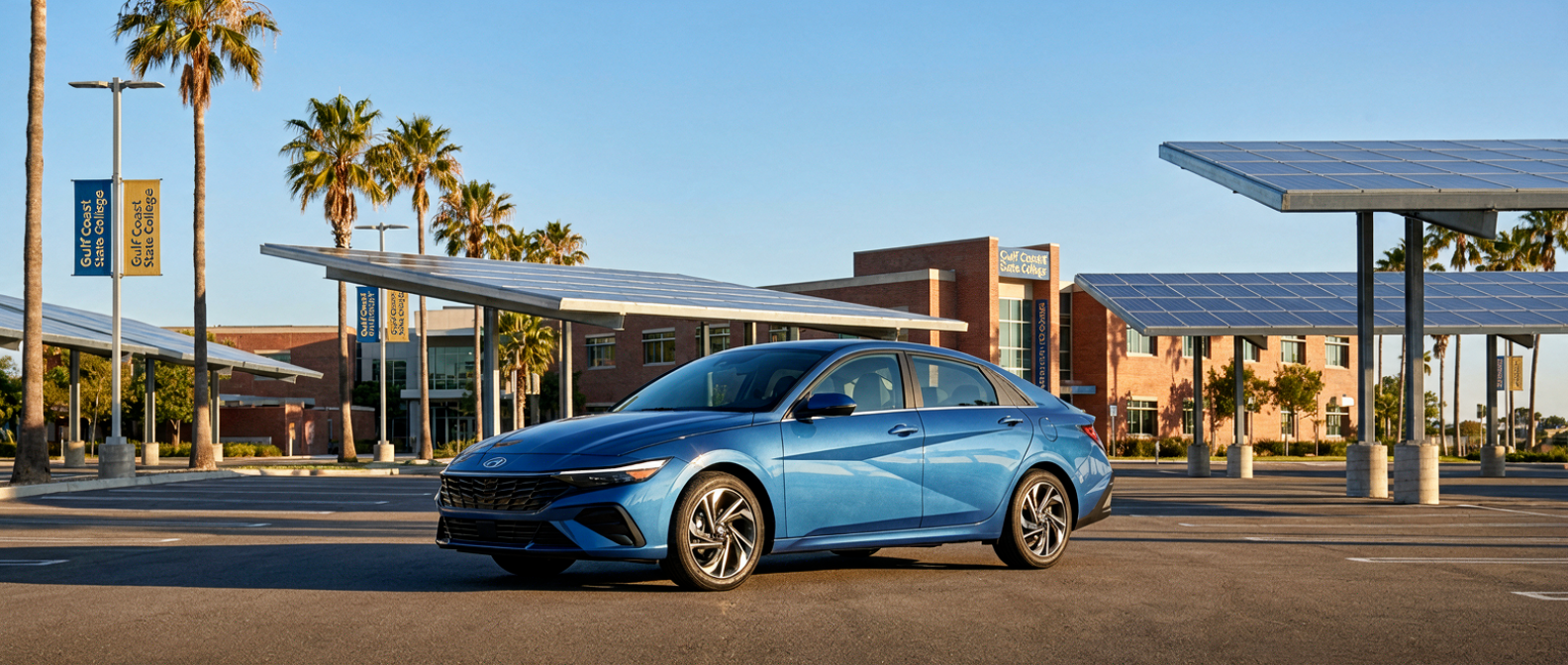
Gulf Coast State College draws over 12,600 students a year, and nearly every one of them drives in. The campus at 5230 West Highway 98 has no on-campus housing, so the commute isn't optional. Sitting on US-98 while traffic backs up between the bridge and the parking lot entrance is a real, daily pattern for thousands of Panama City drivers. So when someone on our lot asks whether the 2026 Hyundai Elantra makes sense for that life, we give a concrete answer. Yes, but for specific reasons worth knowing before you sign anything.
Below is what the Elantra gets right for this commute and this campus, plus the one honest limitation you should weigh going in.
Does the Elantra Actually Fit the GCSC Commute?
Yes, it fits the GCSC commute better than most sedans in its class, and fuel economy is the biggest reason, though the back seat is where it asks you to compromise. For a one or two person run down US-98 to campus and back, the efficiency, the compact width, and the standard safety gear line up with what the drive actually demands.
| Local Condition or Use | Elantra Feature That Handles It | Why It Matters Here |
|---|---|---|
| US-98 stop-and-go between stoplights | EPA-rated 31 mpg city (gas SE trim) | City driving burns fuel fast on surface roads; the Elantra holds up well in the cycle |
| Hybrid option for max efficiency | Elantra Hybrid Blue: EPA 51 city / 58 hwy / 54 combined | Regenerative braking recaptures energy at every stoplight on Highway 98 |
| Tight campus and off-campus parking | 71.9-inch exterior width | Narrower than most crossovers; fits standard lots without drama |
| Campus pedestrian crossings and high-foot-traffic zones | Forward Collision-Avoidance Assist with pedestrian detection | Standard on every trim; detects pedestrians crossing ahead and can apply braking |
| Reversing out of tight parking rows | Rear Cross-Traffic Collision-Avoidance Assist | Detects vehicles approaching from the side while backing out; standard |
| Long drives home after evening classes | Driver Attention Warning | Monitors driving patterns and prompts a break when it detects fatigue-related drift |
| Bay windows and glare off the water on US-98 | High Beam Assist | Automatically adjusts high beams based on oncoming traffic |
| Hauling textbooks, gear, and a beach bag on the same trip | 14.2 cu ft trunk | Competitive for this class; enough for a semester's worth of supplies |
The Efficiency Case Is Especially Strong on This Route
US-98 in Panama City isn't really a highway, it's a Gulf Coast surface road stacked with stoplights, turning lanes, and seasonal congestion from Harrison Avenue through the St. Andrews stretch right past the GCSC entrance. That stop-and-go pattern is exactly where the Elantra Hybrid earns its keep, because slow, braking-heavy traffic is what a conventional hybrid handles best.
The EPA rates the Elantra Hybrid Blue at 51 mpg city, 58 mpg highway, and 54 mpg combined. The standard gas-powered Elantra SE comes in at 31 city, 40 highway, and 35 combined, per the EPA. Neither figure guarantees what you'll see on your own commute, especially in Gulf Coast heat where the air conditioning runs hard from April through October. Those numbers tell you the efficiency floor. The Hybrid's edge on city streets comes straight from regenerative braking. Every time you slow for a light on US-98, the system turns that deceleration into stored electric charge instead of wasting it as heat in the brake pads.
The real tradeoff is worth naming. The back seat is cramped for tall adults on a long drive. If you're regularly loading people into the rear for any stretch, that's where the Elantra compromises. At 38 inches of rear legroom, it's workable for shorter trips, but taller passengers will feel it on anything past a campus-to-home run across town. When three adults need genuine comfort on a regular basis, compare a larger sedan or a compact crossover like the Hyundai Kona directly. Call it a one or two person commuter.
The Safety Suite Is Standard, Not an Upgrade
Every 2026 Elantra trim ships with the full Hyundai SmartSense suite as standard equipment, which is the opposite of how driver-assist tech usually arrives in this class, where it's bundled into pricier trims. The gear comes standard across the board, though the adaptive cruise piece waits for the upper trims.
The suite itself includes Forward Collision-Avoidance Assist with pedestrian detection, Blind-Spot Collision-Avoidance Assist, Lane Keeping Assist, Lane Following Assist, Rear Cross-Traffic Collision-Avoidance Assist, High Beam Assist, Driver Attention Warning, and Safe Exit Warning. NHTSA awarded the 2026 Elantra (non-N models) a 5-Star Overall Safety Rating.
Safe Exit Warning deserves singling out in a campus parking context. It uses radar sensors at the rear corners to alert passengers about to open a door into traffic. Tight parking rows with active bicycle and foot traffic are exactly where that function does something useful. Call it practical, not a luxury.
Upper trims add Smart Cruise Control with Stop and Go, which can maintain a set following distance and bring the car to a stop in traffic, then resume. On a congested US-98 morning run, that function cuts driver fatigue in a way that's easy to undervalue until you've used it. The Elantra N goes the performance direction entirely, with 276 horsepower from a 2.0-liter turbocharged engine, but that's a different vehicle for a different driver. For this commute, the standard and Hybrid trims carry the case.
A Compact That Handles the Trunk Test
The Elantra clears the everyday trunk test for a commuter even if it won't swallow bulky sporting gear, because the cargo numbers back up the kind of hauling a campus day actually asks for. Students and commuters always carry more than they plan to.
A laptop bag, a change of clothes for a beach trip after class, a week's groceries folded into a campus day. The 2026 Elantra's 14.2 cubic feet of trunk space won't hold a mountain bike. It will hold a semester's practical load without a fight. The opening is wide enough to be genuinely useful, not a cargo area that's technically there and fights you every time.
The Elantra also keeps the interior tech within reach without charging you to use it. The base SE trim runs an 8-inch touchscreen with wireless Apple CarPlay and Android Auto. Move up the line and the dual 10.25-inch panoramic screens (one a digital cluster, one infotainment) arrive on the SEL Sport Premium, Limited, and N Line. Wireless phone charging and a push-button start show up on mid-range trims. None of it makes you hunt for a premium package.
Bay Hyundai sits at 641 West 15th Street in Panama City, roughly four miles from the GCSC campus via US-98 and 15th Street. Explore financing options if you want a feel for the monthly picture before you come in.


