

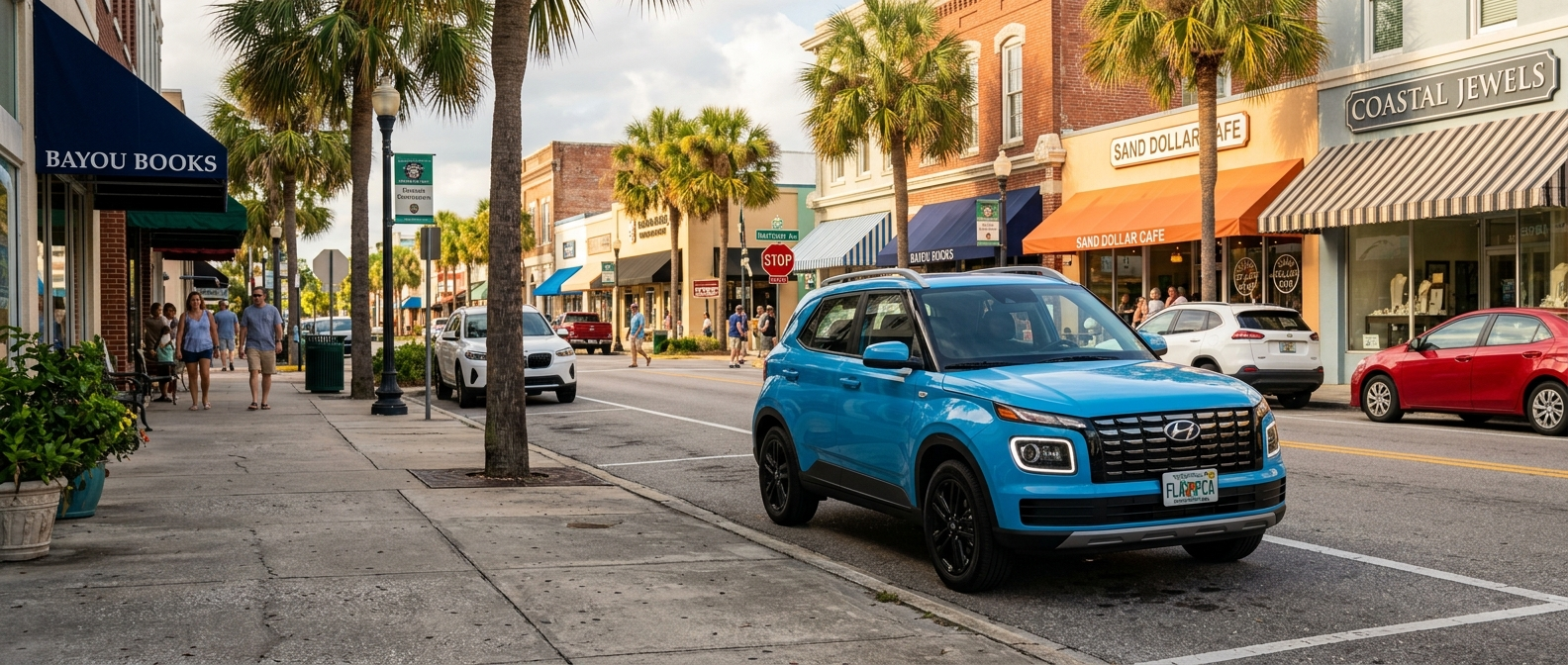
Three Hyundai models handle downtown Panama City differently, and the one that fits your errand loop comes down to three specific variables. Footprint, fuel economy under A/C load, and cargo capacity. Work through this checklist and you'll know which one is yours before you walk onto the lot.
Browse our current 2026 Hyundai inventory to see what's available right now.
What Goes on the Checklist?
Seven checks make up the list, and each one maps to a real downtown constraint rather than a showroom feature, from footprint against a timed curbside spot to city mpg when the compressor never quits in September. Work them in order and the right model tends to sort itself out.
Panama City has tightened its downtown parking rules (effective October 2025 in the core area, January 2026 in St. Andrews, per the City of Panama City's published ordinance updates). Timed zones, new violation categories, and a revised fine schedule are all in effect. The City of Panama City publishes the downtown and St. Andrews parking maps online. All of that sets the backdrop for errand driving here, and it's what makes vehicle fit more than a preference question.
Here is the full checklist, built around the variables that separate a smooth errand run from a frustrating one:
- [ ] Footprint check. Will this vehicle slot cleanly into a timed street spot or a compact structured garage? Measure your comfort zone against the vehicle's overall length.
- [ ] Turning radius check. Can you pull into a nose-in curbside spot and exit in one motion? A radius under 35 feet matters on a narrow two-lane downtown block.
- [ ] A/C-adjusted fuel reality check. September in Panama City means the compressor runs on every single errand. How does this model's city mpg hold up when the cabin starts at 95 degrees?
- [ ] Stop-and-go recovery check. Does the drivetrain recover energy in a short-hop pattern (a few blocks, a signal, repeat), or does it just burn through fuel the whole loop?
- [ ] Cargo minimum check. Pharmacy, dry cleaning, groceries, post office. What's the smallest cargo opening and volume that handles your actual haul without a loading puzzle?
- [ ] Tech-at-a-glance check. Can you read navigation and dismiss a parking-timer alert without a long look away from a narrow lane? Screen placement and size genuinely matter in tight urban quarters.
- [ ] Parking ordinance awareness check. Know which blocks have timed limits before you park. The City of Panama City's downtown and St. Andrews maps are published and publicly available. The right vehicle gets you in, done, and out before the clock runs down.
The Reasoning Behind Each Item
The 2026 Venue makes the strongest case on two checklist items right away, footprint and turning radius, though it asks you to trade away some interior room to get there. It measures 159.1 inches in overall length. Its turning circle is 33.2 feet. Pull into a downtown garage off a two-lane approach and that combination earns its keep on the first try, no multi-point shuffle, whether you're swinging into a nose-in curbside spot or making a clean U-turn on a narrow block.
Know your typical load before you fall for that footprint, because the tradeoff is interior volume. Cargo space behind the second row is 18.7 cubic feet. Fine for light errand runs (a few bags, a small pharmacy haul), but tighter once you fold a grocery trip into a bulk-purchase run. Rear passenger legroom is snug for adults.
The 2026 Elantra Hybrid is the fuel story. Its SEL Sport and Limited trims earn an EPA estimate of 49 city/52 highway. The Blue trim goes further at 51 city/58 highway. Those are significant numbers for a stop-and-go errand loop, and they hold up in downtown driving for a mechanical reason. Regenerative braking recovers energy every time you slow for a signal or a crosswalk. A gas engine wastes it. On a loop with eight or ten stops, the recovery adds up. It's not a guarantee, it's a mechanical fact, and the EPA's city rating reflects exactly the kind of driving pattern downtown Panama City produces.
The A/C-load question is the one we like to walk through, and it rests on a single mechanism. The Elantra Hybrid's regenerative system recaptures braking energy as electricity instead of dissipating it as heat, which is why its city efficiency holds up better than a comparably sized gas sedan when the compressor is running hard in September heat. We can stand behind that one.
The honest tradeoff: the Elantra is a sedan. Loading goes through the trunk, not a liftgate, and the opening is narrower than a crossover's. For anyone hauling awkward items (folded strollers, beach gear, hardware-store runs), that difference is worth knowing upfront.
Weigh the 2026 Kona SE FWD when cargo outranks fuel math. It earns an EPA estimate of 29 city/34 highway/31 combined mpg on its base 2.0-liter engine. It won't match the Elantra Hybrid on fuel math. What it gives you is a liftgate, meaningfully more cargo volume, and a 12.3-inch touchscreen on every trim. That screen size genuinely helps with quick navigation and parking-timer glances in tight urban lanes. For shoppers whose errand loop involves bulk loads and awkward items, the Kona is the practical swing answer between the Venue's footprint and the Elantra Hybrid's efficiency.
The 2026 Elantra gas (non-hybrid, base 2.0-liter) earns an EPA estimate of 31 city/40 highway. It has the same compact sedan footprint as the Hybrid, handles downtown parking with no real difficulty, and is the right pick for drivers who prefer a conventional gas powertrain and don't need a crossover body.
Item-Why Table
| Checklist Item | Why It Matters on a Downtown Errand Loop |
|---|---|
| Overall length (Venue: 159.1 in) | Shorter vehicles fit timed curbside spots and exit compact garages with fewer moves |
| Turning radius (Venue: 33.2 ft) | Tight two-lane streets and nose-in spots reward a tighter turning circle |
| City mpg under A/C load | September heat means the compressor runs continuously; a higher city estimate gives more headroom |
| Regenerative braking | Recovers energy at each stop instead of losing it; pays off across a multi-stop errand loop |
| Liftgate vs. trunk | Awkward loads clear faster through a liftgate opening than a sedan trunk |
| Screen size and layout | A 12.3-inch screen lets you glance at navigation without a long look away from a narrow lane |
| Parking ordinance update | New timed zones and violation categories are active; knowing the rules before you park matters |
Print-and-Go Recap
Six points capture the whole decision, and you can carry them straight into the showroom without re-reading the section above, from footprint priorities to the parking rules that shape how long you've got at the curb. Take these six with you when you come in.
- Footprint first. If narrow curbside spots are part of your regular loop, the Venue's 159.1-inch length and 33.2-foot turning radius are the two specs to anchor on. Nothing in the lineup parks more neatly.
- September heat plus stop-and-go means hybrid math wins. The Elantra Hybrid's regenerative braking recovers energy at every downtown signal, which is precisely the driving pattern where its EPA city estimate of 49-51 mpg applies most directly.
- Cargo beats mpg when you haul regularly. The Kona SE FWD gives you a liftgate, more cargo volume, and 31 combined mpg. It's a balanced answer when the Venue is too small and the Elantra sedan body doesn't fit your load.
- Gas Elantra still makes sense. At 31 city/40 highway on the base engine, it's efficient, compact enough for downtown, and conventional to own. It doesn't overcomplicate the decision.
- Know the parking rules. The City of Panama City's timed zones and updated violation schedule are active in both the downtown core and St. Andrews. Build in a few extra minutes, and pick a vehicle that exits quickly.
- Come in with your errand list. Tell us your three most common stops and what you carry. We'll match the model to the actual use, not the feature sheet.
Explore financing options at Bay Hyundai and get a head start before your visit.
Frequently Asked Questions
Which 2026 Hyundai is easiest to park in downtown Panama City?
The 2026 Venue is the most maneuverable model in the current lineup. It measures 159.1 inches in overall length and carries a turning radius of 33.2 feet, the smallest footprint among the models we carry. On timed curbside spots in the downtown core and on the narrower two-lane streets throughout the area, that shorter length reduces the number of moves it takes to get in and out. If parking ease in tight urban spots is your first priority, the Venue is the straightforward answer.
Does the Elantra Hybrid's fuel economy hold up in downtown stop-and-go driving?
Yes, and the reason is specific to the driving pattern. The 2026 Elantra Hybrid earns an EPA city estimate of 49 mpg in SEL Sport and Limited trims, or 51 mpg in the Blue trim. Those ratings reflect the kind of stop-and-go cycle a downtown errand loop actually involves. The hybrid system uses regenerative braking to recover energy each time you slow for a signal or crosswalk, rather than dissipating it as heat the way a conventional gas engine does. In September Gulf Coast heat, with the A/C running at every stop, the Elantra Hybrid's city efficiency holds up better than a comparably sized gas-only model because that recovery partially offsets the compressor load. EPA estimates are for comparison purposes; your actual result will vary with driving habits and conditions. By the Bay Hyundai Team | September 2026


