

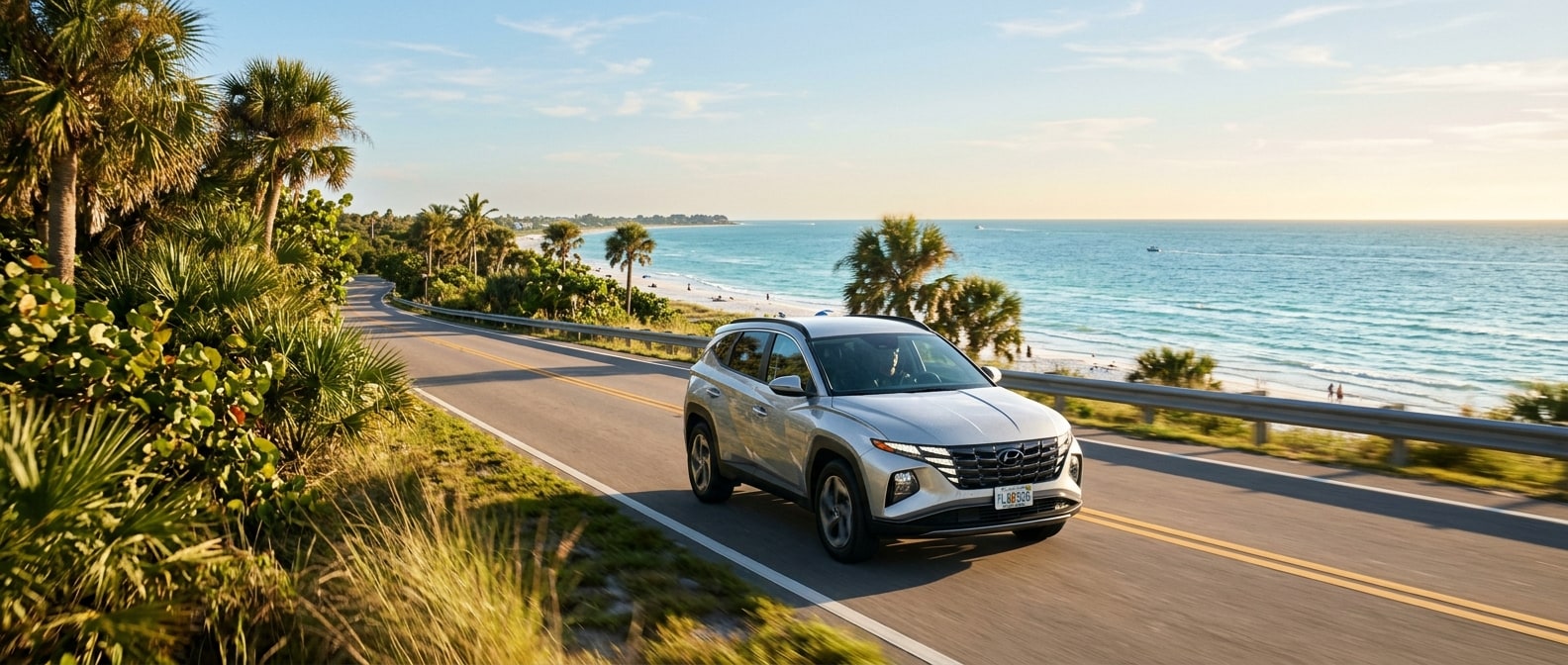
The drive to Panama City Beach isn't a road-trip fantasy. In peak season it's US-98, a corridor FDOT is currently widening from four to six lanes precisely because it handles over 55,000 drivers a day. Near the Pier Park area and the Hathaway Bridge, stop-and-go traffic can turn a five-mile stretch into a forty-minute exercise in patience. The vehicle that shines on an open interstate isn't always the one that serves you best here.
Our ranking criterion is straightforward. We're looking at what the Gulf Coast driving reality actually rewards. Stop-and-go efficiency, cabin comfort for the whole group, and the ability to handle both the beach-town crawl and the longer runs to Destin or Tallahassee without drama. The 2026 Hyundai Tucson Hybrid is our top pick, the model where the local driving pattern does the most work for the buyer, not against them.
How the Four Models Stack Up
All four models below earn a spot for a different Gulf Coast reason, and the table pairs each one with the single spec that matters most for the way you'd drive it near the beach.
| Rank | Model | Best For | Standout Spec |
|---|---|---|---|
| 1 | Tucson Hybrid | Stop-and-go commuters + road trips | EPA-est. 38/38/38 mpg (FWD) |
| 2 | Palisade Hybrid | Large families and groups | EPA-est. ~34 combined mpg, 8 seats |
| 3 | Kona | Parking-conscious solo and couple trips | EPA-est. 29/34/31 mpg, 171-inch length |
| 4 | IONIQ 5 | EV-ready buyers with home charging | Up to 318 miles EPA-est. range |
No. 1: Tucson Hybrid Turns Beach Traffic into Fuel Savings
Stop-and-go traffic is where a hybrid stops being a marketing claim and turns into a real benefit, and the 2026 Tucson Hybrid earns the top spot because it's EPA-rated at 38 mpg combined on FWD trims, with city efficiency matching highway at 38 mpg each. The efficiency comes straight from how a hybrid recovers energy during braking and low-speed crawling, exactly the conditions you'll find on Front Beach Road at 11 in the morning on a Saturday in July.
There's a real tradeoff, because the Tucson Hybrid runs a 1.6-liter turbocharged four-cylinder with an electric motor for 231 combined horsepower, and the cargo footprint (25.5 cubic feet behind the second row) won't swallow a week of beach luggage for four people without some Tetris. If you're hauling serious gear for a crew, look at No. 2. For two adults or a family of four with reasonably packed bags, it's still the right call for most beach runs.
The platform also carries HTRAC all-wheel drive on upper trims, worth noting for anyone who does the occasional run north on US-231 toward I-10. Afternoon storms roll in off the Gulf.
No. 2: Palisade Hybrid Takes the Whole Crew
The 2026 Palisade Hybrid takes the whole crew, seating eight across three rows and returning an EPA estimate of around 34 combined mpg from its 2.5-liter turbocharged hybrid powertrain. Fold the rear seats and it maxes out at 86.7 cubic feet of cargo space. Load beach chairs, coolers, and the kind of gear a family accumulates for a week on the Emerald Coast. The space earns its keep.
The size is a real tradeoff, because the Palisade Hybrid is a large vehicle in a market where the Hathaway Bridge and the beach-side parking situations demand some awareness of your footprint. It's also rated for up to 4,000 pounds of towing, which matters if you're pulling a small boat or personal watercraft to St. Andrews State Park. Not everyone needs that. But when you tally what you're really loading for a week at the beach, that size starts to justify itself.
No. 3: Kona Is the Right Fit When Parking Is the Whole Problem
The 2026 Hyundai Kona is the right fit when parking is the whole problem, measuring 171.3 inches long and seating five, which makes it easy to slot into the tight spaces summer congestion creates on Front Beach Road even if that same compact footprint limits what you can bring along. The EPA rates the base FWD Kona at 29 city / 34 highway / 31 combined mpg, which is solid for a non-hybrid subcompact.
For two people making regular weekend runs from Panama City to the beach, the Kona is the right answer. It's not right for anyone hauling four adults plus gear. The Kona's 63.7 cubic feet of max cargo (seats folded) is generous for its class, but with five people inside there's not much left over. Know the mission before you decide.
Pros and Cons at a Glance
The quick view below lines up each model's biggest strength against the compromise that rides along with it.
| Pros | Cons |
|---|---|
| Tucson Hybrid matches city and highway MPG (38/38, rare in any segment) | Tucson Hybrid cargo is compact for large groups |
| Palisade Hybrid carries eight with meaningful fuel efficiency | Palisade Hybrid's size creates Hathaway-area parking awareness |
| Kona's 171-inch length simplifies parking on congested beach days | Kona's base 147-hp engine feels thin under full passenger load |
| IONIQ 5's 800V architecture delivers 10%-80% charge in roughly 18-20 minutes at a compatible DC fast charger | IONIQ 5 range varies with AC-heavy summer use, home charging is the practical base |
No. 4: IONIQ 5 for Buyers Who've Already Committed to Charging at Home
The 2026 Hyundai IONIQ 5 is the pick for buyers who've already committed to charging at home, with an EPA-estimated range of up to 318 miles on the rear-wheel-drive configuration, enough to cover a Panama City-to-Tallahassee run with room to spare. Hyundai's 800-volt architecture is the engineering headline here. Hyundai rates the charge from 10% to 80% at approximately 18 to 20 minutes on a compatible DC fast charger.
So why does it land at fourth and not first? Not for any weakness in the vehicle itself. The IONIQ 5 is the most technologically interesting vehicle in this lineup, and for a buyer who charges at home overnight, the economics make sense on a long-term basis. It ranks fourth because beach-town range anxiety is a real thing if you don't have a home setup. Battery efficiency also decreases in sustained high-heat environments with the AC running hard, which Gulf Coast summers will absolutely test. Know your charging situation before you commit.
The IONIQ 5 is a genuine first pick if the infrastructure is in place for you. It just requires more upfront planning than the hybrid options on this list.
The Tucson Hybrid Is Still Our Recommendation
Pulled back to what the drive actually demands, the Tucson Hybrid stays our recommendation because US-98 in peak season rewards stop-and-go efficiency, and it delivers EPA-estimated 38 mpg in both city and highway cycles. It carries four adults and their gear comfortably, and it doesn't ask you to think about charging logistics. It's the model where the local conditions and the engineering specification meet in the most useful way.
If group size is the deciding factor, the Palisade Hybrid is the better call. If parking ease is the mission and the group is small, the Kona. If you've got home charging sorted and want the most capable electric platform Hyundai builds at this scale, the IONIQ 5 is worth a long look. But for the widest range of Panama City Beach season drives, the Tucson Hybrid earns the top spot.
By the Bay Hyundai Team | September 2026


