

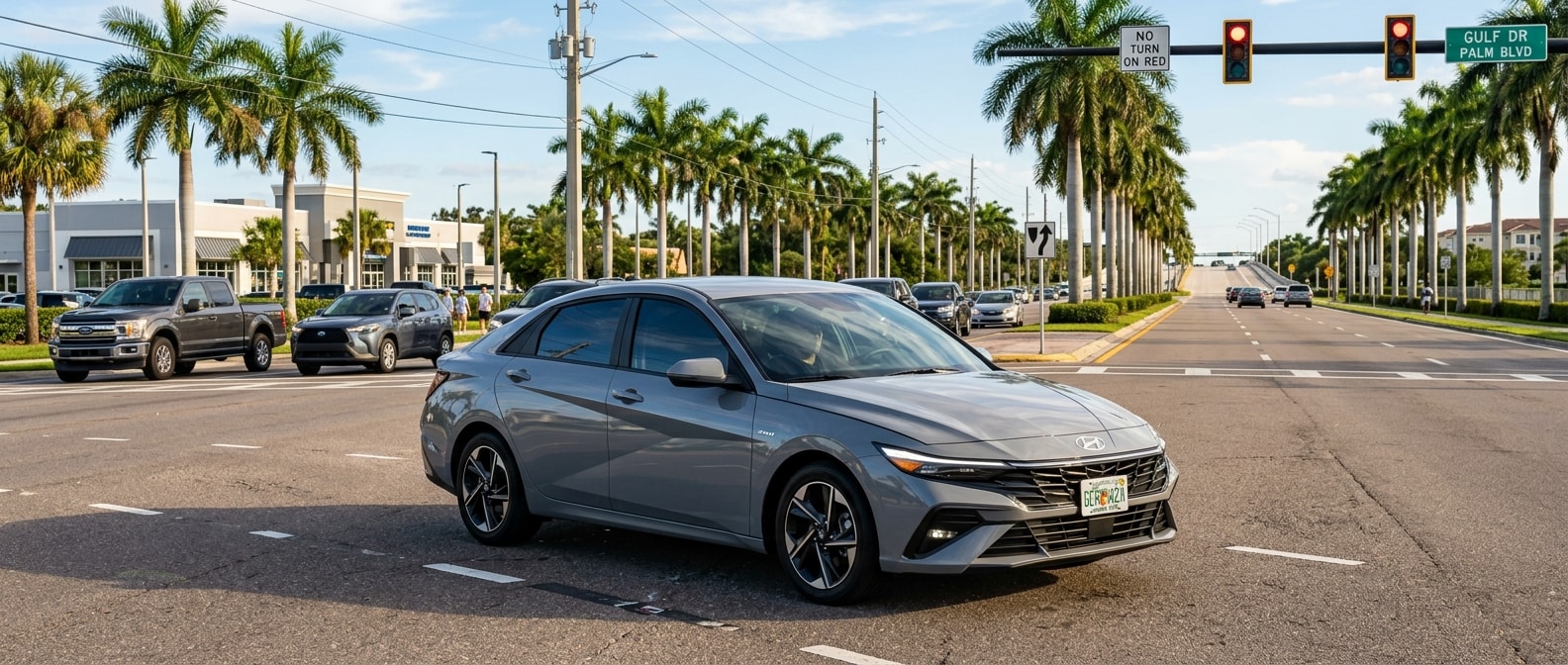
Sit in the queue at US-231 and 15th Street during morning rush hour and you're burning fuel while barely moving. In an Elantra Hybrid, you're doing the opposite. Each time traffic forces you to brake, the car's electric motor runs in reverse and feeds energy back into the battery, banking it for the next block. Regenerative braking is the reason the EPA rates the 2026 Hyundai Elantra Hybrid Blue at 51 MPG in the city. Stop-and-go actually helps that number, because the system captures more energy the more often you slow down.
The one-line answer is simple. Set the car up correctly before you leave the driveway, and the US-231 corridor stops working against you and starts working for you.
What Do You Need Before You Start?
You won't need any tools, apps, or add-on accessories for this setup, since everything you'll touch is already built into the car, and a clear picture of the few controls that matter helps you use them on purpose rather than hoping the car manages itself. No tools. No apps. No accessories.
The quick-reference table below covers the 2026 Elantra Hybrid powertrain and the commuter-relevant controls.
| What | Spec or Detail |
|---|---|
| Powertrain | 1.6L 4-cylinder + 32 kW electric motor, 139 hp combined, 195 lb-ft torque |
| Transmission | 6-speed dual-clutch automatic; front-wheel drive |
| EPA city / hwy / combined (Blue trim) | 51 / 58 / 54 MPG (EPA estimate) |
| EPA city / hwy / combined (SEL Sport and Limited) | 49 / 52 / 50 MPG (EPA estimate) |
| Fuel tank capacity | 11.0 gallons |
| Regen paddle controls | Right paddle (+): increase regen strength; Left paddle (-): decrease |
| Regen levels | 0 (coasting), 1, 2, 3 (most aggressive; closest to one-pedal feel) |
| Plug-in required? | No. Self-charging hybrid only. |
| Standard safety suite | Hyundai SmartSense on every trim (forward collision avoidance, blind-spot assist, lane keeping, rear cross-traffic assist) |
| Smart Cruise with Stop and Go | Limited trim only |
Setting Up Your Elantra Hybrid for the 15th Street Run
The whole setup comes down to six steps, and the very first pass takes you about two minutes at the start of your first week, with most of those steps dropping to under ten seconds after that and turning into pure habit before long.
Step 1: Check your tire pressure before the week begins.
The Blue trim runs 16-inch alloy wheels, and the SEL Sport and Limited run 17s. Either way, you'll find the recommended inflation spec on your driver's door jamb sticker. Underinflation creates rolling resistance that works directly against what the hybrid system is trying to do, so a small oversight carries a measurable cost. Gulf Coast September is the worst time to let it slide. Daytime heat pushes pressure up and the morning cool-down drops it again, so a tire that looked fine Friday afternoon can read low Monday morning. If you'd rather have our service team to check pressures and rotate tires on a schedule, that's a straightforward appointment, and it keeps the efficiency math working in your favor.
Step 2: Select Eco drive mode as your daily default.
The drive mode button on the center console cycles through Normal, Eco, and Sport. Eco mode softens the throttle mapping and asks the climate control system to pull less energy, which on a humid Florida morning matters more than it would in, say, October in North Carolina. In Eco, the gasoline engine stays off longer at low speeds, so the electric motor handles more of the slow crawl between signals on Harrison Avenue and the 15th Street intersections. You won't feel a dramatic change in how the car drives. What you get instead is a quiet, background efficiency gain that stacks up across a week.
Step 3: Set your regen level with the steering wheel paddles. Every single morning.
Of all six steps, this one matters most, and it's the easiest to let slip. The regenerative braking level resets to default (essentially Level 0, light coasting) every time you restart the car, and it won't save your last setting. To recover energy well in stop-and-go, pull the right paddle two or three times after engine start. The level shows on the instrument cluster. Level 2 works well for the signal-heavy run along 15th Street, where the car slows noticeably as you lift off the gas, cutting how often you reach for the brake pedal and maximizing what the motor banks. Level 3 is more assertive and genuinely useful when a long signal queue sits ahead.
Step 4: Glance at the battery state indicator before you merge onto the main road.
Watch the battery charge on the digital instrument display, which updates in real time. You don't need to manage it, since the system handles that on its own. But knowing that charge rises during braking and falls during electric acceleration helps you shape your inputs. Smooth, early lifts off the accelerator recover more energy than hard, late braking does. At the US-231 and 15th Street intersection (one of the most actively monitored points in the Bay County Traffic Management system, with cameras at every leg of that junction), smooth and progressive is both the most efficient and the most sensible technique.
Step 5: Let the Limited's Smart Cruise Control with Stop and Go earn its keep on longer runs.
Trim choice carries more weight here than it might seem at first. The Limited trim includes Smart Cruise Control with Stop and Go and Highway Driving Assist, which handle the full stop-and-resume cycle in slow traffic without any driver input. Neither the Blue nor the SEL Sport includes that feature. For a long stretch of US-231 running northeast toward Lynn Haven, where the corridor feels more highway-like before it tightens up at 15th Street, the adaptive cruise in the Limited takes real fatigue off your plate. For a short, purely local signal run, the Blue's 54 MPG combined against the Limited's 50 MPG combined is the stronger argument. We also carry the Sonata Hybrid for buyers who want similar hybrid efficiency in a slightly roomier sedan.
Step 6: Watch for the EV indicator and protect it with light throttle.
At low speeds and gentle throttle in Eco mode, the gasoline engine shuts off completely and the car moves on electric power alone. The instrument cluster shows an "EV" label while that's happening. In the slow crawl through central Panama City on Harrison Avenue, you'll see it pop up more than you'd expect. Keep the throttle light and the transitions between braking and acceleration smooth, and the engine stays off longer. None of that is a trick. The system is simply working as Hyundai designed it, with the engine re-engaging only when battery charge falls below its threshold or when you ask for significantly more power.
See Current Elantra Hybrid Offers
Your Print-and-Go Commuter Recap
Run this same checklist at the start of each week, and the entire routine costs you about two minutes up front, with the daily items dropping to a few seconds once they're habit, so nothing here asks for more than a quick pass before you pull out of the driveway. Two minutes tops.
| Step | What to Do | Timing |
|---|---|---|
| 1 | Verify tire pressure against door-jamb spec | Weekly (Monday) |
| 2 | Select Eco drive mode at startup | Every commute |
| 3 | Pull right regen paddle 2 to 3 times; confirm level on cluster display | Every commute |
| 4 | Glance at battery charge display before merging | Every commute |
| 5 | Enable Smart Cruise Control (Limited trim only) for longer highway stretches | As needed |
| 6 | Maintain light throttle in city traffic; watch for EV mode indicator | Every commute |
The setup is the whole procedure. None of it needs a special subscription, a dealer visit, or anything that isn't already sitting in your hands.
One tradeoff is worth stating plainly. The Blue trim's 54 MPG combined (EPA estimate) is the efficiency peak of the lineup, and it comes with cloth seats and an 8-inch touchscreen. The Limited gives you dual 10.25-inch displays, a leather-wrapped interior, and Stop and Go cruise control, but it gives up roughly four MPG combined. For a pure fuel-savings case on a short daily run, the Blue is the sharper pick. If your commute runs longer and you want a more finished daily driver, the Limited earns its step-up. We're right here on 15th Street. Come in, drive both, and let the commute itself tell you which one fits. Browse what's in stock before you make the trip.
By the Bay Hyundai Team | September 2026
Frequently Asked Questions
Does the 2026 Hyundai Elantra Hybrid need to be plugged in to charge?
No. The 2026 Elantra Hybrid is a self-charging hybrid. The battery replenishes through regenerative braking and the engine's own generation. There is no charging port and no need to find a charging station.
Why does my regen braking level reset every time I start the car?
The 2026 Elantra Hybrid's regenerative braking level returns to its default setting at every ignition cycle. To set your preferred regen strength, use the right steering wheel paddle to increase the level (displayed on the instrument cluster) each time you start the car. Level 2 works well for most stop-and-go commuting; Level 3 is appropriate when traffic is very slow and you want maximum energy recovery.


